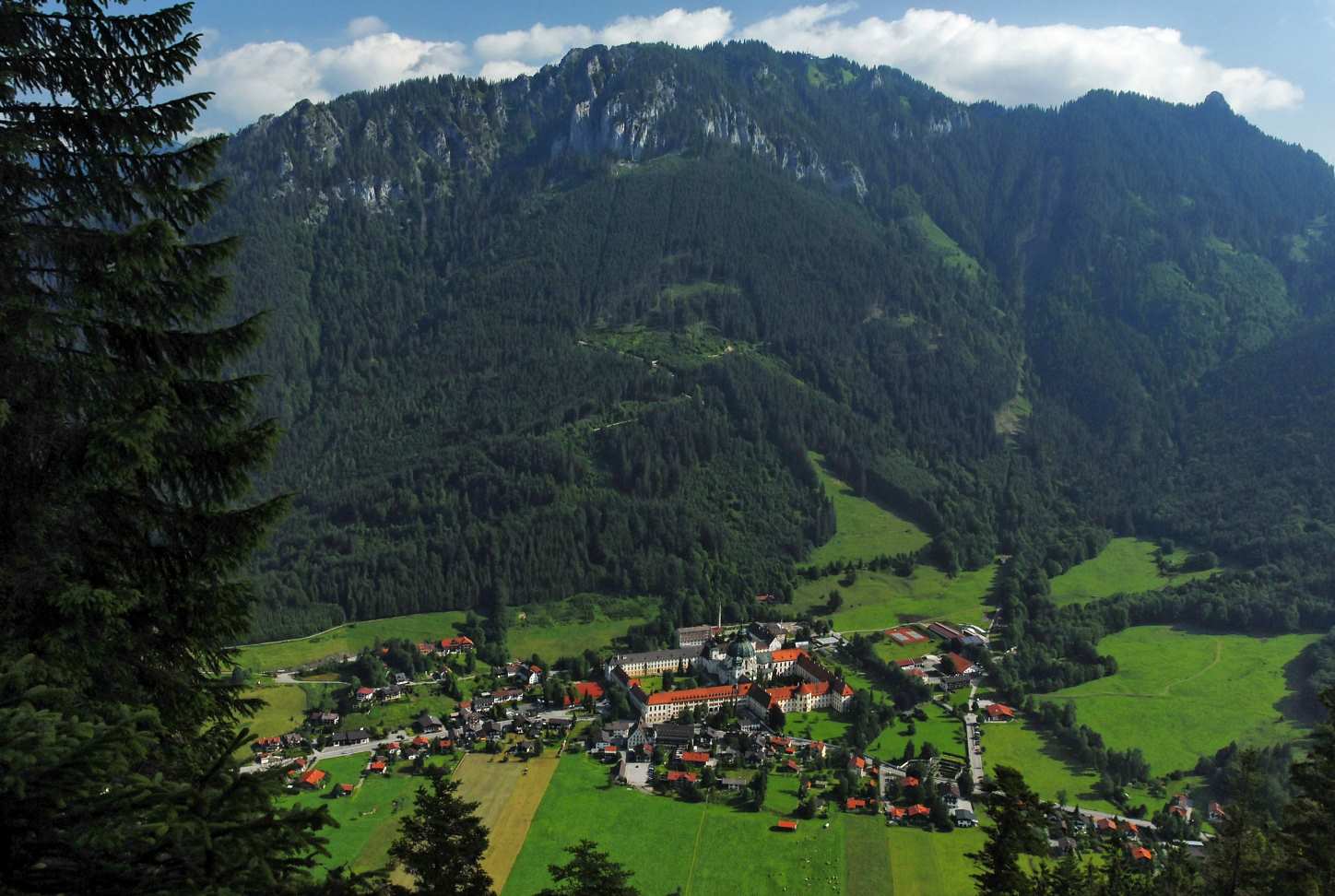
Mount Laber overlooks the Ammer Valley in the Bavarian Alps, near Ettal. At just under 1,700 meters, it’s not the tallest peak, but the view from its summit is what makes it worth the trip. Rolling hills, dense forests, and endless meadows stretch out in every direction. On clear days, distant mountain ranges fade into the horizon. The wind carries the occasional birdcall, and the light shifts slowly over the valley below.
How do you get there?
The cable car takes just a few minutes, lifting you above the treeline with little effort. If you’d rather walk, trails wind through the forest and across alpine meadows. Some sections are slippery after rain, but the path is never too steep. Along the way, the scenery changes constantly—sunlit clearings, sudden valley views, the scent of pine and damp earth. Many hikers stop not because they’re tired, but because the landscape demands it.
The viewing platform is a simple wooden terrace with benches and signs naming the distant peaks. No barriers, no distractions—just the open sky and the mountains. In summer, families unpack picnics, hikers rest, and locals sip coffee from thermoses. Winter brings a different kind of quiet: snow-laden branches, crisp air, the crunch of boots on frozen ground.
For centuries, Laber has been a landmark in this part of the Alps. Shepherds, hunters, and travelers used its slopes as a guide. Medieval trade routes passed through these valleys, and though Laber wasn’t a major crossing, its summit helped people find their way. By the early 1900s, marked trails and viewing platforms turned it into a destination—a place to step away and look out at the world.
The summit buildings are understated. The cable car station and café follow traditional alpine design: wide eaves, wooden balconies, carved details. Inside, a wood stove and fresh bread make the café inviting, but most visitors don’t stay long. The real draw is outside.
The lower slopes are dotted with farms—wooden barns, fenced pastures, cows grazing in summer. Wildflowers bloom in sunlit patches, and in autumn, the forests turn gold and russet. Even if you don’t reach the top, the area around Laber is worth exploring. Quiet trails, hidden clearings, the occasional deer moving through the trees.
Laber doesn’t try to impress. No souvenir shops, no guided tours, no crowds. You can come alone or with others, and the only plan is to take in the view. Some visitors return every year, drawn by the changing light or the way silence feels different in winter.
The mountain reflects how people have lived here for generations. The farms, trails, and buildings show a practical relationship with the land. Today, Laber still offers that—an escape from a world that rarely slows down. Whether you stay an hour or a day, it has a way of making everything else feel far away.