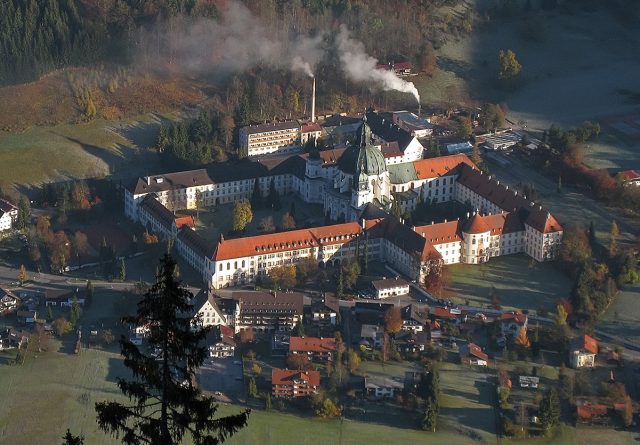
Nestled in the heart of the Bavarian Alps, Ettal Abbey and its basilica stand as a quiet monument to centuries of faith, art, and history. The first glimpse of its towering structure comes long before you reach the village itself—its massive walls and spires rising above the valley like a sentinel, visible from the winding roads that lead into the mountains. Founded in the fourteenth century, the monastery was more than just a religious site; it was a place where devotion, scholarship, and craftsmanship intersected, shaping the cultural landscape of the region. Even today, the abbey doesn’t feel like a relic of the past. There’s a sense of continuity here, as if the monks who once walked these halls have only stepped away for a moment, leaving behind an atmosphere that is both solemn and strangely alive.
The origins of Ettal Abbey are tied to one of Bavaria’s most storied rulers, Emperor Ludwig the Bavarian. According to legend, the emperor was hunting in the mountains when his horse stumbled at the edge of a precipice, yet miraculously did not fall. Grateful for his deliverance, Ludwig vowed to build a monastery on the spot, not just as a place of worship but as a stronghold of Catholic faith in the region. Construction began in 1330, and within a few years, Ettal had grown into one of Bavaria’s most significant monastic communities, drawing pilgrims, scholars, and artists from across Europe. The abbey’s early years were marked by both spiritual fervor and political influence, as it became a favored retreat for nobility and a center of learning.
The basilica’s architecture tells the story of its evolution over the centuries. Originally built in the Gothic style, the church was largely destroyed by fire in 1609 and later rebuilt in the exuberant Baroque fashion that defines its appearance today. The contrast between the two styles is striking—the austere lines of the original structure giving way to the ornate grandeur of the seventeenth century. Inside, the effect is overwhelming in the best sense: soaring vaulted ceilings adorned with intricate frescoes, gilded altars that catch the light, and elaborate stucco work that seems to defy gravity. The high altar, dedicated to the Virgin Mary, is a masterpiece of craftsmanship, surrounded by figures of saints and angels that appear to hover in the golden glow. The space feels both intimate and vast, designed to inspire awe without losing its human scale.
One of the most captivating features of the basilica is its dome, painted with scenes from the life of the Virgin Mary. The frescoes, rendered in soft pastel hues, have a dreamlike quality, their colors shifting subtly as sunlight filters through the high windows. The play of light and shadow across the curved surface gives the paintings a sense of movement, as if the figures might step out of their frames at any moment. The monastery’s library, though not always open to the public, adds another layer to Ettal’s legacy. It houses a collection of medieval manuscripts and early printed books, a reminder that this was once a place where knowledge was as revered as devotion. Even the mere presence of such a library speaks to the abbey’s role as a beacon of learning in a time when monasteries were among the few custodians of written wisdom.
Throughout its history, Ettal Abbey has been deeply entwined with the fortunes of Bavaria. It served as a refuge for royalty, a resting place for emperors, and even a mint in the eighteenth century, producing its own coins. When secularization swept through Europe in the early 1800s, many monastic institutions were dissolved, their lands confiscated by the state. Ettal survived, though not unscathed—it lost much of its property but retained its spiritual purpose. Today, it remains an active Benedictine monastery, where monks continue the rhythms of prayer and work that have defined their order for centuries. The abbey’s resilience is a testament to its enduring significance, not just as a historical site but as a living community.
For visitors, Ettal offers more than just a chance to admire its architecture. The basilica is a place where history feels tangible, where the past isn’t just preserved but actively present. The sound of the organ often fills the nave, its deep, resonant notes echoing through the space, reinforcing the sense of sacredness. Outside, the abbey is surrounded by the natural beauty of the Alps—rolling meadows, dense forests, and the crisp mountain air. In the warmer months, the area draws pilgrims, hikers, and locals seeking a moment of quiet reflection. The village itself is small but welcoming, with a handful of cafés and shops where visitors can linger after exploring the monastery.
What makes Ettal Abbey truly special is its ability to transcend its role as a mere historical monument. It is a place where art, faith, and history converge, creating something greater than the sum of its parts. The basilica’s grandeur is undeniable, but its real power lies in the atmosphere it cultivates—a sense of timelessness that invites contemplation. Here, amid the frescoes and the hushed echoes of footsteps on stone, it’s possible to step outside the rush of modern life and consider something larger than oneself. That, perhaps, is the abbey’s greatest gift: not the gold or the marble, but the quiet reminder that some things endure, unchanged by the passage of centuries.