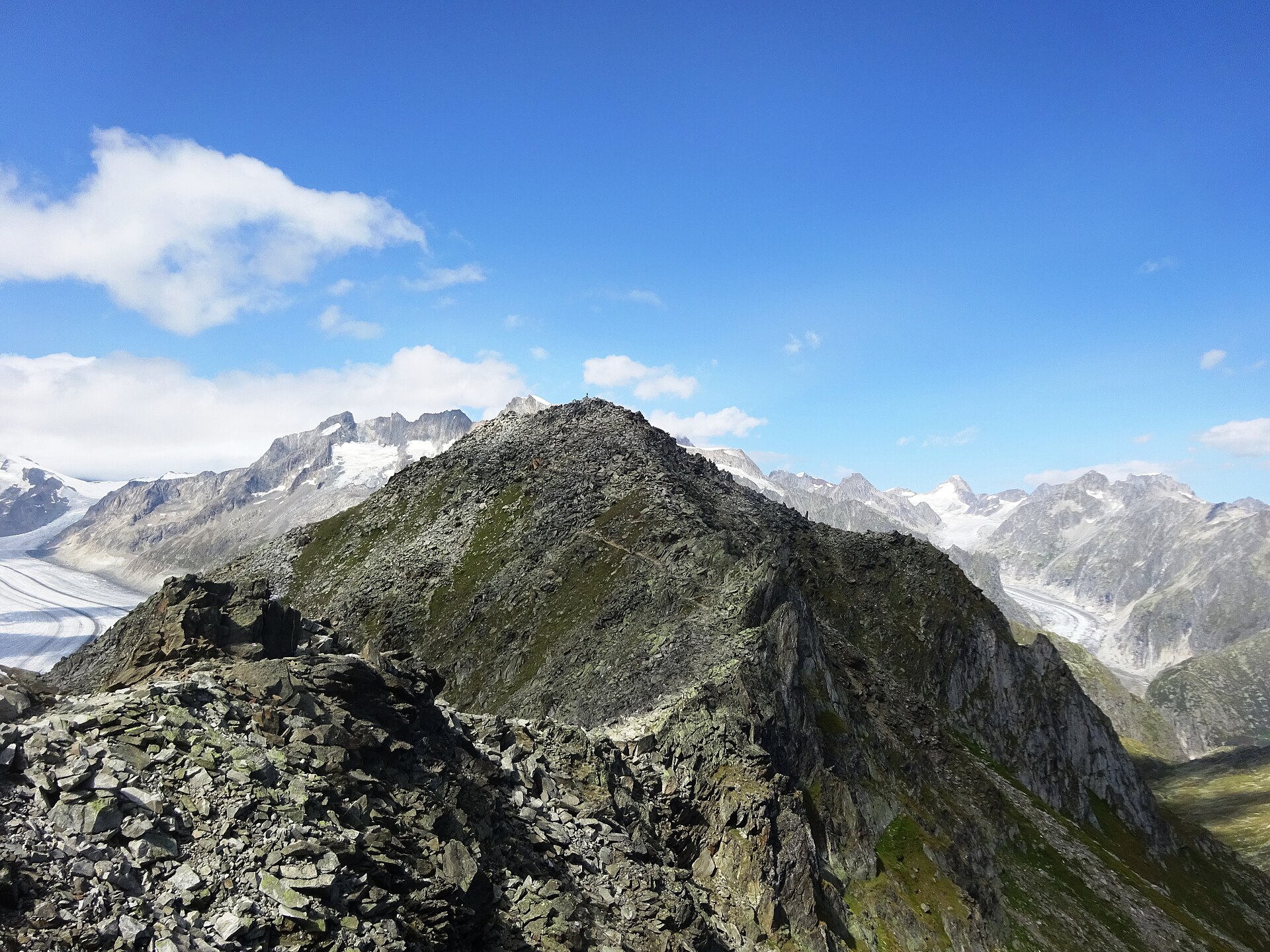
Eggishorn is one of those rare places where the Swiss Alps reveal themselves in all their raw, unfiltered beauty. Rising to 2,927 meters above the Fiesch Valley, this mountain isn’t just a viewpoint—it’s a front-row seat to one of nature’s most impressive displays. From its summit, the Aletsch Glacier unfolds like a frozen river, its vast expanse of ice stretching nearly 23 kilometers, making it the longest glacier in the Alps. The sight is humbling, a reminder of how small we are against the scale of the natural world. On clear days, the panorama extends even further, with the jagged silhouette of the Matterhorn piercing the horizon, its iconic shape unmistakable even from this distance.
Getting here is part of the experience. The funicular from Fiesch climbs steadily, its glass-sided cabins offering a slow, deliberate ascent that lets you take in the changing landscape. At the base, dense forests of spruce and pine give way to alpine meadows dotted with wildflowers—edelweiss, gentians, and others that thrive in the thin mountain air. By the time you reach the top, the trees have disappeared entirely, replaced by rocky slopes and patches of snow that linger even in summer. The ride itself is smooth, almost meditative, a chance to adjust to the altitude before stepping out into the crisp, high-altitude air.
The history of Eggishorn is intertwined with the rise of Alpine tourism in the late 19th century, when Switzerland became a playground for Europe’s elite. The first cable car to the summit was built in 1912, a marvel of engineering at the time, and while the infrastructure has been modernized since, it’s still designed to blend into the surroundings rather than dominate them. The funicular isn’t just a way to get up the mountain—it’s a nod to the past, a connection to the travelers who came here more than a century ago, drawn by the same views that captivate visitors today.
What sets Eggishorn apart from other popular viewpoints is its lack of pretense. There are no flashy attractions, no souvenir shops, no crowds jostling for the best photo spot. Instead, the summit is a place of quiet contemplation. The wind carries the occasional cry of a chamois or the distant rumble of shifting ice, but otherwise, the silence is profound. The observation deck is spacious, with enough room to stand at the edge and watch the glacier’s slow, relentless movement. For those who want to linger, a small café serves simple, hearty food—rösti, fondue, or a steaming cup of hot chocolate—while the terrace offers a place to sit and soak in the view.
The mountain is just as compelling in winter, when it becomes part of the Aletsch Arena, one of Switzerland’s largest ski regions. The slopes here cater to all levels, from gentle runs for beginners to challenging off-piste terrain for experienced skiers and snowboarders. But even if you’re not here to ski, the winter landscape has its own magic. The funicular ride takes on a different quality, the world outside the windows transformed into a monochrome dreamscape of snow-covered peaks and frozen streams. The silence is even more pronounced, the kind that makes you feel as though you’ve stepped into another world.
Eggishorn’s appeal lies in its simplicity. It’s not a place for adrenaline junkies or luxury seekers, but for those who want to witness the grandeur of the Alps without distraction. There’s no need to rush, no itinerary to follow—just the mountain, the glacier, and the vast sky above. Many visitors return year after year, not because the place has changed, but because they have. The glacier, too, is changing, retreating slowly but surely, a silent testament to the passage of time. For now, though, it remains, a frozen giant that has shaped the landscape for millennia.
For those curious about the forces that created this place, an information panel near the funicular’s upper station offers a glimpse into the glacier’s history. Millions of years ago, ice sheets carved out the valleys and left behind the moraines—piles of rock and debris—that now frame the glacier. Today, scientists monitor its retreat, but for most visitors, the Aletsch is a symbol of endurance, a reminder of nature’s power. The glacier’s surface is a study in contrasts: the deep blue of ancient ice, the jagged crevasses that hint at its movement, and the way it seems to flow like a river, even though it moves at a pace too slow for the human eye to perceive.
On the clearest days, the view from Eggishorn extends far beyond Switzerland. The Italian Alps rise in the distance, and on exceptionally crisp mornings, the faint outline of French peaks can be seen on the horizon. But the real spectacle is the glacier itself—its shifting hues, the way it catches the light, the sense of movement in something so still. It’s a place that puts things into perspective, a reminder that the world is far older and vaster than we often realize.
There’s a limit to how much you can capture in words or even in photographs. Eggishorn is the kind of place you have to experience firsthand—the bite of the wind, the way the air feels thinner at this altitude, the quiet that settles over you as you stand at the edge of the observation deck. No guidebook or tour can fully prepare you for it. The mountain doesn’t need to explain itself; it simply is, a silent witness to the passage of time. And for those who make the journey, it leaves an impression that lingers long after the descent.