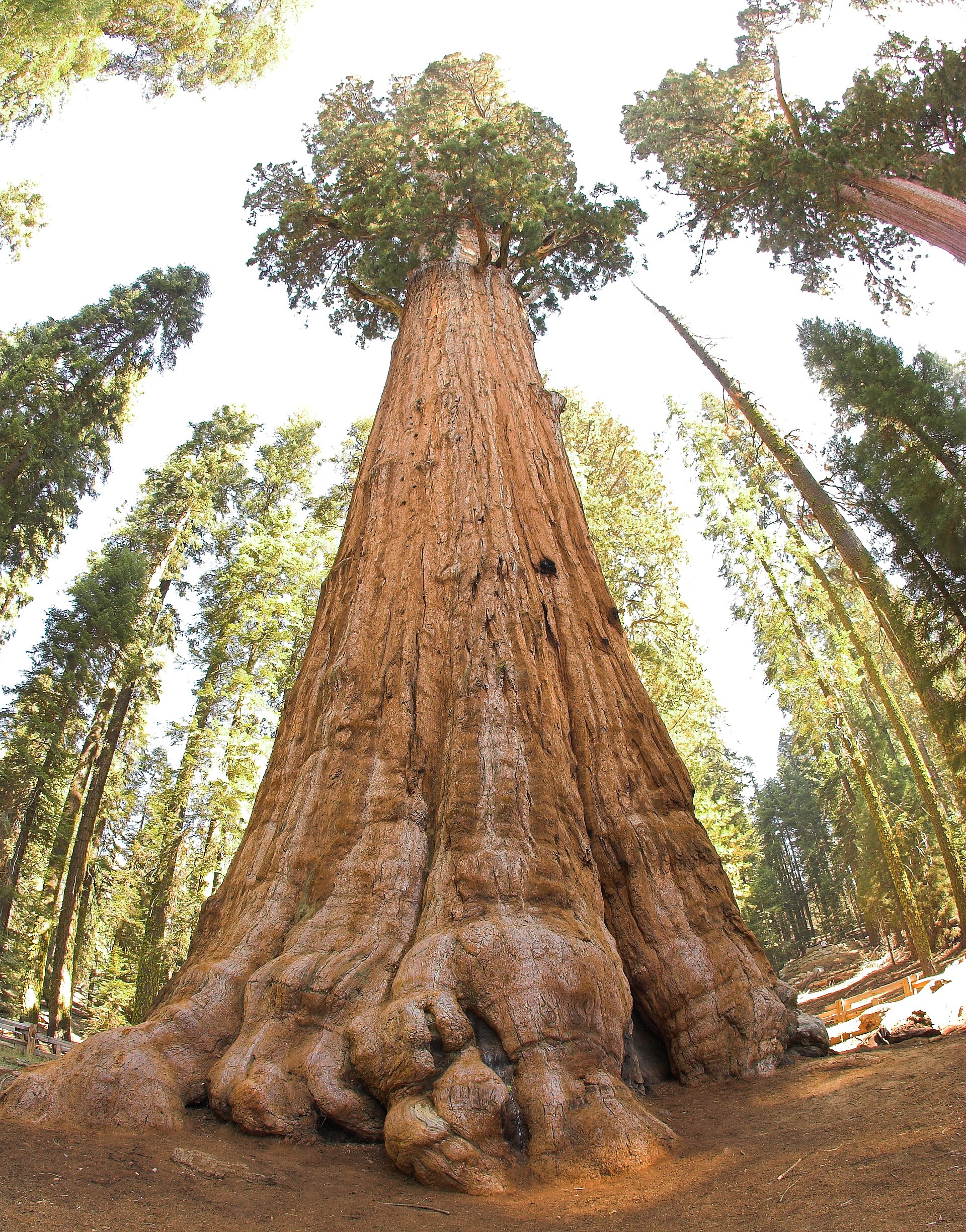
Standing before General Sherman is like stepping into the presence of something ancient and untouchable. This isn’t just a tree—it’s one of the oldest living things on Earth, a giant sequoia that has stood in California’s Sequoia National Park for over two thousand years. Despite its name, it has no connection to the Civil War general; it was named in the late 1800s after William Tecumseh Sherman, a military figure of a different era. The tree belongs to a species that has survived fire, drought, and the rise and fall of human empires, and General Sherman is the largest of them all by volume.
At eighty-three meters tall, with a base circumference of over thirty-one meters, the tree is almost impossible to comprehend in full. It would take twenty people holding hands to encircle its trunk, and its weight—nearly two thousand tons—dwarfs even the largest animals on the planet. Yet for all its size, the tree grows slowly, adding only a fraction of an inch to its girth each year. The bark alone, thick enough to withstand wildfires, can be sixty centimeters deep in places. It’s a living fortress, built to endure.
The story of General Sherman is tied to the history of Sequoia National Park itself. When the park was established in 1890, it was a last-ditch effort to protect these trees from logging, which had already claimed countless giants. Many sequoias were felled before people realized their value, but General Sherman survived, partly because its location made it difficult to access and partly because its trunk wasn’t perfectly straight for timber. Today, the park is a sanctuary, a place where these trees are left to grow as they have for millennia.
There’s no human architecture here, only the quiet grandeur of nature. The tree’s branches stretch outward like the arms of a cathedral ceiling, high above the forest floor. A paved trail loops around its base, allowing visitors to walk its full circumference, though the sheer scale makes it hard to take in all at once. The air smells of pine and damp earth, and the only sounds are the rustle of leaves and the occasional call of a bird. It’s a place where time feels different—slower, deeper, as if the tree itself sets the rhythm.
General Sherman isn’t just a botanical wonder; it’s a symbol of resilience. It has outlasted empires, wars, and the rise of modern civilization, standing as a silent witness to history. For many, visiting the tree is a humbling experience. There’s no fanfare, no grand entrance—just the quiet realization that you’re in the presence of something far older than any human achievement. It’s a reminder of how small we are in the grand scheme of things, and how much there is that we’ll never control.
The forest around General Sherman is just as remarkable. Other giant sequoias stand nearby, some named after historical figures, others known only by their sheer size. Walking among them feels like stepping into another world, one where nature still dictates the rules. The trees are spaced far enough apart that each one has room to grow, their canopies filtering sunlight into shifting patterns on the ground. There’s no rush here, no need to hurry. The forest moves at its own pace.
Visiting General Sherman isn’t like visiting a typical tourist attraction. There are no crowds jostling for photos, no vendors selling souvenirs. Instead, there’s a sense of quiet reverence, as if people instinctively understand they’re in a place that demands respect. The trail is well-maintained but unobtrusive, designed to let the tree speak for itself. Some visitors sit on the benches nearby, simply taking it in. Others walk the loop in silence, as if any sound might disturb the stillness.
What makes this place special isn’t just the tree’s size or age, but the way it makes you feel. There’s a sense of perspective that comes from standing next to something that has seen centuries pass. It’s easy to forget, in the rush of daily life, how brief our time here really is. General Sherman doesn’t offer answers, but it does offer a moment of stillness—a chance to step outside of time and remember what it means to be alive. In a world that moves too fast, that’s a rare gift.