The Forum in Pula is where the city’s ancient past lingers, woven into everyday life. Fragments of Roman architecture stand beside cafés, shops, and the quiet rhythm of a modern Croatian town. The square doesn’t demand attention—it simply exists, a witness to centuries of history.
Founded by the Romans in the 1st century BCE as Pietas Julia, the Forum was the heart of public life. Citizens gathered here for assemblies, legal disputes were settled, and trade flourished. The square was the political and social center of the colony. Today, remnants remain: fragments of temples, the raised platform where decrees were announced, and the outlines of structures that once defined the skyline. Statues of emperors once stood here, though only weathered pedestals and inscriptions survive.
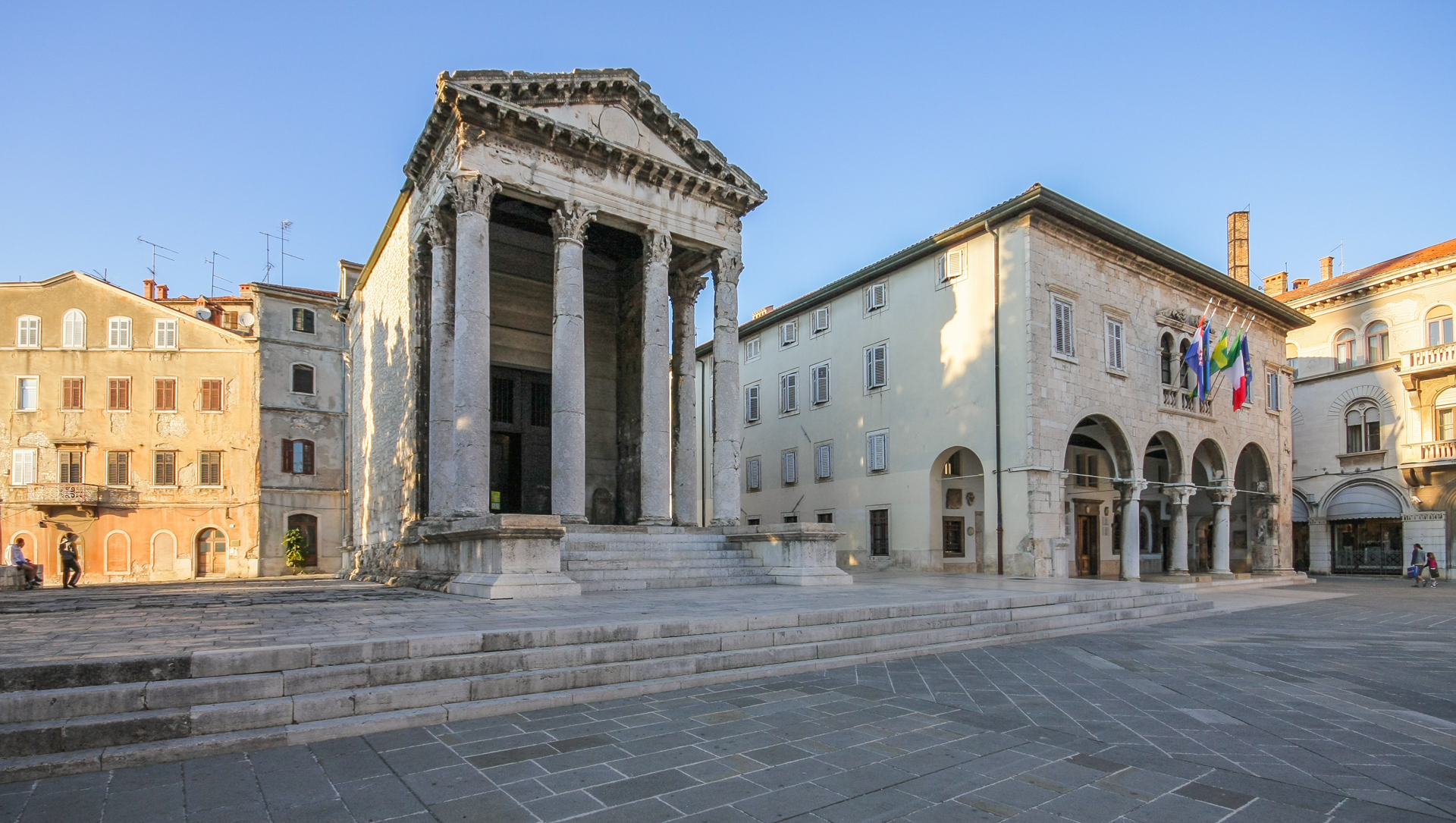
The Temple of Augustus, built in the early 1st century CE, is the most striking survivor. Small but elegant, it honors Rome’s first emperor and remains intact. The temple sits on a high podium, its Corinthian columns framing a portico that once housed a statue of Augustus. Now, the interior is bare. Over the centuries, it became a church, a warehouse, and a grain store before being restored in the 20th century.
Beside it, the foundations of another temple—dedicated to Roma and Augustus—lie beneath the pavement. Excavations show the two temples were part of a larger complex framing the Forum’s northern edge. The southern side held administrative buildings, while the west was dominated by a basilica for legal proceedings. Repairs sometimes uncover mosaics or walls, hinting at stories still buried beneath.
The Forum hasn’t always looked as it does today. In Roman times, it was paved with marble, lined with shaded colonnades. Over centuries, the marble was repurposed, and the square became overgrown. In the 19th century, under Austro-Hungarian rule, cafés and restaurants revived it as a gathering place for officers and locals.
What makes the Forum remarkable is its enduring role. As Pula changed hands—Roman, Byzantine, Venetian, Austrian, Italian, Yugoslav—this space remained the city’s focal point. Decisions were made here, celebrations held, daily life unfolded. Today, it hosts summer film screenings, winter markets, and concerts.
The layers of history are visible everywhere. Next to the Temple of Augustus stands the 13th-century Town Hall, its Venetian Gothic façade carved with coats of arms. The cathedral’s bell tower rises above the square, built on the site of an earlier Roman temple. These buildings show how each generation built upon the past.
This isn’t a place of overwhelming ruins. The Forum offers something quieter. Sit on the steps of the Temple of Augustus, watching people pass by, or linger in a café with Istrian wine. Come in the early morning, when the square is empty, and imagine the sounds of a Roman colony. Return at dusk, when streetlights cast shadows over the stones, and the past feels close. The Forum endures without asking for admiration.