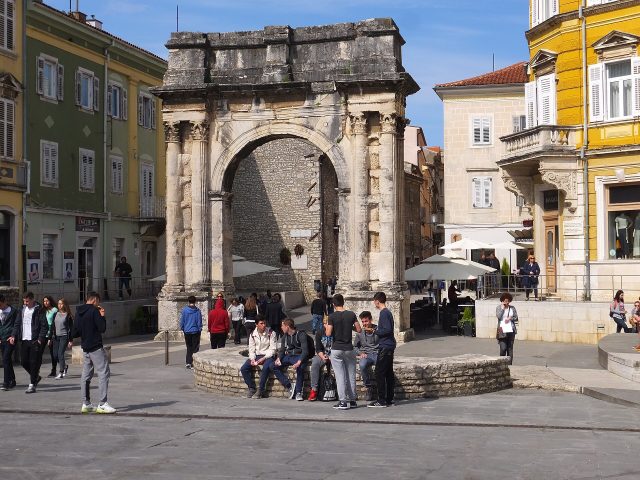
Perched quietly in the heart of Pula, the Temple of Augustus is one of those rare places where time feels suspended. It stands on what was once the bustling forum of the Roman colony of Pietas Julia, a city that thrived as a vital port and administrative hub of the empire. Today, the temple is easy to overlook amid the flow of pedestrians, its modest grandeur often lost in the rhythm of modern life. Built in the early 1st century AD, it was dedicated to the first Roman emperor, Augustus, and to Roma, the goddess who embodied the might of Rome. The temple’s presence is a reminder of Pula’s significance during antiquity, a city that connected the Adriatic to the wider Roman world.
The architecture is unmistakably Roman, a rectangular structure with a deep portico supported by six Corinthian columns. Their slender forms rise gracefully, crowned with capitals adorned with acanthus leaves, a detail that speaks to the craftsmanship of the era. The facade, carved from local limestone, has weathered into a warm golden hue, particularly striking in the soft light of dusk. Once, the pediment would have featured sculptural reliefs, though only fragments remain, hinting at the temple’s former glory. Inside, the space is empty now, save for the echoes of history—where a statue of Augustus once stood, there is only silence, a quiet testament to the impermanence of power.
The temple’s journey through the centuries has been far from straightforward. In the Middle Ages, it was repurposed as a church, its original purpose obscured by time. Later, it served as a granary, its sacred space filled with the practical concerns of daily life. It wasn’t until the 19th century, when Pula became part of the Austro-Hungarian Empire, that efforts were made to restore the temple to its Roman form. The restorers worked carefully, stripping away later additions, though some elements—like parts of the pediment—were lost forever. What remains today is a near-perfect echo of its original state, though the layers of history are still visible to those who look closely.
Pula itself has always been a crossroads of cultures. Long before the Romans arrived, the area was inhabited by Illyrian tribes, and later, Greek influences seeped into the region. The Romans, however, left the most enduring mark, shaping the city’s identity as a strategic outpost of their empire. The forum where the temple stands was once the political and social heart of Pietas Julia, where citizens gathered for assemblies, merchants haggled over goods, and officials made decisions that shaped the province. Today, the forum is a charming square lined with cafes and historic buildings, but if you pause for a moment, it’s not hard to imagine the sounds of Latin, the clatter of sandals on stone, and the scent of incense rising from sacrificial fires.
Visiting the Temple of Augustus doesn’t take long, but it leaves an impression that lingers. The interior is small, with a few informational displays, fragments of ancient inscriptions, and models showing how the temple evolved over time. Yet the real draw isn’t the exhibits—it’s the atmosphere. Standing beneath the portico, the weight of centuries feels almost tangible. The best times to visit are early in the morning, when the square is still quiet, or in the evening, when the lamplight casts long shadows across the stone. There’s a sense of stillness here, as if the past is just beneath the surface, waiting to be noticed.
The temple is more than just a relic of antiquity; it’s a symbol of resilience. It has survived wars, the rise and fall of empires, earthquakes, and neglect, yet it endures, a quiet witness to the passage of time. For Pula, it serves as a kind of anchor, a starting point from which the city’s history unfolds. From its origins as a Roman colony to its modern identity as a coastal destination, the temple remains a touchstone, a place where the past feels immediate. While many visitors flock to the amphitheater or stroll along the waterfront, the Temple of Augustus offers something different—a chance to connect with the layers of history that have shaped this city.
If you find yourself in Pula, take a moment to step away from the usual tourist path. Walk around the temple, run your fingers over the rough surface of the columns, and let the weight of two thousand years settle in. It’s in these small, unscripted moments that travel often reveals its deepest rewards. Afterward, linger in one of the cafes on the square, sip a coffee, and imagine the conversations that might have taken place here centuries ago—a Roman citizen debating politics, a merchant negotiating a deal, or a traveler pausing to rest on a journey. History isn’t just about dates and events; it’s about the people who walked these same streets long before we did.