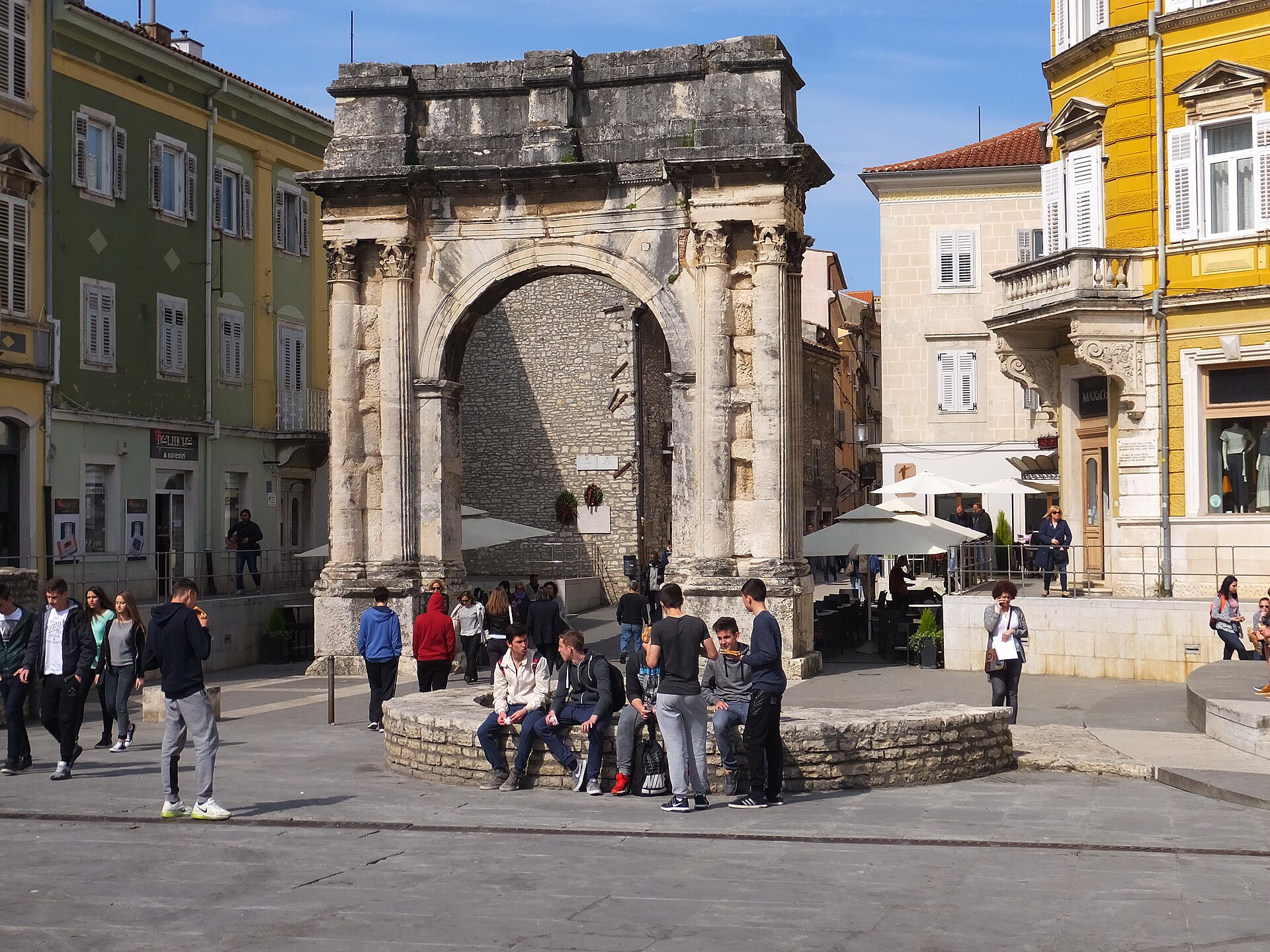
The Arch of the Sergii in Pula is one of those quiet landmarks that lingers in your memory long after you’ve left. It doesn’t demand attention like the city’s more famous sights, but that’s part of its charm. Tucked away on a small square, it blends into the surroundings, yet its presence is undeniable. Built in the 1st century AD, the arch originally stood as part of the city gates, marking the entrance to Pula’s ancient Roman forum. More than just an architectural ornament, it was a symbol of power and gratitude, commissioned by the Sergii family, whose wealth and influence made its construction possible. Today, it remains one of the few surviving structures from Pula’s Roman past, still standing almost as it did two thousand years ago.
The arch follows classical Roman design, though with a few intriguing details. Rising about eight meters high and just over five meters wide, it features Corinthian columns supporting an intricately decorated entablature. The most striking elements are the reliefs carved into its surface—figures believed to represent members of the Sergii family, along with scenes from Roman mythology. Over the centuries, the arch’s purpose shifted. In the Middle Ages, it was incorporated into the city walls, and later, it became part of a gateway used by merchants and travelers. Each era left its mark, yet the arch endured, adapting without losing its essence.
Pula was already an important Roman city by the time the arch was built. Founded long before the Romans arrived, it had grown into a thriving commercial and military hub by the 1st century AD. The Arch of the Sergii wasn’t just a decorative feature; it served as a boundary between the public forum and the residential districts, reinforcing the status of the family that funded it. The Sergii were a prominent clan, and while their contributions to Pula extended beyond this single monument, the arch became their most lasting legacy. It was a statement of prestige, a way to ensure their name would be remembered.
Like the city itself, the arch has witnessed countless changes. Pula passed through the hands of Byzantines, Venetians, and Austrians, flourishing and fading with each new ruler. Yet the arch remained in place, a silent witness to history’s ebb and flow. In the 19th century, when Istria became part of the Austro-Hungarian Empire, the first major restoration efforts began. The arch was stripped of later additions, revealing its original form. Today, it looks much as it did in antiquity, though time and weather have softened its edges, adding a layer of texture to the stone.
There’s a particular atmosphere around the arch. During the day, it’s a busy spot—tourists snap photos, locals hurry past, and the square hums with activity. But if you linger, the details start to emerge. The way the light shifts across the reliefs at different times of day, for instance: morning sun gently illuminates the carvings, while evening casts long shadows across the pavement. Sometimes, street musicians set up nearby, and the ancient stone seems to come alive, bridging the gap between past and present.
The Arch of the Sergii isn’t just a relic; it’s a living connection to Pula’s layered history. It reminds visitors that this city was a significant center long before it became a tourist destination. The stones hold echoes of Roman legions, medieval traders, and Austrian officers, each era leaving its imprint. Today, the arch invites you to step into that history without leaving the present behind. It doesn’t demand reverence, but it doesn’t let you pass by without noticing, either.
If you find yourself in Pula, take a moment before rushing to the amphitheater or the sea. Stand before the Arch of the Sergii, study its carvings, and try to imagine the people who walked beneath it two millennia ago. In those quiet moments, history stops being an abstract concept and becomes something tangible, something personal. The arch won’t reveal all its secrets, nor does it need to. It simply stands there, a quiet testament to time, waiting for you to pause and look closer.