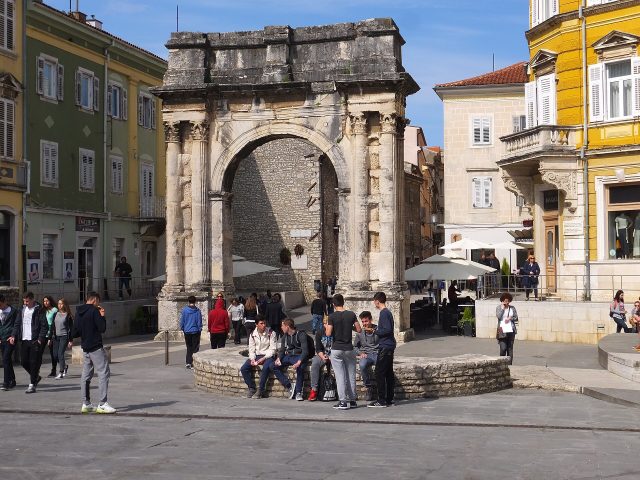
Pula is a city where history isn’t just remembered—it’s embedded in the very stones underfoot. The layers of time here are visible everywhere, from Roman ruins to Venetian palaces, from Austrian military architecture to the quiet streets where Italian and Croatian cultures still blend. The sea has always been more than a backdrop; it was the city’s lifeline, a highway connecting Pula to the wider world. The Maritime Museum, tucked in the heart of the old town, offers a way to experience that history not through dates and battles, but through the objects that once belonged to the people who lived it.
The museum occupies what was once the Austrian arsenal, built in the mid-19th century when Pula served as the main naval base of the Austro-Hungarian Empire. The building itself is a testament to the engineering of the era—thick walls of local limestone, soaring vaulted ceilings, and vast halls that once hummed with activity. Today, the space is quiet, but the echoes of the past linger. It’s easy to imagine the clatter of tools, the creak of pulleys, and the shouts of workers in German, Italian, and Croatian, all part of the daily rhythm of a port city that was the empire’s maritime heart.
The exhibits focus on the Adriatic’s seafaring legacy, but not in the way you might expect. There are no dry recitations of naval battles or shipbuilding statistics. Instead, the museum tells the story of the sea through the everyday lives of those who depended on it. Old navigational instruments, meticulously crafted ship models, and charts mapping trade routes and military voyages fill the rooms. But the most compelling pieces are the personal ones—letters from sailors to their families, faded photographs, and diaries that reveal the human side of life at sea. Some stories are ordinary, others heartbreaking, like the accounts of fishermen lost in storms or the logbooks of men who spent years away from home.
One section is dedicated to the history of submarines, a field where Pula played a pioneering role. The museum holds rare documents and blueprints from the early 20th century, when the city was among the first places in the world to build underwater vessels. The evolution of submarine design is laid out clearly, from the clumsy early prototypes to more refined models that hint at the sleek machines of today. Nearby, artifacts recovered from shipwrecks—coins, pottery, tools—offer a tangible connection to the past. These objects spent decades on the seabed before being brought to the surface, and their presence here feels like a quiet tribute to the lives they once touched.
The museum doesn’t stop at naval history. It also explores the broader relationship between the Adriatic and the people who lived along its shores—through trade, fishing, and even piracy. There’s a section on the salt trade, which for centuries was one of the region’s most valuable industries, and another on traditional tuna fishing, a practice passed down through generations. Piracy, too, gets its due, not as a romanticized tale but as a very real part of life in these waters. Ships were raided, cargoes stolen, and coastal towns lived in constant awareness of the threat from the sea.
Pula’s identity as a port city is a recurring theme. The museum displays models of old shipyards and harbors, showing how the city’s waterfront has transformed over the centuries. You can see what the port looked like during Roman times, when Pula was a key trading hub, or under Venetian rule, when it was part of a vast maritime empire. These exhibits make it clear that the sea wasn’t just a physical presence in Pula—it shaped the city’s economy, culture, and even its soul.
What the museum does best is avoid grand narratives. There’s no attempt to glorify the past or present a single, polished version of history. Instead, it offers a collection of fragments—objects that speak for themselves. A rusted anchor pulled from the seabed, a waterlogged logbook, a yellowed photograph of a crew on deck—each one is a reminder that history is made up of individual lives. The museum doesn’t need to spell this out; the exhibits do the talking.
Visiting the Maritime Museum isn’t just about looking at old things. It’s about stepping into the rhythm of a city where the sea has always been close. After wandering through the halls, you can walk down to the waterfront and see the same waters that once carried the ships now preserved in the museum. Pula is still a port, though not as busy as it once was, and the sea still sets the pace of life here. That continuity makes the museum feel less like a repository of artifacts and more like a bridge between past and present. The objects on display aren’t just relics—they’re part of a living story, one that’s still being written.