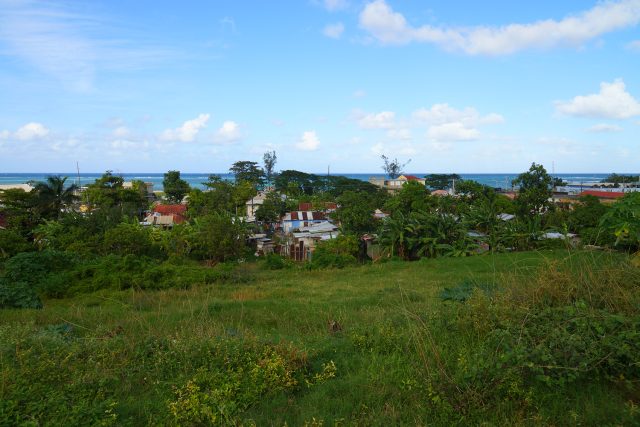
Perched on a low hill overlooking Saint Ann’s Bay, Hampden Fort is one of those places where history doesn’t just linger—it presses against you. The ruins, now softened by time and overgrown with grass and shrubs, once hummed with activity. Soldiers patrolled the ramparts, cannons scanned the horizon, and below, at the docks, ships unloaded their cargo—some of it human. Today, the fort is quiet, its stones worn by salt and rain, but the view remains unchanged: the turquoise sweep of the Caribbean, the jagged coastline, the same sea that carried both trade and tragedy.
Built in the mid-18th century, Hampden Fort was part of a network of defenses guarding Jamaica’s northern coast from Spanish, French, and pirate raids. The island was a prized possession in the colonial era, and Saint Ann’s Bay was a crucial stop on the triangular trade route between Europe, Africa, and the Americas. The fort never saw major battles—its purpose was deterrence. Its cannons could command the approaches to the bay, while its thick walls and moat made it a formidable obstacle. More often than not, its presence alone was enough to keep attackers at bay.
The architecture is classic British colonial military design: thick limestone walls, gun embrasures, powder magazines, and barracks. Some of the original structures still stand, though time has taken its toll. The powder house, where barrels of gunpowder were stored in damp darkness, is now just a hollow shell. The walls, built from local stone, bear the marks of centuries—cracks, erosion, rusted iron fittings. Yet the layout remains clear, especially the central parade ground, where officers once directed the fort’s defense. Now, it’s a place to stand and imagine the past, the weight of history almost tangible in the sea breeze.
By the 19th century, Hampden Fort had outlived its military usefulness. Jamaica’s colonial conflicts faded, and the fort was abandoned, left to the mercy of the elements. Nature slowly reclaimed it, creeping in through cracks in the stone, softening the edges of what was once a symbol of power. Today, it’s more relic than fortress, a quiet monument to a complicated past. Unlike the crowded tourist spots in Montego Bay or Ocho Rios, Hampden sees few visitors. That’s part of its appeal—you can wander its grounds alone, the only sounds the rustle of leaves and the crash of waves below.
Hampden Fort isn’t just a ruin; it’s a silent witness to a darker chapter of history. Saint Ann’s Bay was a key port in the transatlantic slave trade, and while the fort itself wasn’t a holding place for enslaved people, it stood guard over the system that brought them here. Thousands of Africans passed through these waters, bound for plantations across the Americas. The fort doesn’t tell this story explicitly, but its very existence is a reminder of the brutality that shaped the island. Elsewhere in Jamaica, memorials honor the victims of slavery, but here, the past is written in the weathered stone and the empty gun ports.
For locals, the fort is a mixed legacy. Some see it as part of their history, while others associate it with a colonial past that Jamaica has long since moved beyond. It’s not a place of pride for everyone, but in recent years, there’s been a growing interest in preserving such sites. Occasionally, school groups visit for tours, or historians give talks about the fort’s role in the island’s defense. Still, Hampden remains largely unknown to most Jamaicans, a quiet corner of the past that doesn’t demand attention.
There’s a particular kind of stillness at Hampden Fort. No gift shops, no guided tours, no signs explaining what you’re looking at—just the wind, the sea, and the ruins. Sometimes, a fisherman might stop by to mend his nets or sit on the shore, or a stray tourist might wander in from the road. But more often than not, the fort is empty, its solitude part of its charm. It doesn’t try to impress; it simply exists, a place where the past feels closer than it does elsewhere.
Visiting Hampden isn’t about ticking off a checklist or snapping the perfect photo. There’s no set path, no must-see attractions—just the freedom to explore at your own pace. Climb the crumbling walls for a view of the bay, or sit on the rocks below and listen to the waves. Walk the perimeter, tracing the outlines of old buildings, trying to picture the soldiers who once stood guard here. Time moves differently at Hampden. The minutes stretch, the outside world fades, and for a little while, you’re left with nothing but the sound of the sea and the weight of history.
This isn’t a place for those seeking excitement or Instagram-worthy moments. It’s for people who appreciate quiet, who want to step outside the rush of modern life and reflect. Hampden Fort doesn’t offer answers, but it does offer perspective—a chance to think about how empires rise and fall, how people fought for freedom, and how the past lingers in the land. If you find yourself in Saint Ann’s Bay, it’s worth a visit, if only to stand among the ruins and feel the echoes of what once was.