Fort Lafferon sits quietly on a low hill above Montrouis, its weathered stone walls overlooking the Caribbean. The air here is still, the kind of quiet that makes you slow down without realizing it. There are no crowds, no signs pointing the way, just the wind and the sense that time moves differently in this place.
Built in the 18th century, when Haiti was still the French colony of Saint-Domingue, the fort was part of a network of coastal defenses. The French were protecting their wealth—sugar, coffee, and indigo plantations worked by enslaved people—from British, Spanish, and pirate raids. Unlike Fort Laferrière in Milot, which saw major battles, Lafferon played a quieter role. It served as a lookout post and a garrison stronghold, watching the horizon for approaching ships. There’s no record of dramatic sieges or heroic last stands here, just the steady, unglamorous work of soldiers keeping watch.
The fort’s design is simple but effective. Thick walls of local porous stone curve around a central courtyard, where soldiers once drilled and stored supplies. Narrow gun slits punctuate the walls, just wide enough for cannons to fire through. In the middle of the courtyard, a well still stands—a reminder that the fort was built to withstand long sieges. There’s no moat or outer defenses, just the natural protection of the hill. Some say it was constructed in haste, others that the builders trusted the landscape to do half the work for them.
Today, the fort feels like a place caught between past and present. Grass grows between the stones, and the remains of barracks and storerooms crumble under the weight of time and the island’s humid climate. The walls are sturdy but worn, their surfaces softened by centuries of wind and rain. Inside, the space is open, almost empty, as if waiting for something that will never come.
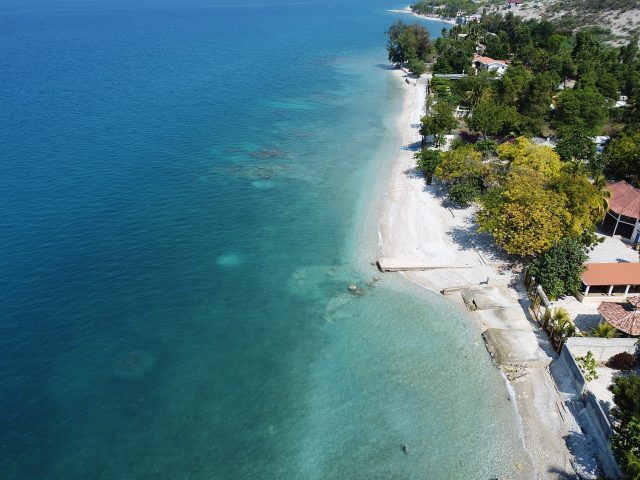
From the top of the hill, the view stretches out over the coast. On clear days, the sea blurs into the sky, and the horizon seems endless. Below, the town of Montrouis sprawls quietly—no luxury resorts, no crowded beaches, just a scattering of houses and fishing villages. The fort isn’t a place you’d find on postcards, and that’s part of its appeal. It doesn’t try to impress or entertain. It simply exists, a silent witness to the years that have passed.
There are no signs, no guided tours, no guards. Entry is free, and you’re as likely to encounter a local taking shelter from the sun as you are another visitor. The lack of infrastructure makes it easier to imagine the fort as it once was—the creak of the gates, the murmur of soldiers, the distant sound of waves. Some come to sit in the shade of the walls, others to wander the courtyard, tracing the outlines of what used to be. It’s a place where history doesn’t feel like a story you’ve heard before, but something you can almost touch.
Haiti’s past is complicated, marked by struggle and resilience. After gaining independence in 1804, the country left behind the colonial era, and forts like Lafferon lost their military purpose. But they didn’t disappear from memory. Locals still speak of the fort as a place where the past lingers, where you can feel the weight of what came before. There are no grand legends attached to it, no famous battles or heroic figures. Just the quiet persistence of stone and time.
The fort is slowly decaying. Haiti has limited resources for preserving its historical sites, and Lafferon isn’t a priority. Yet there’s something fitting about its state of gentle ruin. It hasn’t been polished for tourists or restored to an imagined perfection. It stands as it is—cracked, weathered, but still holding its shape. In a world where so many places are packaged for consumption, Lafferon offers something rare: authenticity.
If you find yourself in Montrouis, set aside a few hours to visit. The path up the hill isn’t well-marked, and you’ll likely arrive on foot or by local transport. Bring water and a snack—there are no cafes or souvenir stands here. The best time to go is early morning or late afternoon, when the sun isn’t as harsh and the air carries the scent of salt and dry grass. The fort won’t be the highlight of your trip, but it might leave you with the feeling that you’ve glimpsed something real, something that hasn’t been smoothed over or staged.
It’s not a place for those who want spectacle. But if you’re curious about Haiti beyond the headlines, if you’re drawn to places where history feels alive rather than curated, then Lafferon is worth the detour. It doesn’t ask for much—just a little time, a little attention. In return, it offers a moment of stillness, a connection to the past that doesn’t need words.