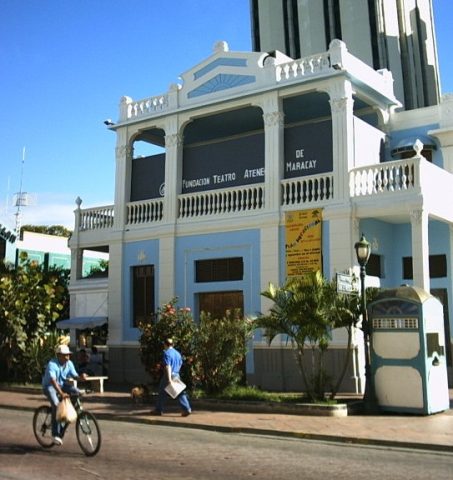
The Maracay Municipal Palace is one of those buildings that quietly becomes part of a city’s identity, blending into the daily rhythm of life while holding within its walls the stories of a place and its people. Tucked in the heart of the city, it doesn’t immediately demand attention, but those who take a closer look will find more than just another government office. This is a structure that has witnessed Maracay’s transformation from a modest settlement into a regional hub, a silent observer of the changes that shaped the city over the past century.
The palace’s architecture reflects the neoclassical style that was popular across Latin America in the early 1900s, a choice that carried symbolic weight at the time. Neoclassicism was seen as a representation of order, progress, and stability—qualities that cities like Maracay, then on the rise, wanted to project. The building’s facade is marked by tall columns, symmetrical lines, and large windows, giving it a sense of dignity and permanence. Inside, the high ceilings, intricate moldings, and wooden paneling evoke an era when public spaces were designed to impress, even if their grandeur has since been softened by time and use. While some details have been updated over the years, the core of the building remains much as it was when first constructed.
Maracay’s growth in the early 20th century was closely tied to Venezuela’s economic boom, driven in part by agricultural wealth from the surrounding valleys, where coffee and cocoa plantations thrived. As the city expanded, local authorities sought to establish its importance with a municipal building that would reflect its newfound status. Construction began in the 1920s, a period when Venezuela was under the rule of dictator Juan Vicente Gómez. This political context influenced the palace’s design, which was meant to convey strength and authority. The result was a structure that, while not overly ornate, carried a sense of solidity and purpose.
Today, the Municipal Palace still serves its original function, housing the city’s administrative offices and hosting council meetings, official ceremonies, and occasional public events. For visitors, it offers a glimpse into the architectural trends of its time, but for locals, it’s more than just a workplace—it’s a piece of the city’s collective memory. The area around the palace is dotted with other historic buildings, and together they create a sense of old Maracay, a place that hasn’t entirely let go of its past. The palace isn’t a museum, nor is it a major tourist attraction, but its presence adds depth to the city’s character.
Across from the palace lies a small square, a gathering spot for residents and a microcosm of daily life in Maracay. On weekdays, people come and go—some to handle official business, others to sit on the benches under the shade of trees. On weekends, the square comes alive with street vendors, musicians, and children playing. The palace, with its unassuming facade, fits naturally into this scene, its quiet elegance complementing the lively atmosphere around it. It’s not the kind of place that draws crowds, but its understated charm is part of what makes the square feel like the heart of the city.
Inside, the palace retains some of its original details, though access is limited. A few rooms still feature antique chandeliers, marble staircases, and portraits of past mayors, offering a sense of stepping back in time. Occasionally, guided tours are organized for school groups or history enthusiasts, but for the most part, the building remains a functional space. Even from the outside, however, it tells a story—of Maracay’s evolution, the ideals that inspired its construction, and the way the city has chosen to preserve its history without turning it into a relic.
What makes the Municipal Palace special is that it isn’t trying to be anything other than what it is. It’s not a monument, nor is it a place of entertainment. Its primary role is to serve the city, and in doing so, it has become a living part of Maracay’s identity. Here, decisions are made that shape the lives of residents, and everyday matters are addressed. For travelers accustomed to more flamboyant landmarks, the palace might seem unremarkable, but for those who want to understand the real Maracay, it’s an essential piece of the puzzle.
Venezuela is a country of contrasts, where modernity and tradition often coexist in unexpected ways. Maracay is no exception. The Municipal Palace is one of those elements that help maintain the balance between past and present. It doesn’t aim to be the most beautiful or the most famous building in the city, and that’s precisely why it fits so well into the urban landscape. There’s nothing ostentatious about it, but there is authenticity—a quality that feels increasingly rare in a world where so much is designed for show. In its quiet way, the palace reminds us that some of the most meaningful places are those that simply endure, serving their purpose while holding onto the stories of the people who pass through them.