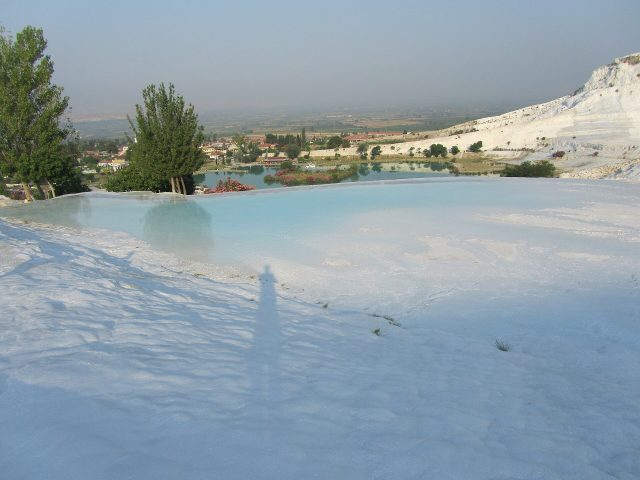
The ancient theatre of Hierapolis is one of those rare places where time seems to stand still, leaving behind stone witnesses to a long-lost grandeur. Perched on a hillside in Pamukkale, it overlooks the thermal springs and the gleaming white travertine terraces below, creating a striking contrast between nature’s artistry and human ambition. Built in the 2nd century AD under Emperor Hadrian, the theatre’s origins stretch back even further, to the Hellenistic era when Hierapolis first emerged as a city. Back then, it was more than just a venue for entertainment—it was a cultural and religious hub where Greek, Roman, and local traditions intertwined.
The theatre’s architecture remains awe-inspiring even today, nearly two thousand years later. With a capacity of twelve thousand spectators, it was an impressive feat for an ancient city. The stage, once adorned with columns and statues, served as the backdrop for performances of Sophocles’ tragedies and Aristophanes’ comedies. The acoustics are so precise that even a whisper on the orchestra can be heard in the highest rows. Beyond the stone seating, fragments of the original decorations survive, including reliefs depicting gods and mythological scenes. The view from the upper tiers is particularly striking—a sweeping panorama of the thermal fields and distant mountains, which in ancient times were believed to be the dwelling place of spirits.
Hierapolis wasn’t chosen at random for this theatre. The city was famous for its healing springs, and the theatre became part of the ritual of restoration. Visitors from across the Roman Empire came not only to bathe in the thermal waters but also to be entertained. Performances were thought to bring emotional balance, aiding in recovery. Yet the theatre wasn’t solely for leisure—it hosted religious festivals, political gatherings, and occasionally even gladiatorial combat, though the latter was rare.
Over time, Hierapolis declined. Earthquakes damaged the city, and the rise of Christianity shifted cultural priorities. The theatre was gradually reclaimed by nature, its stones repurposed for new constructions. It wasn’t until the 20th century that restoration efforts began, bringing the structure back to something resembling its former glory. While some details are lost—the stage’s columns now stand as mere foundations, and the statues of gods have been moved to museums—the theatre still feels alive.
Visiting the theatre is more than just walking among ancient stones; it’s a step into the world of antiquity. It’s easy to imagine the roar of the crowd, the music echoing through the tiers, and the sun setting over the travertine terraces, casting them in golden light. Occasionally, concerts and festivals still take place here, breathing new life into the ancient stage and reminding visitors that art and architecture can endure for centuries. Even if history isn’t your passion, the views and the quiet, broken only by the wind, make the climb up the stone steps worthwhile.
Beyond the theatre, the ruins of Hierapolis stretch out—a vast necropolis with thousands of tombs, the remnants of temples and baths, and an ancient pool where visitors can still swim among fallen columns. The city feels less like a ruin and more like a place in slumber, waiting to be rediscovered. The theatre remains its heart, where past and present merge seamlessly. It’s here, more than anywhere else, that you understand why Pamukkale is considered one of Turkey’s most extraordinary places. The stones hold stories, and the wind carries echoes of a time when this was a city alive with music, worship, and the quiet murmur of daily life.