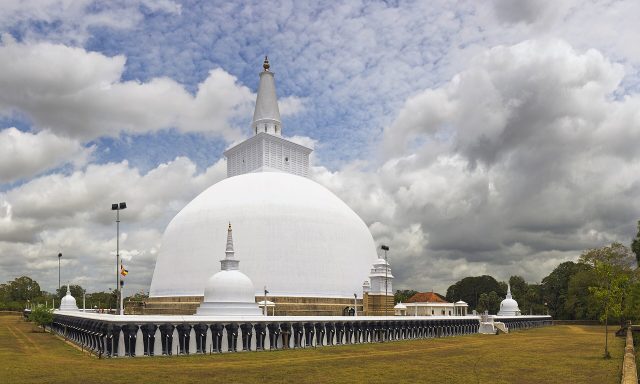
Anuradhapura is one of those rare places where time feels suspended, leaving behind layers of history you can almost reach out and touch. This ancient city in northern Sri Lanka wasn’t just a capital—it was the beating heart of Sinhalese civilization for over a thousand years. Founded in the 4th century BCE, it became the island’s first major political and religious center, where Buddhist traditions took root and still shape the country’s culture today. Now an expansive archaeological park spanning dozens of square kilometers, Anuradhapura is a landscape of ruins where crumbling palaces, towering stupas, and forgotten monasteries rise from the jungle, whispering of a long-lost grandeur.
At the city’s core stands the sacred Sri Maha Bodhi, a descendant of the original Bodhi tree under which the Buddha attained enlightenment. This living relic, sheltered by a golden railing, remains one of Buddhism’s most revered sites. Pilgrims flock here year-round, offering flowers and prayers, their devotion as much a part of the place as the ancient stones. But Anuradhapura was never just a spiritual hub. For centuries, it thrived as a center of learning, art, and trade, linking India, Southeast Asia, and even the distant Roman Empire. Merchants once bartered silk, spices, and precious gems along its bustling streets, while scholars debated philosophy in its shadowy monasteries.
The architecture of Anuradhapura is a testament to the ambition and skill of its builders. The city’s stupas—massive dome-shaped structures—were symbols of faith and royal power. The most famous, Ruwanwelisaya, was built in the 2nd century BCE and still dominates the skyline with its gleaming white dome, over 100 meters tall. Inside, it’s said to house a sacred relic: a tooth of the Buddha. Another marvel, Jetavanaramaya, was once the world’s third-tallest structure after the Egyptian pyramids. Though now in ruins, its sheer scale hints at the engineering prowess of the time. Constructing these monuments required not just vast resources but also advanced knowledge of mathematics and materials—knowledge that still puzzles historians today.
Anuradhapura wasn’t only a religious center; it was a seat of power. Kings like Devanampiya Tissa, who ruled in the 3rd century BCE, transformed it into a true capital. Under his reign, Buddhism became the state religion, and the city flourished. Palaces rose, roads were laid, and an intricate system of reservoirs was built to tame the arid land. These ancient tanks, some still in use, were marvels of hydraulic engineering, turning barren plains into fertile rice fields. They also served as defensive barriers, forcing invading armies to navigate a labyrinth of artificial lakes. The remnants of these systems are a quiet reminder of how deeply the city’s survival depended on human ingenuity.
Life in Anuradhapura was a study in contrasts. On one hand, it was a sanctuary of quiet contemplation, where monks studied scriptures and meditated in secluded monasteries. On the other, it was a vibrant commercial crossroads, where traders from across the known world haggled over goods. Goldsmiths, silversmiths, and sculptors crafted intricate jewelry and statues, their workshops humming with activity. Yet by the 11th century, the city’s fortunes had waned. The capital shifted to Polonnaruwa, and Anuradhapura was gradually reclaimed by the jungle. It wasn’t until the 19th century, when British archaeologists began excavations, that its story resurfaced.
Walking through Anuradhapura today is like stepping into a living museum. The ruins aren’t just relics; they’re echoes of a city that once pulsed with life. At dawn or dusk, when the light softens the edges of the stones and the air hums with the sounds of birds and rustling leaves, it’s easy to imagine the past. Monks chanting in the monasteries, merchants calling out their wares, kings receiving envoys from distant lands—all of it feels just beneath the surface. The park is quiet now, but not empty. Locals still come to pay their respects, sitting in the shade of sacred trees or leaving offerings at the stupas. Their presence keeps the city from feeling like a mere tourist attraction.
What makes Anuradhapura special is its sense of continuity. Though many structures are in ruins, the place doesn’t feel abandoned. Instead, it feels alive in a different way—slower, deeper. Here, the past isn’t just remembered; it’s still part of the present. The Sri Maha Bodhi still draws pilgrims, the stupas still cast long shadows, and the reservoirs still hold water. For travelers interested in history or architecture, Anuradhapura offers something rare: a chance to connect with a civilization that shaped an entire island. There’s no rush here, no crowds jostling for the best photo. Just space, silence, and the weight of centuries.
To truly understand Anuradhapura, you have to look closely. The carvings on a weathered pillar, the curve of a stupa’s dome, the way a stone bears the marks of time—each detail tells a story. Take the rock-cut monastery of Isurumuniya, where faded frescoes and Buddha statues cling to the walls, or the ruins of the once-lavish Lohapasada palace, its grandeur now reduced to scattered columns. Even without knowing the full history, the place has a way of making you feel small in the best sense—like you’re standing at the edge of something vast and enduring.
Anuradhapura isn’t just a relic of Sri Lanka’s past; it’s a thread in its present. Religious ceremonies still take place here, and traditions are passed down with care. For many Sri Lankans, this is sacred ground, treated with a reverence that sets it apart from other tourist sites. There are no pushy vendors, no tacky souvenir stalls—just the quiet rhythm of a place that has always been more than a destination. It’s a reminder that some cities aren’t built to last; they’re built to endure. And in Anuradhapura, the past isn’t just preserved—it’s still alive.