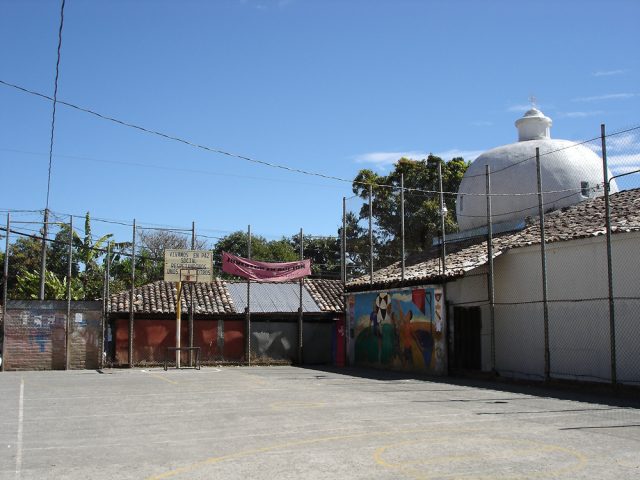
San Francisco Gotera is one of those quiet Salvadoran towns tucked away in the eastern highlands, where time moves at its own unhurried pace. The town’s cultural center, a modest building with a quiet presence, feels like a living archive of the region’s past. It doesn’t have the grandeur of a national museum, nor does it need it. Instead, it offers something more intimate—the chance to step into the everyday rhythms of a place shaped by generations of farmers, artisans, and families who called these mountains home.
The building itself is unassuming, blending seamlessly into the town’s low-slung streets. Its architecture is typical of mid-20th-century provincial cultural spaces across Latin America: a single-story structure with a central courtyard, its whitewashed walls softened by wooden shutters and simple geometric patterns near the roofline. Inside, the layout is open and inviting, with small galleries arranged around the courtyard. The exhibits are understated—tools, textiles, faded photographs, and handwritten documents—but they tell a story of resilience and continuity. A wooden loom stands in one corner, its threads still taut, as if the weaver just stepped away. Nearby, a collection of black-and-white images captures the town in different eras, from the bustle of market days to the quiet moments of rural life.
What makes this place special is its role in the community. San Francisco Gotera isn’t a tourist hotspot, and the cultural center isn’t designed for crowds. For locals, it’s a gathering space—a place where history isn’t just preserved but lived. On any given day, you might find a group of elders sharing stories in the courtyard, a workshop on traditional pottery, or a rehearsal for a folk dance performance. The center also plays a key part in keeping alive the heritage of the Lenca people, one of El Salvador’s Indigenous groups. Their presence in the region predates the town itself, and the exhibits here—handwoven textiles, clay vessels, and oral histories—offer a glimpse into a culture that has endured despite centuries of change.
The building’s history mirrors that of the town. Constructed in the 1950s, when San Francisco Gotera was thriving thanks to coffee production, it became a symbol of progress—a place where education, art, and civic life could take root. The civil war that tore through El Salvador in the 1980s left deep scars, and the town, like much of the country, had to rebuild. The cultural center was no exception; it was repaired and repurposed, but its core mission remained the same: to be a space where people could come together, remember, and move forward.
Today, the center is as much about the present as it is about the past. Local artists display their work in rotating exhibitions, and the courtyard often hosts small concerts or craft fairs. On weekends, the sound of marimbas or the chatter of children learning to embroider might drift through the open doors. For visitors, the experience is less about ticking off a sightseeing list and more about slowing down. There are no guided tours here, no audio guides—just the quiet hum of a place that has seen generations come and go.
If you’re lucky enough to visit during one of the town’s festivals, the center comes alive in a different way. In August, when San Francisco Gotera celebrates its patron saint, the building fills with color and music. Stalls selling handmade goods line the courtyard, and the air is thick with the scent of pupusas grilling nearby. Even outside of festival season, the town has its own rhythm. The central plaza, with its colonial-era church, is just a short walk away, and the surrounding streets are dotted with small comedores where you can try the thick, handmade corn tortillas stuffed with cheese, beans, or loroco, a local flower bud.
What the cultural center offers isn’t spectacle, but something far more meaningful: a sense of connection. It’s a reminder that history isn’t just about grand events or famous figures, but about the small, everyday moments that shape a place. Here, you can spend an afternoon flipping through old photographs, listening to a local historian recount tales of the town’s past, or simply sitting on a bench in the courtyard, watching life unfold at its own pace. For those who seek more than just postcard views, this unassuming building holds the kind of authenticity that’s increasingly hard to find. It’s not a place you visit—it’s a place you experience.