The Valley of the Kings sits on the west bank of the Nile, directly across from Luxor, tucked into a barren ravine beneath the jagged peak of El-Qurn. For nearly five hundred years, from the sixteenth to the eleventh century BCE, this was the burial ground of Egypt’s New Kingdom pharaohs—Ramses, Thutmose, Seti, Amenhotep, and nearly every ruler of the era. Unlike the towering pyramids of the Old Kingdom, these tombs were carved deep into the limestone cliffs, their entrances hidden in the folds of the valley in an attempt to thwart grave robbers. It was a strategy that ultimately failed; most were plundered in antiquity, their treasures scattered long before modern archaeologists arrived.
The tombs vary in scale and complexity, but all follow a similar design: long, descending corridors lined with intricate carvings and paintings, leading to a burial chamber where the pharaoh’s sarcophagus once rested. The walls are covered in vivid scenes from ancient Egyptian funerary texts—the Book of the Dead, the Book of Gates, the Amduat—depicting the perilous journey of the soul through the underworld, the weighing of the heart before Osiris, and the solar barque’s nightly voyage across the sky. The colors remain astonishingly bright, preserved by the valley’s dry air and the absence of light. Reds, blues, and golds leap from the stone as if painted yesterday, a rare glimpse into the artistic mastery of the time.
Only one tomb escaped the fate of the others. When Howard Carter uncovered the tomb of Tutankhamun in 1922, it was nearly intact, its chambers still packed with the young king’s belongings. By the standards of the valley, Tutankhamun’s tomb is modest—smaller than those of his predecessors, with none of the grand architectural flourishes of later rulers. Yet its discovery was revolutionary. The golden death mask, the nested coffins, the chariots, jewelry, and everyday objects buried alongside the pharaoh offered an unprecedented look into royal burial practices. Most of these treasures now reside in Cairo’s Egyptian Museum, but the tomb itself remains a draw, its cramped corridors and simple decoration a stark contrast to the more elaborate chambers nearby.
Visiting the valley is a carefully managed experience. A standard ticket grants access to three tombs from a rotating selection of those currently open to the public. Some, like the tombs of Seti I, Ramses V and VI, and Tutankhamun, require an additional fee. The list of available tombs changes frequently, as sites are closed in turn for conservation work. Photography is permitted inside, but only with a separate ticket, and flash is strictly prohibited to protect the fragile pigments. The air inside the tombs is thick and still, the passageways narrow and steep in places. It’s not uncommon to emerge from the depths of a burial chamber feeling slightly disoriented, the weight of the stone pressing in around you.
The valley itself is a harsh place. There is little shade, and the heat radiates off the rock, unbroken by even the slightest breeze. Water and a hat are essential, as is a willingness to move at a measured pace. Most visitors spend around two hours exploring three tombs, including the short walks between them. A small electric train ferries people from the parking area to the entrance, a brief ride that spares you the initial climb under the midday sun. For those who prefer not to navigate the site alone, guides are available at the entrance, though many travelers opt to join a tour from Luxor or further afield, where the logistics are handled in advance.
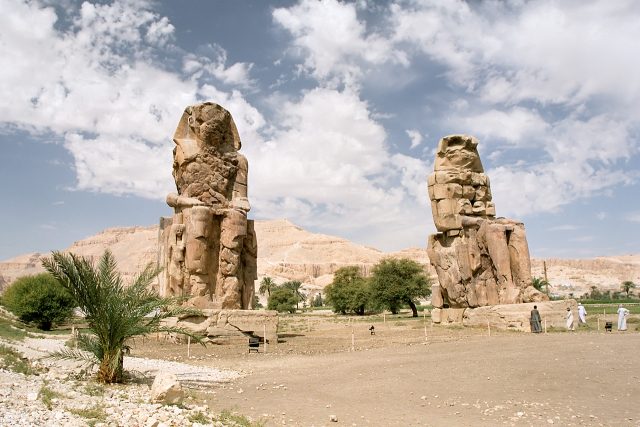
The west bank of the Nile is rich with history, and the Valley of the Kings is often paired with other nearby sites. The mortuary temple of Hatshepsut, with its striking terraces carved into the cliffs, lies just a short drive away. Further along the road stand the Colossi of Memnon, two massive stone statues of Amenhotep III that once guarded his now-lost temple. Together, these sites form a full morning’s itinerary, best tackled early to avoid the worst of the heat. The contrast between the grandeur of the temples and the quiet, almost secretive nature of the tombs is striking—one a public declaration of power, the other a private journey into the afterlife.
There is something unsettling about the valley, despite its beauty. The silence is profound, broken only by the occasional murmur of visitors or the crunch of gravel underfoot. The tombs, though empty now, were never meant to be seen again. They were sealed after the burial, the entrances concealed, the pharaohs left to their eternal rest. That so many were violated in antiquity only adds to the sense of intrusion, as if each step into the darkness is a transgression. Yet it’s impossible not to be moved by the craftsmanship, the sheer ambition of these underground palaces, built not for the living but for the dead.
For all its fame, the Valley of the Kings is not a place that reveals itself easily. There are no sweeping vistas, no grand facades—just the quiet, insistent presence of the rock and the stories it holds. It’s a site that demands patience, a willingness to look beyond the obvious and imagine the valley as it once was: a place of ritual, of mourning, of the final, desperate attempt to cheat oblivion. The pharaohs may be gone, their treasures long since carried away, but the tombs endure, a testament to a civilization that believed in eternity.