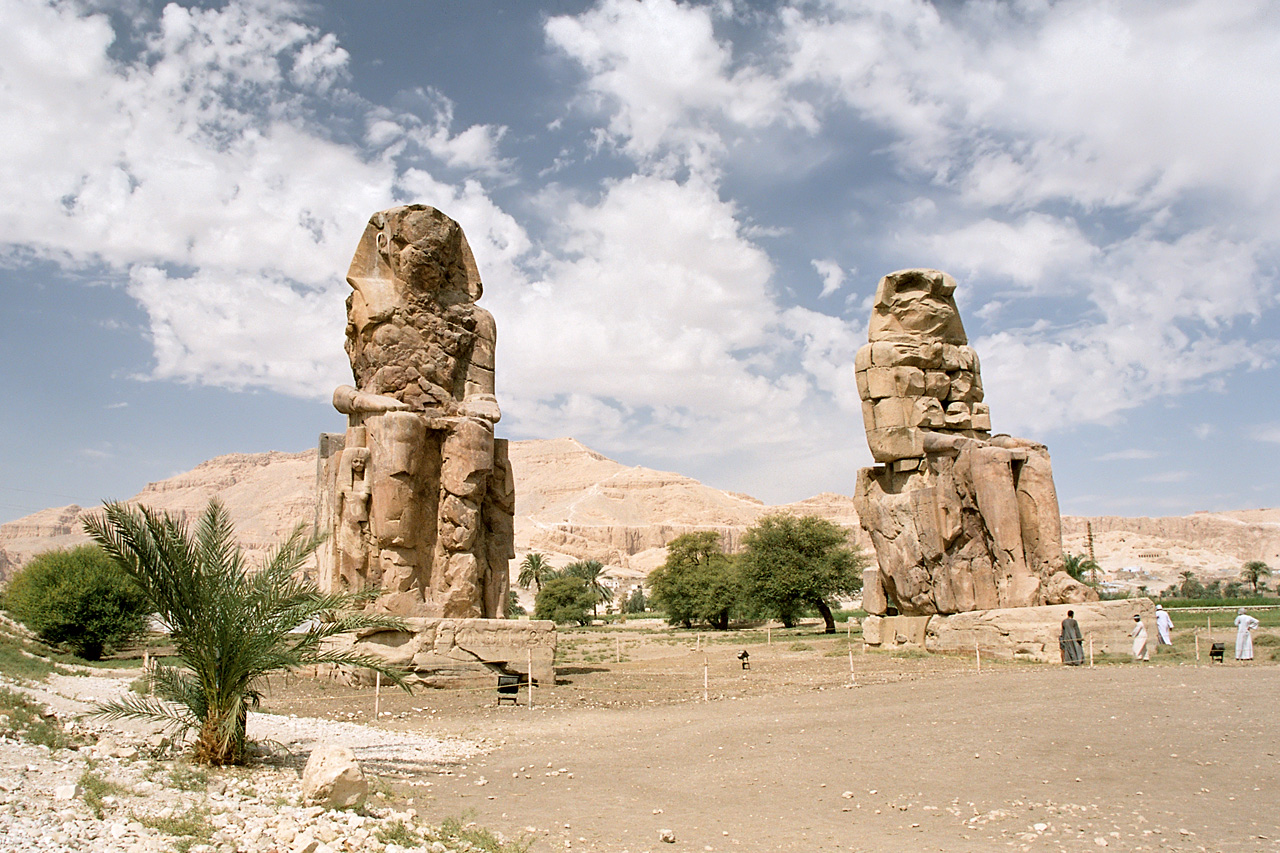
Standing sentinel on the west bank of the Nile near Luxor, the Colossi of Memnon have witnessed the passage of millennia with quiet endurance. These two towering stone figures were once part of the grand mortuary temple of Amenhotep III, a pharaoh who ruled during Egypt’s Eighteenth Dynasty. Though the temple itself has long since vanished—eroded by time, the river’s floods, and the hands of later builders—the statues remain, their imposing forms a testament to the ambition of an empire that sought to defy oblivion.
Carved from single blocks of quartzite, each statue depicts the pharaoh seated on a throne, his hands resting on his knees, his gaze fixed toward the east and the rising sun. The sheer scale of the figures is staggering: nearly twenty meters tall, with individual blocks weighing over seven hundred tons. The stone was quarried near Aswan, hundreds of kilometers to the south, and the logistics of transporting such massive slabs across the desert and up the Nile remain one of history’s enduring puzzles. Once, their surfaces gleamed with gold and precious stones, reflecting the sun’s rays in a display meant to emphasize the pharaoh’s divine authority. Today, their faces are worn smooth by time, the once-intricate details lost to centuries of wind and sand.
The name by which we know them today was given not by the Egyptians, but by the Greeks who arrived in Egypt during the Ptolemaic period. They associated the statues with Memnon, a mythical Ethiopian king and son of Eos, the goddess of dawn, who died at Troy. According to legend, Eos wept for her fallen son each morning, her tears becoming the dew. When an earthquake in 27 BCE damaged the northern statue, it began to emit a strange sound at dawn—perhaps caused by the expansion of stone as it warmed in the morning sun, or by air passing through cracks. To the Greeks and Romans who flocked to hear it, the sound was the voice of Memnon greeting his mother. The phenomenon persisted until the Roman emperor Septimius Severus, eager to leave his own mark, ordered repairs to the statue, silencing it forever.
For all their grandeur, the Colossi of Memnon are not the kind of attraction that demands attention. There are no ticket booths, no guided tours, no carefully curated displays. They stand in an open field, surrounded by sugarcane and date palms, with the distant Theban mountains framing the horizon. Locals pass by without a second glance, as accustomed to their presence as they are to the river or the desert beyond. Tourists, too, often treat them as a brief stop on the way to more famous sites like the Valley of the Kings or the temples of Karnak. Yet it is this very lack of fanfare that makes them compelling. Here, history is not preserved behind glass or explained in plaques—it simply *is*, raw and unfiltered.
The best time to visit is early morning, when the light is soft and the air still cool. At this hour, the site is nearly empty, allowing for a quiet examination of the details: the hieroglyphs carved into the bases, the faint traces of Roman-era repairs, the deep cracks that have split the stone over centuries. If you look closely, you’ll find graffiti left by ancient travelers—Greeks, Romans, even Byzantines—who etched their names and messages into the stone, as if hoping to share in the statues’ immortality. These inscriptions, some over two thousand years old, are a reminder that the Colossi have always been a place of pilgrimage, a spot where people came to marvel, to reflect, or simply to leave their mark.
What remains of Amenhotep III’s temple is scattered across the landscape in fragments: broken columns, shattered statues, the occasional block half-buried in the earth. Archaeologists continue to uncover pieces of the puzzle, but the full grandeur of the complex will never be restored. The Colossi are the last surviving elements of a vast architectural ensemble that once included avenues of sphinxes, towering obelisks, and dozens of other statues. Their isolation only deepens their melancholy beauty. They are not just relics of the past; they are monuments to the inevitability of decay, a reminder that even the mightiest empires fade.
There is something humbling about standing before them. Unlike the meticulously restored temples of Luxor or the carefully preserved tombs of the pharaohs, the Colossi of Memnon have not been sanitized for modern consumption. They are weathered, imperfect, and unapologetically themselves. The wind carries the scent of earth and river, the occasional cry of a bird breaks the silence, and the sand shifts beneath your feet. It is easy to imagine the Greeks and Romans who traveled here centuries ago, standing in the same spot, listening for the voice of Memnon, or simply marveling at the sheer scale of the statues. The experience is less about learning facts and more about feeling the weight of time.
If you find yourself in Luxor, resist the urge to rush straight to the more famous attractions. Take a moment here, in the shadow of these silent giants. Try to picture the landscape as it was three thousand years ago: the temple in its full glory, the processions of priests and courtiers, the Nile flowing just as it does today. The Colossi of Memnon do not ask for admiration; they do not need it. They have outlasted empires, myths, and the very people who built them. In their quiet, unyielding presence, they offer a rare and honest encounter with history—one that is as much about the fragility of human achievement as it is about its grandeur.