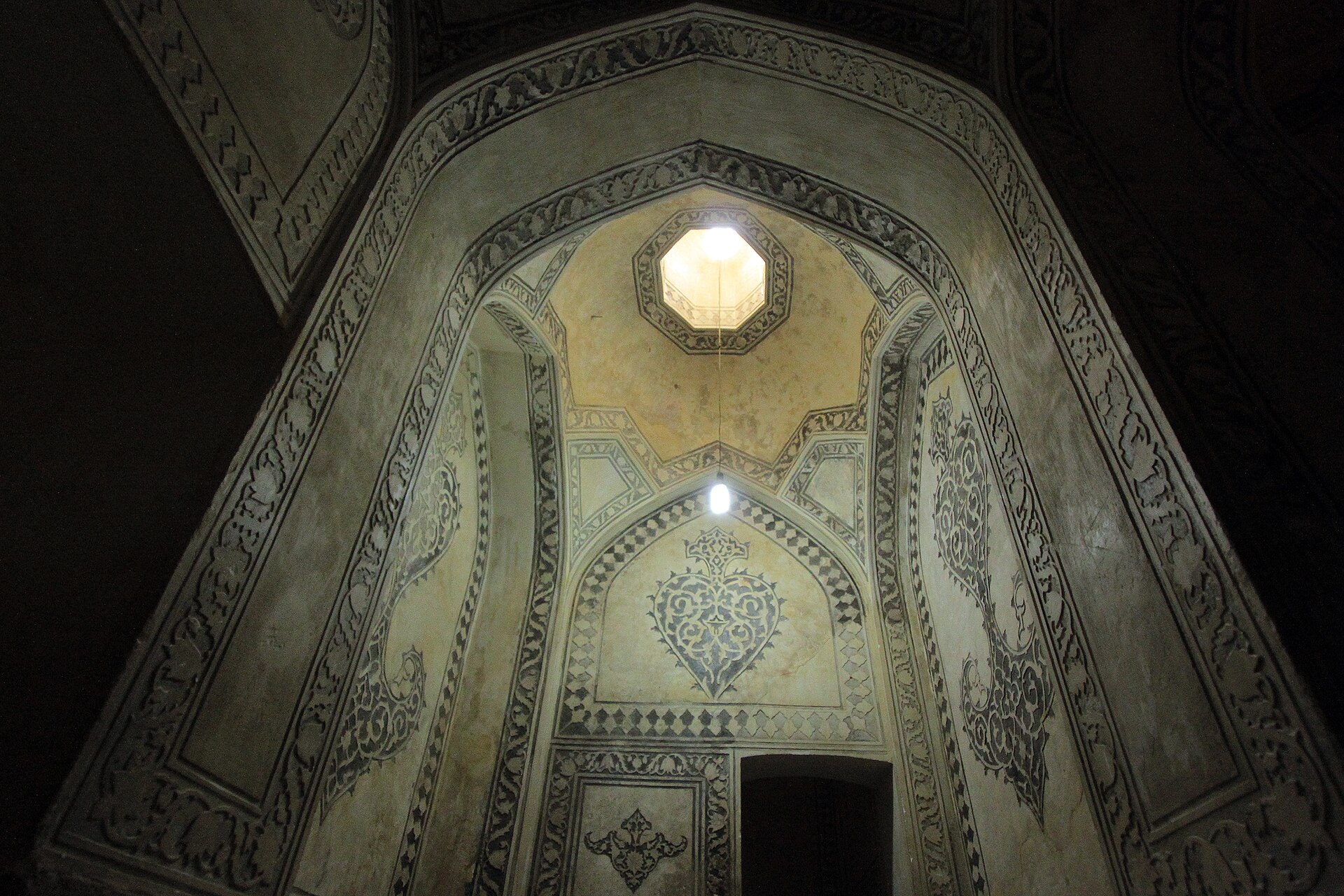
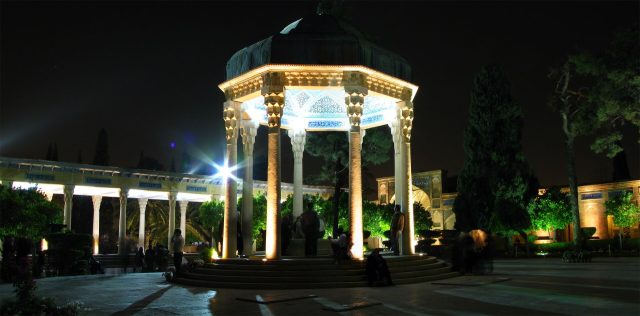
Shiraz carries Persian history in its streets. Arg-e Karim Khan, built in the 18th century, stands in the city’s heart. Its thick mud-brick walls and towering battlements were built for defense, not display. Karim Khan Zand, founder of the Zand dynasty, ruled Persia from here, making Shiraz his capital. This fortress was his home, his stronghold, and his statement—a place where power was exercised, not flaunted.
The fortress reveals contrasts at every turn. Outside, four circular towers rise above the skyline. Their smooth surfaces are interrupted only by narrow arrow slits and patches of weathered brick. The walls, nearly twelve meters high, curve inward at the top, a design that made them harder to scale. Inside, the courtyard feels smaller than expected. A rectangular pool reflects the sky, surrounded by simple arches. The buildings—once living quarters for Karim Khan and his court—have high ceilings and deep verandas, built to combat the summer heat.
Arg-e Karim Khan defies expectations of a Persian fortress. There are no elaborate tilework mosaics or gilded domes. Instead, its beauty lies in its purpose. The towers doubled as granaries, their thick walls insulating against heat and cold. The Divankhaneh, where Karim Khan conducted state affairs, has niches that once held documents and treasures. Even the prison cells in the basement of one tower were designed with a grim efficiency—low ceilings, no natural light.
Karim Khan Zand was an unlikely ruler. He didn’t claim divine right or ancient lineage. He rose through military skill and political cunning, uniting Persia during a fractured era. He chose Shiraz not for its strategic location but for its cultural weight. The city was already a center of poetry, art, and learning. He invited scholars and artists to his court, and under his rule, Shiraz flourished. The fortress was his base, but also his declaration: power could be both strong and enlightened.
After Karim Khan’s death in 1779, the fortress changed. The Zand dynasty faded, and the Qajars moved the capital to Tehran. Arg-e Karim Khan became a governor’s residence, then a prison. For much of the 20th century, its walls held not treasures but prisoners. The cells, once used for political detainees, became symbols of oppression. The fortress fell into disrepair until restoration began in the late 1970s. Today, it’s a museum. The exhibits are sparse, but the building itself tells the story.
The courtyard, now quiet, once buzzed with activity.
The residential quarters, with their high ceilings and cool stone floors, show how Karim Khan lived. The prison cells, with their heavy wooden doors, reveal the darker side of power. This was more than a home or a military base—it was where decisions were made and lives were shaped.
Arg-e Karim Khan feels authentic. Unlike many restored sites in Iran, it hasn’t been polished to perfection. The bricks are worn, the plaster cracked. In places, the original mud-brick construction is visible beneath later repairs. This isn’t a sanitized version of history. It’s raw, unfiltered—a reminder that empires rise and fall, and even the mightiest structures succumb to time.
For visitors, the fortress offers a moment of reflection. The courtyard, with its still pool and shaded verandas, is a place to sit and watch the light change. The towers, once defensive structures, now provide panoramic views of Shiraz. From above, the city unfolds: ancient mosques beside modern apartment blocks, the scent of orange blossoms mixing with motorbike exhaust. Past and present coexist here, uneasily.
Arg-e Karim Khan isn’t Iran’s most famous or visually stunning site. It doesn’t dazzle with gold or overwhelm with scale. Instead, it invites you to look closer. Notice the thoughtfulness in its design, the pragmatism in its construction. The longer you stay, the more you see—the way light slants through arrow slits, the texture of the bricks under your fingers, the faint sound of the city drifting over the walls. In a country rich with history, this fortress feels real.