The Citadel of Acre is one of those rare places where history isn’t just preserved in stone—it lingers in the air, in the weight of the walls, in the echoes of centuries past. Perched on the edge of the Mediterranean, within the labyrinthine streets of Acre’s Old City, this fortress has stood as a silent witness to empires rising and falling, to crusades and conquests, to the ebb and flow of power that shaped the region. What remains today is far more than a ruin; it’s a layered architectural puzzle where medieval fortifications, Ottoman grandeur, and underground passageways intertwine, each telling a fragment of a story that spans over a thousand years.
The origins of the Citadel trace back to the Byzantine era, but its true significance emerged during the Crusades. By the 12th and 13th centuries, Acre had become one of the most vital ports of the Kingdom of Jerusalem, a last bastion of Christian rule in the Holy Land. When Jerusalem fell to Saladin in 1187, Acre became the de facto capital of the Crusader states, and the Citadel transformed into the nerve center of political and military power. Within its walls, rulers held court, merchants stored their goods, hospitals treated the wounded, and coins were minted. The fortress thrived until 1291, when the Mamluks seized the city and reduced much of it to rubble. Yet beneath the destruction, the underground halls and tunnels survived, buried under layers of time, waiting to be rediscovered.
The Citadel as it appears today owes much of its character to the Ottoman period, particularly under the rule of Ahmad Pasha al-Jazzar in the late 18th century. Known for his ruthlessness as much as for his ambitious building projects, al-Jazzar restored the fortress, turning it into an administrative and military hub. The Ottomans reinforced the walls, added new bastions, and infused the structure with their signature architectural elements—graceful arches, domed ceilings, and expansive courtyards. It was during this time that the Citadel became part of the city’s prison system, housing not only common criminals but also political prisoners, including Jewish fighters for independence in the early 20th century.
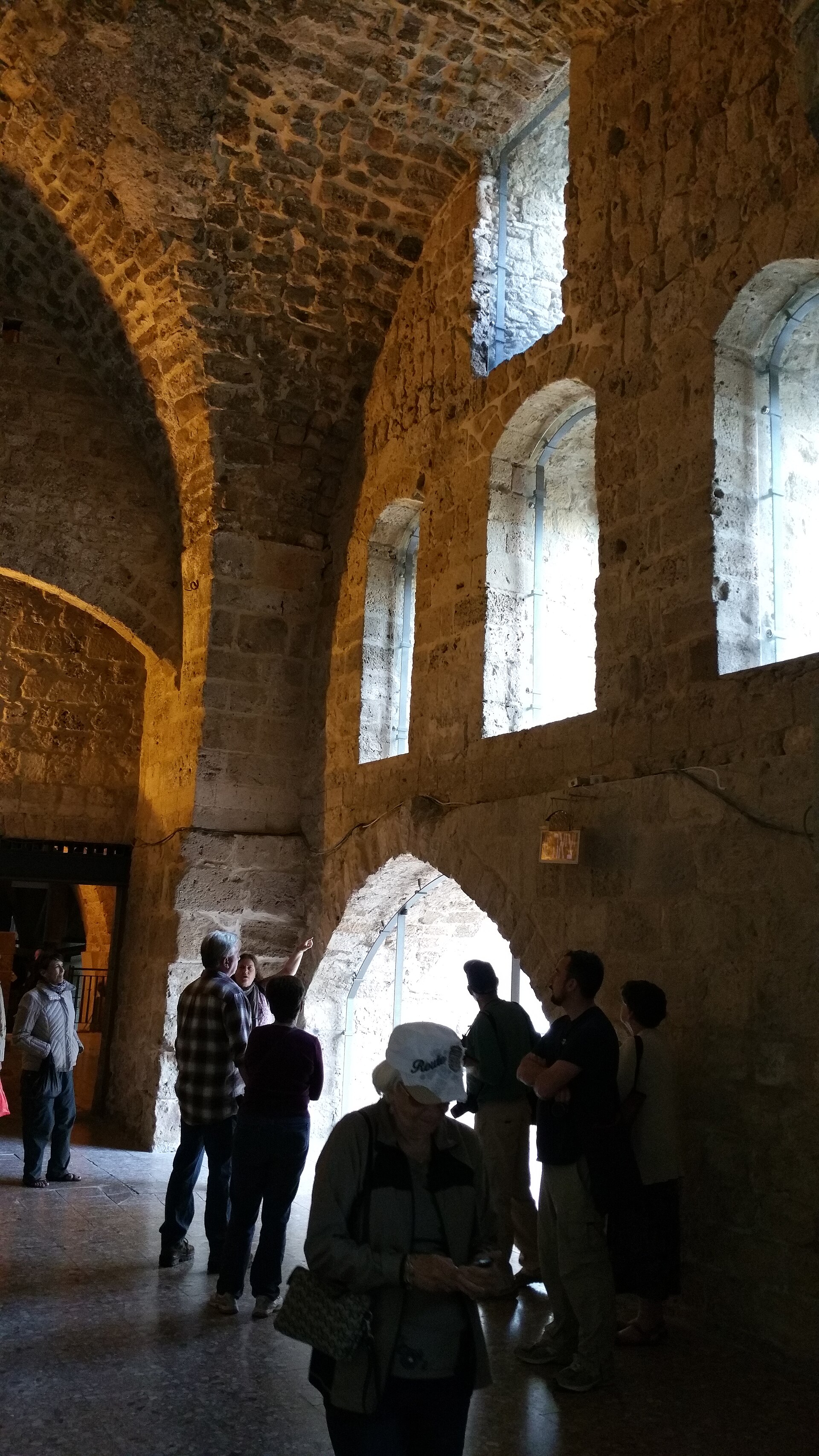
Stepping through the Citadel’s massive gates today feels like entering a time capsule. The central courtyard, once bustling with soldiers and the clatter of arms, is now a quiet space framed by towering walls. From here, visitors can descend into the underground chambers, where the legacy of the Crusaders is most palpable. The vast halls, supported by thick columns and vaulted ceilings, were once used as knightly assembly rooms or storage for supplies. Now, they stand in a kind of suspended animation, their ancient masonry illuminated by the flicker of artificial light. In one of these chambers, the walls bear the marks of 19th- and 20th-century prisoners—names, dates, prayers—scratched into the stone as if to defy oblivion.
One of the most haunting sections of the Citadel is the prison block, where British authorities held members of Jewish underground organizations during the Mandate period. The cells, solitary confinement chambers, and even the gallows in the courtyard are preserved as they were, offering a stark reminder of the struggles that preceded Israel’s independence. There’s no attempt to romanticize this history; the exhibits are straightforward—iron bunks, barred windows, faded documents bearing sentences. In one cell, a Hebrew inscription reads, *If I forget thee, O Jerusalem*, a verse that underscores how deeply personal the fight for statehood was for those imprisoned here.
The architecture of the Citadel is a conversation between eras. The Crusaders built for permanence, using massive limestone blocks and intricate defensive systems designed to withstand sieges. The Ottomans introduced elegance, adorning the walls with intricate carvings and arcades that softened the fortress’s imposing silhouette. The British, in turn, adapted parts of the structure for their own purposes, yet managed to preserve its essence. Climbing to the upper terraces rewards visitors with a sweeping view of Acre’s Old City—the red-tiled roofs, the minarets piercing the skyline, the fishing boats bobbing in the harbor, and the endless expanse of the Mediterranean. From this vantage point, it’s easy to understand why the Citadel was such a strategic prize: it commanded both the land routes and the sea approaches to the city.
For centuries, the Citadel was the heart of Acre, shaping its destiny in ways both grand and grim. During the Crusader period, it was the center of trade, diplomacy, and military might. Under Ottoman rule, it became a place of justice—or at least, the kind of justice meted out by rulers like al-Jazzar. In the British era, it was a site of oppression, where dissent was crushed. Today, it draws those who seek to connect with history not through textbooks, but through atmosphere—the scent of aged stone, the echo of footsteps in the underground halls, the whisper of the wind along the ramparts. There’s no pomp here, just a sense of authenticity that’s increasingly rare in restored castles or sanitized historical sites.
Visiting the Citadel isn’t just a tour; it’s an immersion in the layers of the past. You could spend hours wandering its corridors, trying to imagine the clamor of knights in the great halls, the creak of carts laden with goods, the shouts of guards echoing through the prison wings. Or you could simply sit on one of the benches in the courtyard, gazing out at the sea, and reflect on the countless lives that have passed through these walls. Acre is a city where history isn’t confined to the past—it lives on in the present, and the Citadel is one of the places where that connection feels most tangible. There’s no need for grand narratives here; the stones speak for themselves.