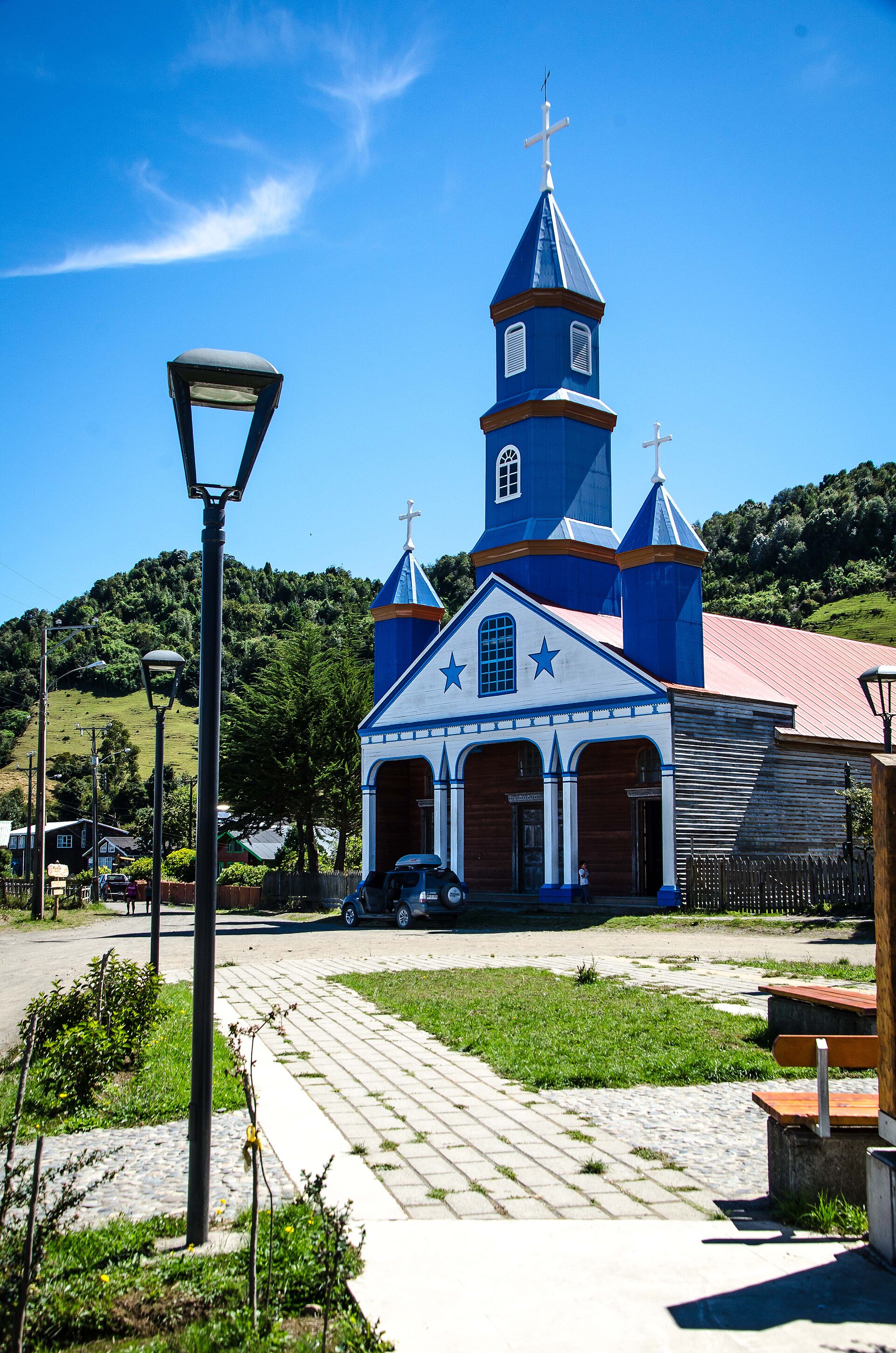
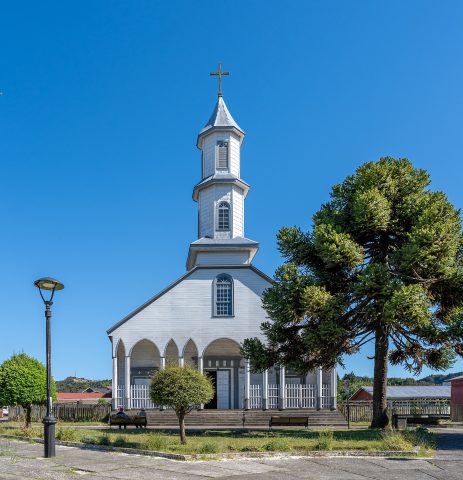
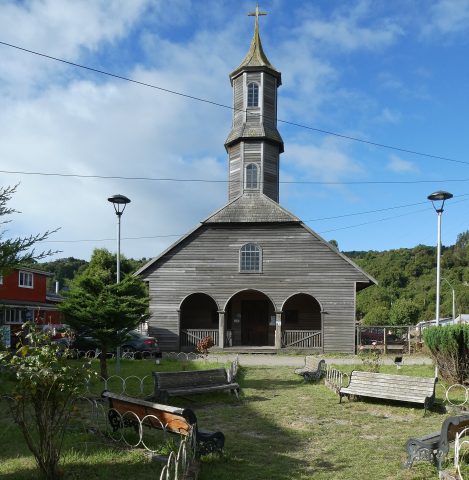
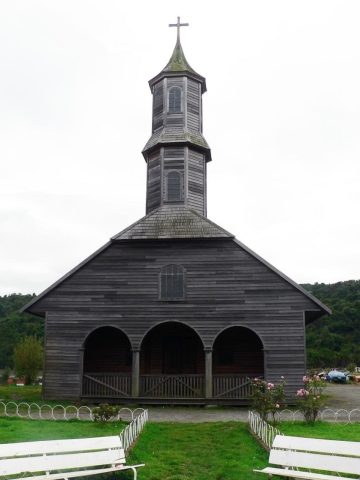
Perched on a gentle rise overlooking the waters of Dalcahue Bay, the wooden church of Tenaún feels like a place where time has quietly settled into stillness. Its whitewashed walls and three-tiered tower, crowned with a steep shingle roof, stand out against the muted greens and blues of Chiloé’s landscape, as if lifted from an old traveler’s sketchbook. Yet beyond its picturesque facade lies a story woven into the island’s history—one of faith, craftsmanship, and the slow rhythm of life in this remote corner of Chile.
Built in the mid-18th century, when Chiloé was still a distant outpost of the Spanish colonial world, the church reflects the island’s unique cultural blend. Here, European Catholic traditions met the customs of the indigenous Huilliche people and the Chilote way of life, shaped by the sea and the forest. Wood was the natural choice for building—stone would have been impractical in the damp climate, where rain falls for days on end. Instead, local craftsmen turned to the island’s native trees: cypress, larch, and alerce, a slow-growing conifer so durable it can last for centuries. The church at Tenaún is a testament to their skill, a structure that has weathered storms and time with quiet resilience.
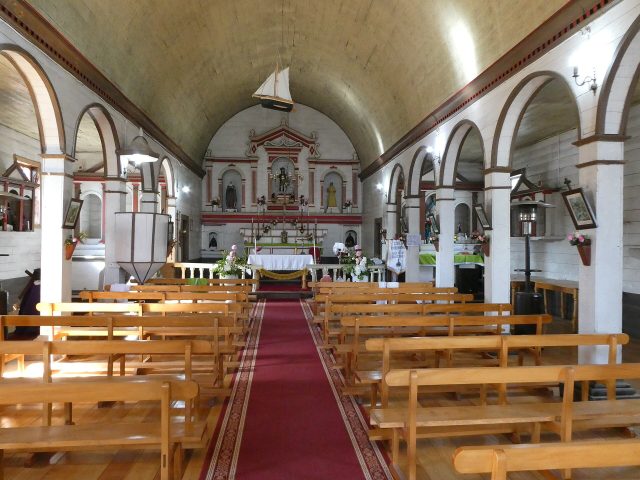
The architecture marries Baroque influences with Chilote ingenuity. The facade’s columns and pilasters, carved from wood with such precision they could be mistaken for stone, echo the grand churches of Europe. Inside, the high vaulted nave and gilded altar follow Spanish traditions, but the execution is distinctly local. The tower, often dismissed as purely decorative, serves a practical purpose—its design helps shield the building from Chiloé’s relentless winds and rain. Even the way the church sits on its hill, slightly elevated, speaks to an understanding of the land and its challenges.
Tenaún’s church is more than a historical monument; it remains a living part of the community. Every January, the Fiesta de los Santos Apóstoles draws pilgrims from across Chiloé, turning the village into a hub of music, food, and shared devotion. For a few days, the church is at the heart of it all—stalls selling local crafts, the scent of traditional dishes like curanto (a seafood stew cooked in an earth pit), and the sound of hymns sung in Spanish and Huilliche. The festival is as much about preserving heritage as it is about faith, a moment when the past feels close enough to touch.
The village itself moves at a pace set by the tides. Brightly painted wooden houses line narrow streets that often end at the water’s edge, where fishing boats bob in the shallows. The church doesn’t dominate the landscape so much as belong to it, its white silhouette mirrored in the bay on clear days. When fog rolls in, as it often does, the building seems to fade into the mist, a ghostly presence hinting at the layers of history beneath its weathered planks. It’s easy to imagine the generations who have walked up the hill to its doors, their lives shaped by the same winds and waters that shape Tenaún today.
Chiloé is famous for its wooden churches, sixteen of which are UNESCO World Heritage sites. But Tenaún’s stands apart, perhaps because of its setting—perched at the village’s edge, as if welcoming those who arrive by sea. Or maybe it’s the way it embodies the spirit of old Chiloé, where people lived in harmony with the land and the sea, and where faith was woven into daily life. There’s no grand spectacle here, no crowds of tourists snapping photos. Instead, the church offers something quieter: a chance to step into a world where time moves differently, where the past isn’t just remembered but still alive.
On a weekday, when the village is at its most peaceful, the church feels even more intimate. The trees around it are old, their branches swaying in the wind off the bay. Nearby, fishermen mend nets or unload their catch, while women sell fresh shellfish and seaweed along the shore. The air carries the salt of the ocean and the faint scent of woodsmoke from chimneys. It’s a scene that hasn’t changed much in centuries, a reminder that some places resist the rush of the modern world.
Unlike many historic sites, Tenaún’s church isn’t roped off or treated as a relic. Its doors are open to anyone who wants to step inside, to sit in the quiet or admire the intricate carvings of the altar. There’s no pressure to hurry, no guided tour urging you to move along. You can climb the hill behind the church and look out over the bay, the islands dotting the water, the forested hills rising in the distance. This is the landscape that shaped the church and the people who built it, a place where the land and the sea dictate the rhythm of life.
What makes Tenaún special isn’t its grandeur or its fame, but its authenticity. It doesn’t try to impress; it simply exists, as it has for centuries. The church, the village, the people—all are part of a continuum, a way of life that has endured despite the changes sweeping the rest of the world. To visit is to glimpse that continuity, to understand that some places aren’t just about what you see, but about what you feel. And in Tenaún, what you feel is the quiet persistence of history, still alive in the creak of wooden planks and the murmur of the tide.