Perched on a gentle rise above the village of Soldeu, the Church of Saint Bartholomew feels like a quiet guardian of Andorra’s mountain past. Its stone walls, weathered by centuries of wind and snow, blend seamlessly into the rugged Pyrenean landscape, as if the building grew from the earth itself rather than being shaped by human hands. From this vantage point, the view stretches across the valley, where jagged peaks frame the horizon and the air carries the crisp scent of pine. The church is unassuming—small, with clean lines and no grand flourishes—but that simplicity is precisely what gives it its character. It doesn’t demand attention; it earns it.
The origins of the church are hazy, lost in the mists of medieval history. The earliest records mention it in the 12th century, though the structure standing today likely dates to the 17th or 18th century, a time when Soldeu was little more than a cluster of homes clinging to the mountainside. Life here was shaped by the rhythms of farming and herding, and the church was more than a place of worship—it was the heart of the community. Villagers gathered within its thick stone walls to mark births, marriages, and deaths, to share news, or simply to escape the winter cold. In a world where survival depended on cooperation, the church was a constant, a place where people could find both solace and solidarity.
Architecturally, the church is a fine example of the Romanesque style that took root in the Pyrenees. Built from local gray stone, its walls have mellowed over time, acquiring a soft, golden hue that catches the light at dawn and dusk. The roof, layered with traditional Andorran tiles, was designed to withstand heavy snowfall, its steep pitch allowing the weight to slide off rather than accumulate. The bell tower is sturdy and square, with narrow openings for the bells—practical choices for a region where mountain winds could easily damage more delicate structures. The entrance is modest, a simple portal that once may have been adorned with faded frescoes or carvings, though little remains of them now.
Inside, the church is a study in restraint. The space is intimate, with a low ceiling supported by rough-hewn wooden beams. The walls are whitewashed, their surfaces broken only by a handful of faded murals. One depicts Saint Bartholomew, the church’s patron, while another shows scenes from the life of Christ, rendered in a naive style that speaks more to devotion than artistic skill. These were not works of master painters but of local craftsmen, men who painted what they knew, using simple techniques to convey stories of faith to their neighbors. The altar is plain, a wooden table holding a few aged icons, among them a striking image of the Virgin Mary with the infant Jesus, one of the few surviving relics from the church’s earlier days.
Near the entrance stands a wooden crucifix, its lines rough but expressive. Local lore claims it was carved in the 18th century by a villager, and a story persists that during a particularly brutal winter, when avalanches threatened to bury Soldeu, the crucifix was brought into the church and the community prayed before it through the night. By morning, the avalanche had diverted, sparing the village. Whether true or not, the tale captures the church’s role in the lives of those who lived here—not just as a place of worship, but as a symbol of protection and resilience. In a landscape where nature could be both provider and destroyer, such stories were more than superstition; they were a way of making sense of the world.
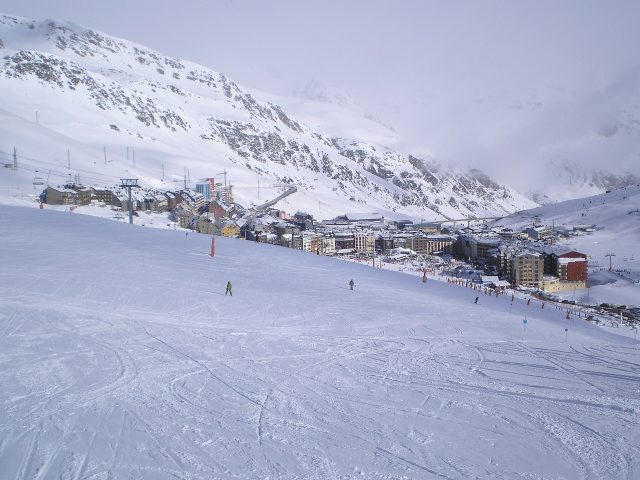
Today, the Church of Saint Bartholomew remains an active place of worship, though services are less frequent than they once were. Soldeu has transformed from a quiet mountain hamlet into a bustling ski resort, drawing visitors from across Europe to its slopes. Yet the church endures, a quiet counterpoint to the lively energy of the modern village. Those who step inside often remark on the stillness, a sense of stepping back in time. The thick stone walls muffle the sounds of the outside world, and the air carries the faint scent of old wood and wax. In summer, wildflowers bloom around the church, their colors vivid against the gray stone; in winter, snow blankets the roof, softening its edges and making it seem almost part of the mountain itself.
The church is more than just a historical monument—it’s a living piece of Andorra’s past. It speaks of a time when life in these mountains was hard but not without its joys, when faith was a daily companion and community was a necessity. While Soldeu has embraced the modern world, the church stands as a reminder of what came before. There are no crowds here, no guided tours rushing through—just the quiet, the mountains, and the weight of centuries. It’s a place to pause, to breathe, and to remember that some things, like the land itself, endure.