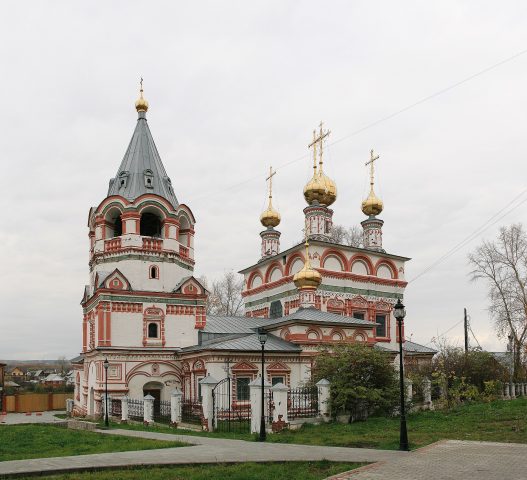
Perched on a gentle rise overlooking the quiet streets of Solikamsk, the Church of All Saints feels like a place where time has quietly settled. Built in the late 18th century, it stands among the low wooden houses that have long defined this corner of the Urals, its white walls and modest bell tower blending seamlessly into the landscape. There’s nothing grand about its appearance—just a sense of quiet permanence, as if every stone was laid with care. The traditional Russian dome and unassuming facade give it an air of understated dignity, the kind that lingers in the memory long after you’ve left.
Solikamsk itself is one of the oldest towns in the Urals, founded in the early 15th century as a center for salt production. For centuries, salt was the lifeblood of the region, bringing wealth and trade that shaped the town’s character. By the time the Church of All Saints was built, Solikamsk had already seen its golden age, but it remained an important hub, its streets lined with merchants’ houses and warehouses. Churches like this one weren’t just places of worship—they were symbols of a community’s prosperity, built to endure. That sense of solidity is still palpable in the thick walls and sturdy construction, a reminder of a time when buildings were meant to last.
The church’s architecture reflects the late Baroque style that spread across Russia in the 18th century. The smooth curves of the facade, the symmetrical windows, and the delicate decorative details all hint at the elegance of the period, even if the overall effect is restrained. Inside, the space feels surprisingly open, with high ceilings and light-colored walls that make the modest interior feel larger than it is. The iconostasis, though no longer in its original state, still carries echoes of the past, its faded icons and worn wood telling stories of the people who once gathered here.
Solikamsk has always been a town of mingling cultures. Russians, merchants from distant lands, and workers drawn by the salt trade all passed through its streets, leaving their mark on the town’s identity. The Church of All Saints, like many of Solikamsk’s religious buildings, was a place where these different threads came together. In the Soviet era, when many churches were destroyed or repurposed, this one survived—barely. It served as a warehouse, then a workshop, its original purpose nearly forgotten. Yet the building endured, its bones intact, waiting for the day it could be restored.
Today, the church is once again a place of worship and quiet reflection. The scent of beeswax and aged wood fills the air, and the only sounds are the occasional creak of floorboards or the rustle of a prayer book’s pages. There are no crowds here, no hurried tourists snapping photos—just the stillness of a space that has seen centuries pass. You can stand for a long time in front of the darkened icons, tracing the lines of faces worn smooth by time, or simply sit on one of the wooden benches, listening to the wind in the trees outside. It’s the kind of place where the hours seem to stretch, where the weight of history settles gently on your shoulders.
The Church of All Saints is more than just an architectural landmark. It’s a living piece of Solikamsk’s past, a witness to the town’s rise and fall. When the salt trade declined, so did the town’s fortunes, but the church remained, a quiet constant in a changing world. It speaks of the people who built it, the generations who prayed within its walls, and the traditions that have endured even as the world outside moved on. Today, as Solikamsk finds its place in the modern era, the church still stands, a bridge between what was and what is.
For visitors, the church offers something unexpected. Most who come to Solikamsk are drawn to its famous salt museums or the historic brine wells, but this small, unassuming building often goes unnoticed. And yet, it’s here that you can feel the true spirit of the Urals—not in grand monuments, but in the quiet resilience of a place that has weathered time. There’s no opulence, no fanfare, just the quiet authenticity of a building that has seen history unfold around it. In a world that often values the new and the flashy, the Church of All Saints reminds us of the beauty in things that endure.