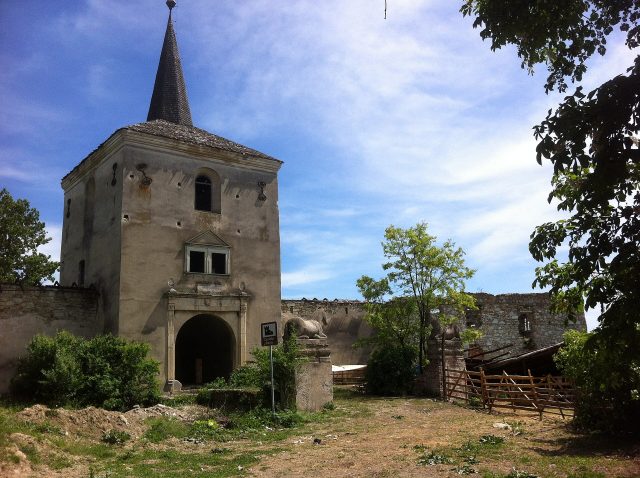
The Church of the Ascension in Unguraș is the kind of place that doesn’t announce itself to travelers. It stands quietly on the edge of a small Transylvanian village, where life moves at a slower pace than in Romania’s more famous destinations. The surrounding hills are dotted with vineyards and orchards, and the church itself seems to have grown from the earth, blending seamlessly into the unhurried landscape. There’s no grand architecture here, no soaring spires or ornate facades—just a simple, unassuming building that carries its own quiet charm.
The history of the church is woven into the story of Unguraș itself, a village that has long been shaped by the rhythms of rural life and the traditions of its people. While the exact date of its construction remains unclear, records suggest it was built sometime in the 18th century, when Transylvania was part of the Austro-Hungarian Empire. This was a time when Orthodox Romanian traditions intersected with Catholic influences from the west, and the church reflects that cultural blend. Though it was built as an Orthodox place of worship, its design shows traces of later styles—subtle hints of Baroque and neoclassical elements that local craftsmen adopted over time.
The building is made of stone and brick, its walls unadorned by elaborate decoration. The main entrance is framed by a modest portal, above which rises a small bell tower with a steep, shingled roof. Inside, the space is equally understated: an iconostasis painted by local artists, walls covered in faded frescoes depicting biblical scenes, and wooden pews darkened by age. There’s a sense of lived-in history here, not the kind preserved behind glass in museums, but something that still breathes alongside the people who visit it.
One of the church’s most revered treasures is its icon of the Ascension, believed to be miraculous. According to local tradition, it was brought here in the 19th century from a monastery in Moldavia and has since become a focal point of devotion. Every year on Ascension Day, pilgrims from nearby villages gather to pray for health and prosperity. At other times, the church isn’t always open, but if you’re lucky enough to find it unlocked, the soft light filtering through narrow windows casts a gentle glow over the old icons, creating a sense of peace.
Unguraș isn’t a place people visit for grand attractions. There are no crowds, no souvenir stalls, no cafes with multilingual menus. That’s precisely why the Church of the Ascension feels less like a tourist site and more like a living piece of history. It serves as a reminder that beauty often lies in the overlooked corners of the world, where life unfolds at its own pace, shaped by faith and the land.
If you pass through in late spring or early summer, the village comes alive in a way that makes the church feel even more welcoming. Orchards bloom, birds sing, and the air is filled with the scent of fresh greenery. In moments like these, the church seems to invite you inside—not to rush or take photos, but simply to stand in silence and listen to the quiet. There’s no need to do anything but be present, and in that stillness, even a humble rural church takes on a deeper meaning.
Unlike many of Transylvania’s older churches, which have undergone extensive restoration, the Church of the Ascension retains its original character. Whether due to limited funds or the care of locals who value what they’ve inherited, it remains untouched by modern renovations. That makes it all the more precious—a piece of the past that doesn’t need gilding to tell its story.
For travelers who venture beyond Romania’s well-trodden paths, Unguraș and its church can be an unexpected discovery. There are no tourist routes here, just the quiet authenticity of a place where life hasn’t changed all that much over the centuries. The church stands as a testament to a way of living that values faith, tradition, and the land—not as something to be displayed, but as something that simply is. If you find yourself in this part of Transylvania, it’s worth taking a detour to Unguraș, even for just an hour, to experience the real heart of the region.