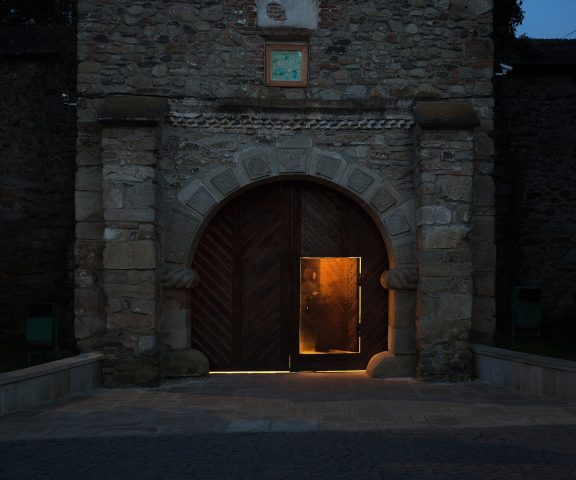
The Church of the Beheading of St. John the Baptist in Arbore is one of those rare places in Romania where time seems to stand still. Tucked away in the quiet village of Cajvana, deep in the heart of Bukovina, it sits surrounded by rolling hills and dense forests. There are no crowds here, no guided tours chattering in multiple languages, no souvenir stalls—just the quiet rustle of leaves and the occasional murmur of villagers going about their day. The church itself is small, but its significance to Romanian culture and history is immense.
Built in the early 16th century, it belongs to the famous group of painted churches of Bukovina, now recognized as a UNESCO World Heritage site. Yet Arbore stands apart from the others, not just for its frescoes but for its story. Commissioned by the Arbore family, one of the most powerful boyar dynasties of the Moldavian Principality, the church was constructed near the family’s estate. Luca Arbore, a counselor to the prince and a military leader entangled in the political intrigues of his time, chose this spot deliberately. Today, little remains of the boyar’s manor, but the church endures as a quiet testament to the family’s once-great influence.
The architecture is simple and unadorned, typical of Moldavian churches of the period. A modest rectangular structure with a tall bell tower and narrow windows, it blends seamlessly into the landscape. Inside, the space is divided into three traditional sections: the narthex, the nave, and the altar. But the true treasure of Arbore lies not in its stone and mortar, but in its colors. The frescoes, painted in 1541, still astonish with their vividness and preservation, covering both the exterior and interior walls.
The outdoor murals were meant to serve as a Bible for the illiterate, a visual narrative of faith for those who could not read. On the western wall, the Last Judgment unfolds in dramatic detail, with the righteous and the damned facing their fate before Christ. The southern wall depicts the Tree of Jesse, tracing the lineage of Jesus, while the northern wall is filled with scenes from the lives of saints. One of the most striking images is that of Luca Arbore and his family, shown in prayer—a rare secular portrait in religious art of the time, offering a glimpse into the personal devotion of the church’s patrons.
Inside, the frescoes focus on the life of St. John the Baptist, to whom the church is dedicated. The most powerful scene is the Beheading itself, where the executioner raises his sword over the bound prophet while Salome watches with unsettling curiosity. The palette is soft, dominated by ochres, greens, and blues, creating a sense of calm that contrasts with the often violent subject matter. The artists who painted these walls likely belonged to a local school of iconography, blending Byzantine traditions with subtle Western European influences.
For much of its history, the church in Arbore was an active parish, not a tourist attraction. It was only in the 20th century that it was recognized as a monument of historical and cultural importance. Today, it draws those who seek out the authentic art of the Renaissance, untouched by later restorations. Unlike some of the more famous painted churches in Bukovina, Arbore remains relatively untouched by mass tourism. There are no gift shops or visitor centers here—just the church, the quiet village, and the chance to linger over the frescoes without hurry.
Cajvana and its surroundings offer a glimpse into traditional rural life in Romania. Old wooden houses with carved shutters still line the streets, and villagers tend to their fields and livestock much as they have for centuries. The forests around the village are rich with mushrooms and berries, and sheep graze on the hillsides. If you’re lucky, you might stumble upon a local festival or market, where homemade cheese, honey, and embroidered linens are sold. The church in Arbore isn’t just an open-air museum—it’s part of a living culture that persists despite the passage of time.
Getting here requires some effort. The nearest major city, Suceava, is about an hour’s drive away along winding mountain roads. Public transport is infrequent, so a car is the most practical option. There are no hotels in the village, but some families offer simple bed-and-breakfast accommodations. The locals are welcoming but unobtrusive, accustomed to the occasional visitor but not eager to turn the church into a tourist spectacle.
What makes Arbore special is its unassuming nature. It doesn’t impress with grandeur or opulence, but that’s precisely where its charm lies. Here, you can feel the weight of history, see how art and faith intertwined in the lives of people centuries ago, and understand why these frescoes have been so carefully preserved. For those who seek more than just a checkbox on a travel itinerary, Arbore is one of Romania’s most rewarding discoveries.