Great St Mary’s stands at the very heart of Cambridge, where the city’s medieval streets converge and the weight of history lingers in the air. It is not just a parish church, though it serves as one today; it is a place where the life of the university and the life of the town have intertwined for centuries. From its tower, the view stretches over the rooftops of the colleges, the curve of the River Cam, and the quiet fields beyond—an outlook that has remained largely unchanged since the days when scholars first gathered beneath its spire.
The building we see now dates to the early sixteenth century, though records of a church on this site go back to the twelfth. The original structure was lost to fire, and what rose in its place became one of the finest examples of late Perpendicular Gothic in the region. The exterior is all soaring lines and intricate stonework—tall, narrow windows, buttresses that seem to defy gravity, and a spire that has become as much a symbol of Cambridge as the colleges themselves. Inside, the effect is one of lightness, despite the scale. The nave’s slender columns and delicate fan vaulting draw the eye upward, while the play of sunlight through the glass softens the stone’s severity.
Over the centuries, Great St Mary’s has played a central role in the university’s rituals. Until the mid-eighteenth century, degree ceremonies were held here, and the church’s pulpit was a stage for both sermons and scholarly debate. It was here, in 1521, that Thomas Cranmer—later Archbishop of Canterbury—first voiced support for Henry VIII’s break with Rome, a moment that would ripple through English history. During the Reformation, the church became a stronghold of Protestant thought, its clergy often caught in the crosscurrents of religious change. Even now, the connection to academia is palpable. The wooden pews, worn smooth by generations of students, still bear the marks of those who sat through long services, and in one of the side chapels, a plaque commemorates William Harvey, the physician who discovered the circulation of blood.
The interior is a quiet record of the past. Nineteenth-century stained glass fills the east window, but older fragments remain—a medieval piscina here, a carved misericord there. The organ, with its rich, resonant tones, still sounds during services, and the brass lectern, polished by centuries of use, gleams under the soft light. In the crypt, the foundations of the earlier church are visible, a reminder that this ground has been sacred for far longer than the current building has stood. The vestry holds a collection of old books and vestments, their pages and fabrics bearing the patina of age.
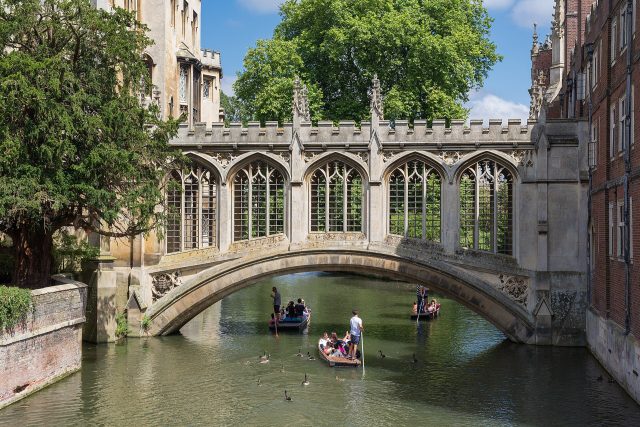
One of the church’s most enduring traditions is the ascent of its tower. The climb is steep, a spiral of narrow stone steps that winds upward through dimly lit chambers, but the reward is worth the effort. From the top, Cambridge unfolds in all directions—the honey-colored stone of King’s College Chapel, the green courts of Trinity, the slow glide of punts along the Cam. On a clear day, the view stretches to the flatlands beyond the city, where the same fields that once supplied wool to medieval merchants now lie quiet under the sky. It is a perspective that few visitors get to see, and one that makes the city feel both vast and intimate.
Unlike many of Cambridge’s medieval buildings, Great St Mary’s has escaped the heavy-handed restorations of the Victorian era. While other churches were stripped of their original character in favor of fashionable Gothic revivalism, this one retained its Tudor essence. The result is a space that feels authentic, where the passage of time is visible in the uneven floors, the patched stonework, and the faint graffiti left by long-ago students. There is no sense of a museum here; the church is still very much alive. On Sundays, the sound of hymns fills the nave, while on weekdays, tourists and locals wander in and out, pausing to light a candle or simply to sit in the quiet.
The church’s dual identity—as both a place of worship and a university landmark—is what makes it unique. It has witnessed coronations and controversies, academic triumphs and personal sorrows. During the English Civil War, its bells were melted down for cannon, and in the nineteenth century, it narrowly avoided demolition when a railway line was proposed to cut through the city center. Yet through it all, it has remained a constant presence, a place where the sacred and the scholarly coexist.
For those who take the time to look, Great St Mary’s offers more than just grand architecture. The small details tell their own stories—the initials carved into a pew, the worn step where generations have knelt, the faint echoes of footsteps in the empty nave. The church is a palimpsest of lives lived, a place where the past is not just remembered but still felt. And perhaps that is why it endures. It is not a monument to be admired from a distance, but a living part of Cambridge, as much a part of the city’s rhythm as the chime of its bells or the rustle of gowns in the street outside.