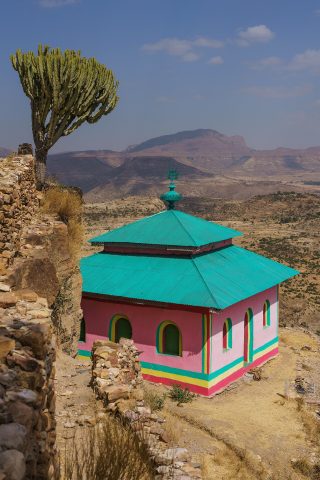
The Church of St. Mary of Zion in Aksum stands as one of Ethiopia’s most revered spiritual landmarks, a place where faith and history intertwine with quiet intensity. Nestled in the ancient city that once served as the heart of the Aksumite Empire, this church is believed to safeguard one of Christianity’s most sacred relics—the Ark of the Covenant. According to tradition, the Ark was brought here from Jerusalem in the 4th century, carrying the stone tablets of the Ten Commandments, and has remained under the watchful care of a single guardian monk ever since. This enduring mystery has shaped the church’s identity, drawing pilgrims not only from across Ethiopia but from around the world, all seeking a connection to something far older than themselves.
The church’s architecture tells a story of resilience and evolution. The first structure was built in the 4th century under King Ezana, who converted to Christianity and declared it the state religion. Little remains of that original building, as the church has been destroyed and rebuilt multiple times over the centuries. The current structure, completed in the 20th century, blends traditional Ethiopian design with Byzantine and even European influences. Its domes, crowned with the distinctive Ethiopian cross, rise above the city, while the interior walls are adorned with frescoes depicting scenes from the life of Christ and the saints. The design reflects both the endurance of faith and the cultural exchanges that have shaped Ethiopia’s religious heritage.
Inside, the church feels both humble and profound. The space is divided into several chambers where pilgrims gather in prayer, but the true heart of the church—the Ark of the Covenant—remains hidden from public view. Only one monk, chosen as its guardian, is permitted to approach the sacred relic, a tradition upheld for over fifteen hundred years. For visitors, the experience is less about seeing and more about feeling the weight of history and belief. The air hums with quiet devotion, and even those who come as observers often find themselves moved by the sense of something greater at work.
Aksum and the Church of St. Mary of Zion are inseparable from the history of the Ethiopian Orthodox Tewahedo Church, one of the oldest Christian denominations in the world. Unlike other branches of Christianity, the Ethiopian Church has preserved traditions that date back to the earliest centuries of the faith. Services are still conducted in Ge’ez, an ancient language long fallen out of everyday use but retained as the sacred tongue of liturgy. Festivals like Timkat, the Ethiopian Epiphany, transform the church into a vibrant center of celebration, with processions, chanting, and ritual dances passed down through generations. These moments offer a glimpse into a living tradition that has remained largely unchanged for centuries.
The surroundings of the church are steeped in history. Just a short walk away lie the ruins of ancient Aksum, once the capital of a powerful empire that dominated trade routes between Africa and Arabia. Towering obelisks, carved from single slabs of stone, stand as silent witnesses to the city’s former grandeur, alongside royal tombs and the remnants of palatial complexes. These monuments serve as a reminder of a time when Ethiopia was a major force in the ancient world, with the Church of St. Mary of Zion already playing a central role in its spiritual life.
Visiting the church is less about ticking off a tourist attraction and more about stepping into a living tradition. Pilgrims arrive from all corners of Ethiopia and beyond, each bringing their own hopes and reasons for coming. Some seek solace in prayer, others are drawn by the chance to witness a history that spans millennia. The area around the church is always alive with activity—people sitting on the steps in quiet reflection, monks engaged in conversation, and visitors simply absorbing the atmosphere. There’s a sense of continuity here, as if the past and present exist side by side without conflict.
Aksum itself feels like a place where time moves differently. Despite its ancient roots, the city carries on with a quiet rhythm, where modern life and tradition coexist. The streets are filled with women in vibrant traditional dress, men leading donkeys laden with goods, and children playing near weathered stone houses. Coffee, Ethiopia’s gift to the world, is served with reverence in cafes and markets, its aroma mingling with the scent of incense and earth. As evening falls, the sound of church bells drifts across the hills, a gentle reminder that this is a place where time follows its own unhurried pace.
The Church of St. Mary of Zion is more than just a historical monument; it is a testament to a faith that has endured through wars, the rise and fall of empires, and centuries of change. It remains a place where history and the present exist in harmony, where every stone seems to hold a memory, and every visitor becomes part of an unbroken thread of devotion. To come here is to step beyond the usual tourist experience and into something deeper—a chance to understand why, for so many, this place has remained sacred for over a thousand years. Whether you arrive as a pilgrim or a traveler, the church offers a quiet invitation to reflect on what it means to be part of something far larger than oneself.