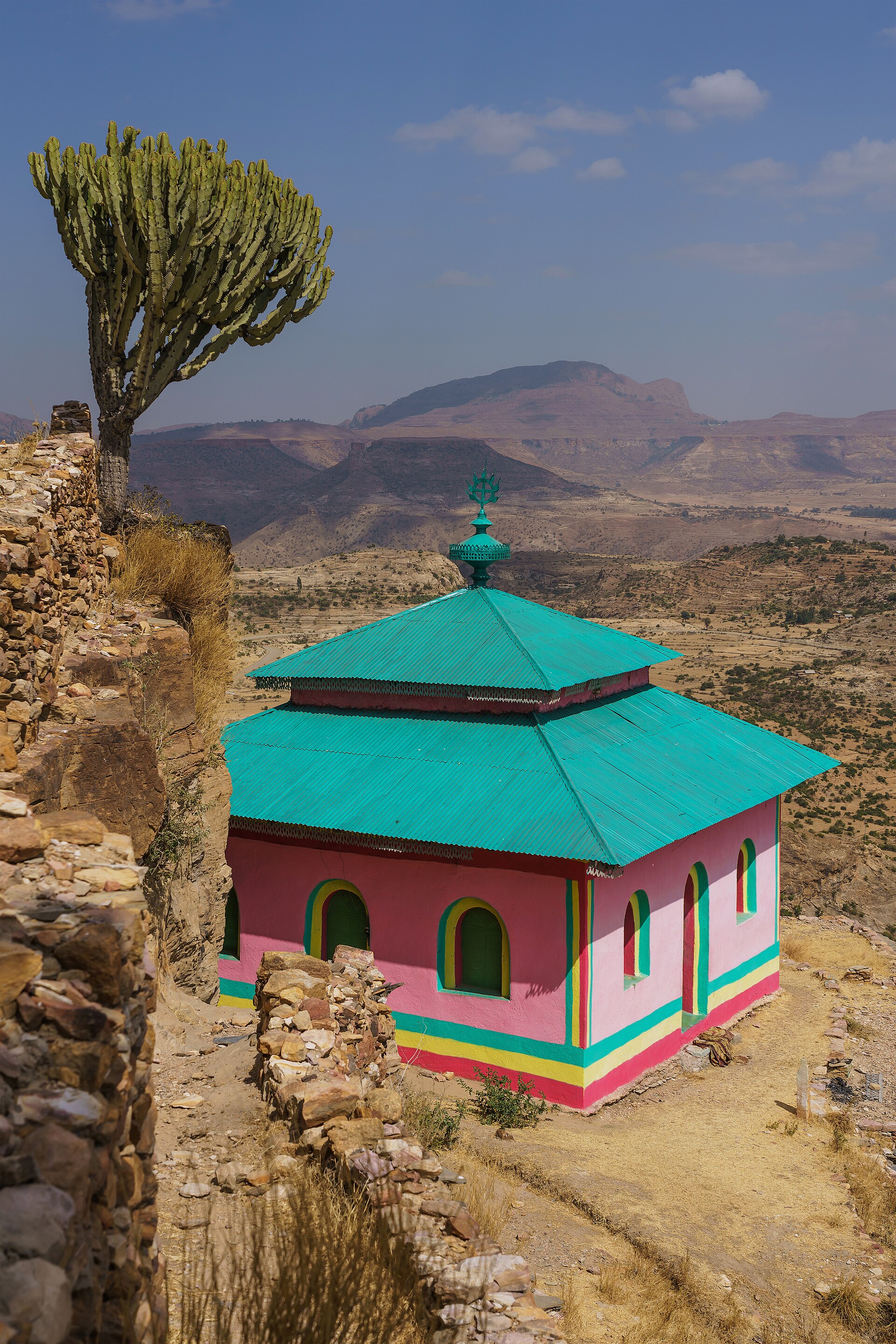
Debre Damo is one of those places in Ethiopia where the journey itself feels as meaningful as the destination. Perched atop a flat-topped mountain rising nearly six hundred meters above the surrounding landscape, the monastery can only be reached by climbing a sheer cliff using a rope lowered by the monks. The ascent isn’t for the faint-hearted, but this isolation has preserved the site’s singular character for centuries. The mountain’s natural defenses shielded the monastery from raids, while its remoteness helped safeguard ancient manuscripts and relics, many of which remain off-limits to outsiders.
The history of Debre Damo stretches back to the sixth century, when, according to tradition, the Syrian monk Abuna Aregawi—one of the Nine Saints credited with bringing Christianity to Ethiopia—arrived here. Legend claims he was lifted to the summit by a serpent, though a more grounded explanation ties the monastery’s founding to the need for an impregnable spiritual refuge. The church we see today dates to the eleventh century, though it has been rebuilt and restored over time. It stands as one of the oldest surviving religious structures in the country, a rare example of early Ethiopian Christian architecture.
From the outside, the church appears unassuming, its rough stone and timber construction blending seamlessly with the rocky plateau. Yet there’s a quiet harmony to its simplicity, as if the building grew naturally from the mountain itself. Inside, the atmosphere is one of hushed reverence—dim light filters through small windows, the scent of incense and aged wood lingers in the air. The altar is adorned with traditional Ethiopian crosses, and the walls bear inscriptions in Ge’ez, the ancient liturgical language that has long since faded from everyday use. The monks guard a collection of medieval manuscripts, though access to them is tightly controlled.
Debre Damo isn’t just a church; it’s a living monastery where time moves to its own rhythm. There’s no electricity, running water, or modern comforts—life here unfolds much as it has for centuries. The monks farm the land, pray, transcribe sacred texts, and occasionally welcome pilgrims. Women are strictly forbidden from entering, a rule that remains unbroken even today. For men, a visit is more than a religious experience; it’s a glimpse into a way of life untouched by the passage of time.
The landscape around Debre Damo is as striking as the monastery itself. The plateau is dotted with sparse vegetation, and from its heights, the view stretches across valleys and distant mountains. Below, small villages cling to the slopes, their inhabitants leading lives that have changed little over generations. Farmers cultivate teff and coffee, and in the evenings, families gather around fires to share stories. The path to the monastery winds through these settlements, where you might see shepherds guiding their flocks or women carrying clay jars of water on their backs. It’s a world where modernity has barely left its mark.
For Ethiopia, Debre Damo holds profound significance. It’s not merely an architectural relic but a living testament to a spiritual tradition that has endured wars, the rise and fall of empires, and colonial incursions. The monastery was once a center of Ethiopian Orthodoxy, home not only to religious texts but also to historical chronicles that shaped the nation’s identity. Even now, as the country evolves, Debre Damo remains a place where time moves differently, a reminder that some things resist change.
Visiting the monastery isn’t like a typical tourist stop. There are no guides, informational plaques, or souvenir stalls—just the chance to step into something authentic and nearly forgotten. The climb up the rope, a brief exchange with a monk who might speak a few words of English or offer a quiet smile, the silence broken only by the wind rustling through the rocks—all of it leaves the sense that you’ve touched a place where history still breathes. While many travelers flock to Ethiopia’s more famous landmarks, it’s these quiet corners, like Debre Damo, that make the journey truly unforgettable.