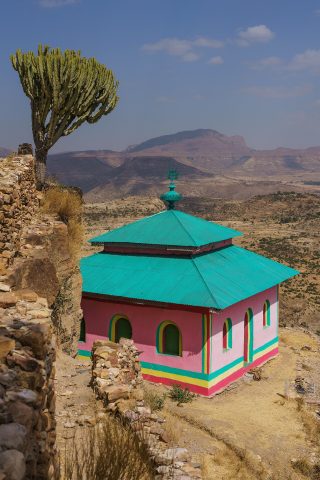
Perched high in the rugged mountains of northern Ethiopia’s Tigray region, Abuna Yemata Guh is more than just a monastery—it’s a place where faith, history, and the raw beauty of nature converge. To reach it, visitors must navigate a steep, vertiginous climb up a sheer cliff face, a journey that tests both body and resolve. Yet those who make the ascent are rewarded with something rare: a glimpse into a world where time moves differently, where devotion has shaped the landscape itself, and where the past feels alive in every stone and fresco.
The monastery’s origins trace back to the 5th century, when it was founded by Abuna Yemata, one of the Nine Saints who brought Christianity to Ethiopia. According to tradition, he sought this remote perch for solitude and prayer, and over time, a community of monks grew around his hermitage. Today, the site remains a vital spiritual center for the Ethiopian Orthodox Church, its cave chapel preserving some of the country’s oldest religious art. The walls are adorned with vivid frescoes depicting biblical scenes and saints, painted in the distinctive style of medieval Ethiopia. While many date to the 14th or 15th centuries, some scholars suggest parts of the artwork could be even older, their faded colors and bold lines offering a direct connection to the hands of long-gone artists.
What makes Abuna Yemata Guh remarkable is how seamlessly it blends with its surroundings. The cave that houses the monastery wasn’t carved by human hands—it formed naturally, and the monks simply adapted it to their needs. Inside, the space is spare but purposeful: a simple altar, wooden benches for worshippers, and small niches where ancient manuscripts and sacred objects are kept. The frescoes, though worn by time, still tell their stories—of Christ’s life, the Virgin Mary, and the Nine Saints who left their mark on this land. One of the most striking images shows the saints themselves, a reminder of the monastery’s deep roots in Ethiopia’s Christian heritage.
The climb to the monastery is an experience in itself, a physical and almost ritualistic challenge. The path winds up the cliffside, narrow and uneven, with sections so steep they demand hands as well as feet. In places, visitors must rely on ropes or the guiding hands of locals, who know every foothold and crevice. The effort, though, is part of the draw. With each step, the view expands—rolling valleys, jagged peaks, and the vast Ethiopian highlands stretching into the distance. The air grows cooler, thinner, and the silence deepens, broken only by the wind or the occasional call of a bird. For many, the journey becomes as meaningful as the destination, a quiet meditation on endurance and faith.
Abuna Yemata Guh isn’t a relic of the past; it’s a living place of worship. Monks still reside here, maintaining the rhythms of prayer and tradition that have endured for centuries. Visitors might arrive to the sound of liturgical chants in Ge’ez, the ancient language of Ethiopian Christianity, or find a monk quietly tending to the altar. The atmosphere is one of reverence, a sense of stepping into a space untouched by the rush of the modern world. Even those who don’t share the faith often feel the weight of history here, the quiet power of a place where generations have come to seek something greater than themselves.
Beyond its spiritual role, the monastery is a guardian of Tigray’s cultural heritage. The cave holds ancient manuscripts written on parchment, their pages filled with religious texts, historical accounts, and theological debates. Some chronicle Ethiopia’s past, while others delve into matters of doctrine, offering scholars invaluable insights into the country’s intellectual and religious evolution. These documents, fragile and irreplaceable, are a testament to the monastery’s enduring significance—not just as a place of worship, but as a repository of knowledge.
Despite its isolation, Abuna Yemata Guh draws travelers from far beyond Ethiopia’s borders. Some come as pilgrims, others as curious explorers, but all leave with a sense of having touched something extraordinary. There are no grand facades here, no modern comforts—just the raw, unfiltered presence of history. The monastery doesn’t try to impress; it simply endures, as it has for over a thousand years. That, in the end, is its greatest allure.
Time moves slowly at Abuna Yemata Guh. There are no clocks, no schedules, just the steady rhythm of the day unfolding under the vast African sky. The only sounds are the whisper of the wind, the distant murmur of voices, and the occasional rustle of a monk’s robes. For those who make the journey, it’s a chance to step outside of time, to sit in the quiet and listen to the echoes of centuries. The monastery doesn’t ask for attention—it doesn’t need to. It has stood here long before visitors arrived, and it will remain long after they’ve gone. That quiet persistence is what makes it unforgettable.