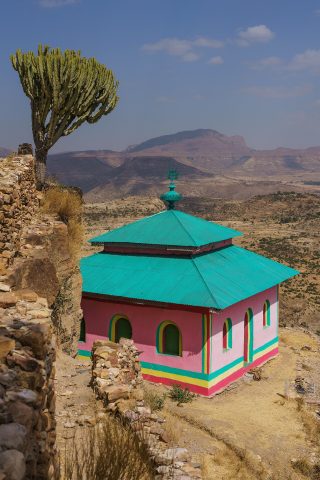
Perched on a rocky plateau in northern Ethiopia, far from the hum of modern roads and settlements, the monastery of Yeha feels like a natural extension of the landscape itself. The rough-hewn stone walls blend into the sun-scorched hills, where every rise and ridge seems to whisper of ancient civilizations. Here, in the quiet outskirts of the small town of Wuqro, time moves differently—unhurried, deliberate, as if governed by the rhythm of prayers that have echoed beneath its vaults for nearly fifteen hundred years.
Yeha’s architecture doesn’t overwhelm with grandeur like the pyramids of Egypt or the cathedrals of Rome, but there’s a quiet strength in its simplicity. The monastery’s main structure is a modest temple with thick walls and narrow windows that resemble arrow slits. Its design harks back to pre-Christian times, when the Kingdom of Da’amat, one of Ethiopia’s earliest states, flourished in this region. Built sometime between the 5th and 6th centuries, as Christianity was just taking root, the temple has remained largely unchanged since. Inside, the air is cool and dim, with light filtering through a few openings in the ceiling, casting shifting shadows across the stone floor.
The monastery is deeply woven into the history of the Ethiopian Orthodox Church, one of the oldest in the world. According to tradition, it was here in Yeha that King Ezana of Aksum was baptized in the 4th century, an event that led to Christianity becoming the state religion. While there’s no definitive proof of this, Yeha undeniably became a spiritual hub in the early centuries of the faith. Sacred texts were copied here in Ge’ez, the ancient liturgical language of Ethiopia, and relics were kept before being moved to larger monasteries like Debre Damo. Today, Yeha remains a place of pilgrimage, particularly for those drawn to the early history of Christianity in Africa.
The land around the monastery is a patchwork of fields and sparse trees, offering shade in the midday heat. Local farmers grow teff, maize, and coffee—the lifeblood of Ethiopia—while coffee ceremonies, slow and ceremonial, unfold in every village. These rituals often feel like the true heartbeat of the region, more so than the church services themselves. The monks of Yeha, much like their predecessors, live by a strict routine: praying, tending the land, and transcribing manuscripts. Women are not permitted inside, a tradition that has endured since the days when such rules were common in religious communities.
Visiting Yeha is a chance to touch the roots of Ethiopian culture, where pagan beliefs, early Christianity, and local customs intertwine. There are no crowds of tourists, no guided tours, no souvenir stalls—just silence, broken only by the calls of birds and the rustle of wind through dry grass. The journey here isn’t easy: first by bus or car to Wuqro, then on foot or by shared taxi along a dusty path winding between hills. But it’s this remoteness that makes Yeha special—a place where history feels tangible, uncluttered by the noise of the modern world.
Nearby, the ruins of ancient Yeha offer further glimpses into the past. Once the capital of the Kingdom of Da’amat, the city was a center of trade and worship, with temples dedicated to Sabaean gods and inscriptions in a language related to ancient Arabic. These remnants confirm that long before Christianity arrived, this land was part of a vast network connecting Africa to the Arabian Peninsula. Today, only foundations and a few stelae remain, standing as silent witnesses to a once-great civilization.
Yeha isn’t a museum; it’s a living place, still writing its story. There are no explanatory plaques or audio guides—just the quiet words of a monk who might show you ancient manuscripts or point out faded frescoes on the temple walls. Though time has worn them down, these paintings still bear traces of the colors that once depicted biblical scenes. They lack the refinement of Byzantine mosaics or Gothic cathedrals, but there’s a raw, honest beauty in their simplicity.
For those who come here, it’s important to remember that Yeha isn’t just a landmark—it’s a place where people still live by rules set centuries ago. Loud conversations, unauthorized photos, or disruptions are frowned upon. The monastery welcomes visitors, but its doors aren’t always open; sometimes, you wait until a service ends or a monk finds time to greet you. This isn’t an inconvenience but part of the experience, a reminder that Yeha isn’t a relic—it’s a living tradition.
Leaving Yeha, you can’t help but reflect on the generations who have walked these paths, the prayers offered beneath these arches. It’s not Ethiopia’s most famous site, and perhaps that’s why it feels so precious. There’s no luxury, no comfort, no entertainment—just authenticity. The kind of authenticity that comes from a place where history isn’t just remembered but lived, where every stone holds the past, and every new day begins with prayer.