Zaslavl is one of those Belarusian towns where history lingers in the air, not as something distant or forgotten, but as a quiet presence woven into the landscape. Tucked among gentle hills and winding streets, the Church of St. Vladimir stands unassuming yet striking—a place that feels like a bridge to an era when these lands were first embracing Christianity. Built in the early 21st century, it doesn’t carry the weight of centuries like many other Belarusian churches, but there’s something in its design that makes you pause, as if it holds a story worth hearing.
The church is dedicated to Prince Vladimir Sviatoslavich, the ruler who brought Christianity to Kievan Rus, and the choice of patron saint is no coincidence. Zaslavl itself was founded in the late 10th century as one of the first fortified settlements in what is now Belarus, closely tied to the legacy of Prince Izyaslav, son of Vladimir. Local lore suggests that Izyaslav established a fortress here on the banks of the Svislach River, laying the foundation for the town. The church, built in honor of his father, serves as a subtle reminder of those early days when faith was taking root in these lands, not through grand decrees, but through the quiet persistence of tradition.
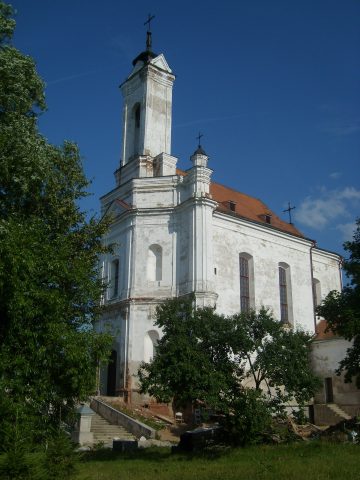
Architecturally, the Church of St. Vladimir is simple, even modest, but that simplicity gives it a certain charm. Designed in the Neo-Russian style—a revival of medieval Orthodox aesthetics popular in the early 20th century—it blends traditional elements with a modern touch. The whitewashed walls, tall narrow windows, and the tiered bell tower create a sense of lightness, as if the building is reaching upward without strain. Inside, the space is small but bright, with an iconostasis crafted in a classic style. There’s no opulence here, no gilded excess, just a quiet dignity that feels more intimate than the grandeur of older cathedrals.
What makes the church particularly interesting is its location. It doesn’t sit in the heart of Zaslavl but slightly apart, on the edge of the town’s historic core. The spot was chosen deliberately—the hill offers a sweeping view of the surrounding countryside, the winding Svislach River, and the patchwork of fields beyond. On clear days, you can even make out the faint outline of Minsk in the distance, a reminder of how close the past and present lie here. This vantage point turns the church into more than just a place of worship; it becomes a quiet observation deck, a spot to take in the landscape and see the town from a different angle.
Zaslavl moves at its own unhurried pace, and the Church of St. Vladimir fits seamlessly into that rhythm. Even on holidays, it rarely feels crowded. Locals come not just for services but to stand in silence, to gather their thoughts, or simply to sit for a while. In summer, linden trees bloom around the church, their scent mingling with the faint aroma of candles and incense, creating an atmosphere that feels both sacred and deeply ordinary. In winter, when snow blankets everything, the church looks like something out of a folktale—a small, sturdy structure nestled among drifts, as if waiting for the next chapter of its story to unfold.
Though the church is relatively new, it has already become part of Zaslavl’s identity. It doesn’t draw crowds of tourists, nor does it compete with the town’s more famous landmarks. But for those who visit not just to check off sights but to feel the pulse of a place, it offers something rare: a moment of stillness, a chance to connect with the layers of history that have shaped this corner of Belarus. There are no ancient frescoes or relics here, but there is something perhaps more meaningful—a living thread to the past, one that continues in the people who come to light a candle or say a prayer.
The church is also a quiet witness to the broader history of the region. Zaslavl and its surroundings are dotted with remnants of the past—ancient burial mounds, the ruins of old fortifications, and crumbling estates—each a silent testament to the wars, migrations, and upheavals that have swept through these lands. The Church of St. Vladimir, though young, has become another link in that chain, a modern addition to a landscape shaped by centuries of change. It doesn’t claim to be a relic, but it doesn’t need to be; its significance lies in how it carries forward the traditions that have endured here for over a thousand years.
For those curious about the history of Christianity in Belarus, the church offers a different kind of insight. It’s not a place of grand historical revelations, but rather a space to reflect on how faith has evolved here—how it was first introduced, how it survived through turbulent times, and how it remains a part of daily life today. There are no 12th-century murals or the bones of saints, but there is something more elusive and perhaps more powerful: the sense that history isn’t just something you read about, but something you can feel in the quiet moments between prayers.
Zaslavl itself is a town where the past feels alive without being frozen in time. It’s not a museum, not a reenactment, but a place where people go about their lives amid reminders of what came before. The Church of St. Vladimir is part of that life—you might see locals decorating it for a festival, children playing on the grass outside, or elderly men sitting on a bench, talking about the weather or the latest news. These small, everyday scenes give the place a sense of authenticity, the kind that’s often lost in more polished tourist destinations.
If you find yourself in Zaslavl, don’t rush to leave. Take a walk through the town, step inside the church, sit by the Svislach River for a while. Maybe here, in this quiet corner of Belarus, you’ll find what so many travelers seek without realizing it: not a grand monument or a famous landmark, but a moment of connection—a place where history doesn’t shout, but simply exists, offering a sense of peace that lingers long after you’ve walked away.