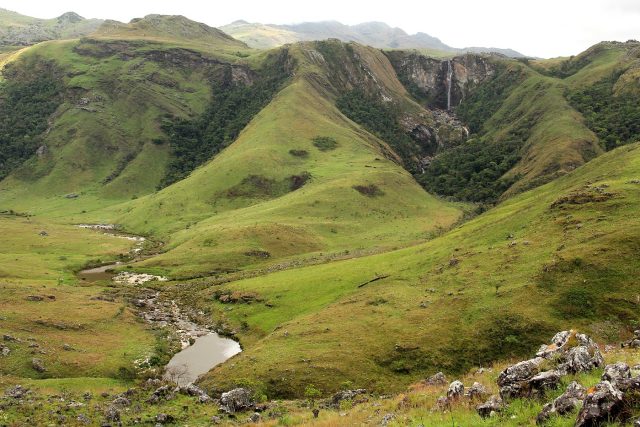
St. Peter’s Church in Rusape is the kind of place that doesn’t demand attention but lingers in the mind long after you’ve left. It sits on the edge of town, where the land rolls into low hills and the air carries the scent of dry grass and woodsmoke. The surrounding fields stretch out under the vast African sky, dotted with the occasional acacia or msasa tree. There are no tour buses here, no crowds jostling for the best view, no grand facades competing for admiration. Just an old church, built in the early 1900s when this part of the world was still known as Southern Rhodesia, standing quietly as it has for over a century.
The building itself is unassuming, its design shaped by necessity rather than ambition. Local stone, weathered by decades of sun and rain, forms the walls, their surface darkened by time. The corrugated iron roof, once a practical choice, now bears the marks of rust, its edges worn thin in places. Inside, there are no marble columns or gilded icons—just wooden pews, their surfaces smoothed by generations of hands, and a handful of stained-glass windows that cast uneven patches of light across the stone floor. The altar is simple, adorned with modest carvings, and the walls hold faded photographs of long-forgotten parishioners, their faces blurred by time.
The church’s history is woven into the fabric of Rusape itself. The town began as a small settlement in the late 1800s, when European missionaries and farmers arrived in the region. St. Peter’s was one of the first permanent structures in the area, a symbol of both faith and the changing order of the land. In those early years, it served as more than just a place of worship. It was a community hub where meetings were held, children attended school, and the sick sometimes came for care. When Zimbabwe gained independence in 1980, many of the European settlers left, but the church remained, though its role in daily life gradually diminished.
Today, Rusape is a quiet provincial town where time moves to the rhythm of the seasons and the demands of the land. St. Peter’s still holds services, though the congregation has grown smaller over the years. On Sundays, a handful of locals—mostly older residents—gather for prayers, switching between English and Shona, one of Zimbabwe’s main languages. After the service, people linger outside, chatting about the week’s news or the state of the harvest, before slowly making their way home. On weekdays, the church is usually empty, save for the occasional visitor—a traveler passing through or a group of schoolchildren on a field trip.
Behind the church lies a small cemetery, its graves scattered across the gently sloping ground. There are no grand monuments here, just simple headstones, many of them overgrown with grass. Some bear inscriptions in English, while others have only names etched into the stone. The place doesn’t feel like a tourist attraction or a historic landmark, but there’s a quiet dignity in its simplicity. It’s a reminder of the people who built Rusape, who lived and died here, and whose stories are now part of the land itself.
St. Peter’s isn’t the kind of place that makes it onto must-see lists, and that’s part of its charm. There’s no pressure to rush, no need to pose for photos or check off another sight. You can sit on one of the wooden pews, listen to the wind rustling through the trees, and let your thoughts wander. Time here moves differently—slowly, patiently, like the rivers that carve their way through the landscape. It’s a place that invites reflection rather than admiration, where the weight of history is felt in the silence rather than in grand gestures.
If you find yourself in Rusape, it’s worth stopping by, even if just for a few minutes. Not because you’ll find anything extraordinary, but because sometimes the most ordinary places leave the deepest impressions. There are no dramatic tales of conquest or revolution here, no architectural marvels to marvel at. Instead, there’s something far more subtle—the sense of lives lived quietly, of faith that endured, of a community that once gathered within these walls and still does, in its own way.
In a world where travel often feels like a race to see as much as possible, St. Peter’s offers a different kind of experience. It doesn’t shout for attention, doesn’t promise spectacle or revelation. It simply exists, as it has for generations, a quiet witness to the passage of time. And perhaps that’s what makes it worth visiting—not for what it is, but for what it represents. A reminder that history isn’t just made by the grand and the famous, but by the everyday, the unremarkable, the people who lived and loved and left their mark in ways that aren’t always visible.