St. Mauritius Church in Zermatt is one of those quiet places that doesn’t demand attention but lingers in memory long after you’ve left. Tucked away in the heart of the village, it stands surrounded by traditional chalets and the towering presence of the Matterhorn, a subtle reminder that life here moves to its own rhythm, shaped by the mountains. The building itself is unassuming—a small stone structure with a modest steeple, nothing like the grand cathedrals of larger cities. Yet that very simplicity is what makes it so compelling.
The church’s history stretches back to the 16th century, when Zermatt was little more than a cluster of shepherds’ huts and hunters’ lodges, cut off from the world by the harsh Alpine landscape. The first written record of the church dates to 1540, though it’s likely an earlier chapel stood on this spot long before. In those days, Zermatt was a remote outpost, rarely visited by outsiders, and the church served as more than just a place of worship. It was a gathering point where villagers made decisions, celebrated festivals, and found solace during the long winters when snow sealed them off from the outside world.
The architecture reflects the practicality of life in the Alps. Built from local stone, the church has weathered over centuries, its facade blending seamlessly with the surrounding landscape. Inside, there’s no opulence—just wooden pews, a simple altar, and a handful of old icons and stained-glass windows depicting biblical scenes. The ceiling is the most striking feature, adorned with folk-style frescoes of angels and saints. Though not the work of master artists, these paintings carry a raw sincerity, a testament to a time when art was woven into everyday life rather than displayed for admiration.
The church is dedicated to St. Maurice, an early Christian martyr and the patron saint of Alpine regions. According to legend, he was a Roman legion commander who refused to persecute Christians and was executed alongside his soldiers. In Switzerland, he’s revered as a protector against natural disasters, a fitting patron for a village like Zermatt, where avalanches and landslides have long been a threat. Every year on September 22nd, the feast day of St. Maurice, the church holds a service that draws both locals and visitors, a quiet moment of reflection amid the village’s usual bustle.
Today, St. Mauritius Church remains an active place of worship and a piece of Zermatt’s living history. It has been rebuilt and restored over the centuries, yet it retains the same understated character it had when it first served the village’s earliest inhabitants. Inside, the air is always still, even when the streets outside are crowded with tourists. In summer, hikers step inside to escape the heat; in winter, skiers pause to warm up before heading back to the slopes. There’s no rush here, no tourist trappings—just the scent of wax and wood, the creak of old floorboards, and the quiet hum of a place that has seen generations come and go.
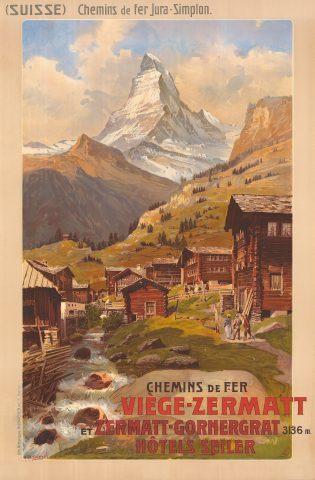
The church sits on a small square, framed by one of the most iconic views in the Alps: the Matterhorn. It’s almost as if the building was deliberately positioned to keep the mountain in sight, a constant reminder of nature’s dominance in this landscape. In summer, wildflowers bloom around its base; in winter, snow drifts against its walls. Yet no matter the season, it remains a pocket of tranquility in the middle of a village that thrives on movement and energy.
For many visitors, St. Mauritius Church is an unexpected discovery. Zermatt is famous for its mountains, its skiing, and its luxury, so it’s easy to overlook this modest little building. But those who take the time to step inside often find something far more meaningful than the usual tourist attractions. Here, you can sense the true spirit of an Alpine village—a place where time moves slowly, where life is dictated by the seasons, and where faith and tradition have been passed down through the centuries. There are no guided tours, no souvenir stands, just the quiet presence of a building that has stood the test of time.
If you find yourself in Zermatt, resist the urge to rush straight to the ski lifts or the boutiques. Instead, take a moment to visit St. Mauritius Church. Sit on one of the wooden pews, listen to the silence, and let the atmosphere settle over you. It’s in places like this that you begin to understand why Zermatt has such a hold on people—not just for its breathtaking scenery, but for the intangible sense of peace that comes from standing at the intersection of nature, history, and human resilience.