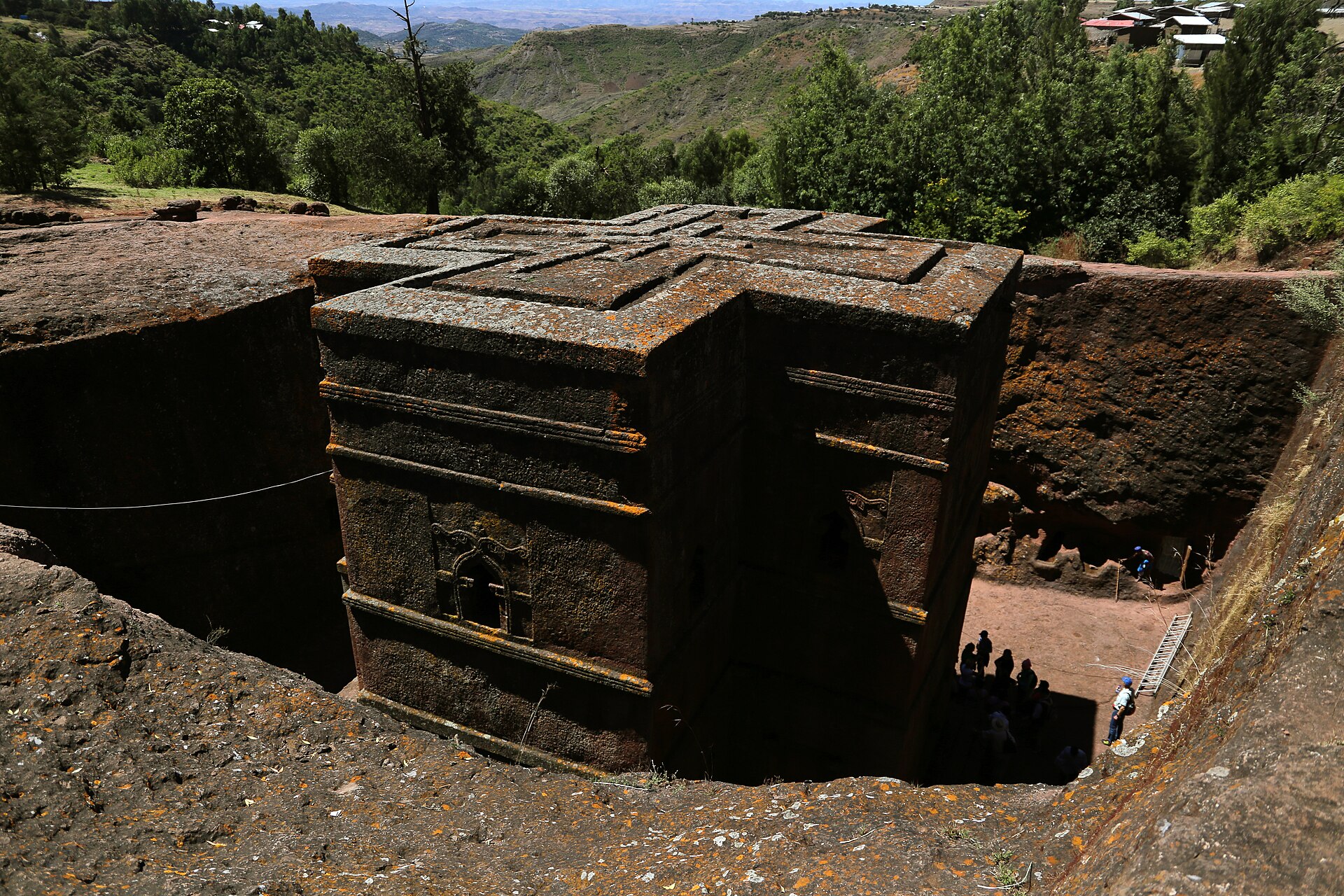
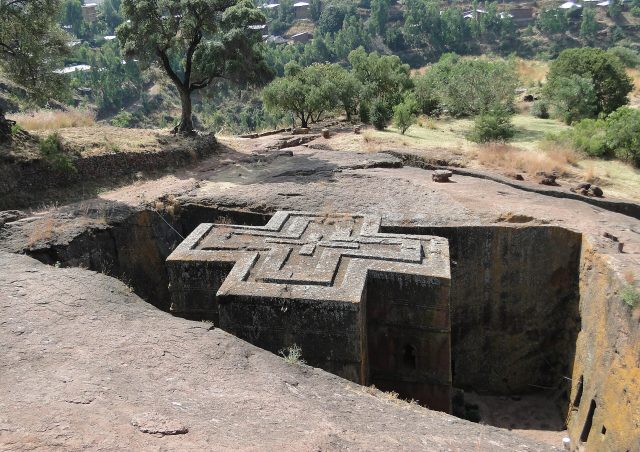
From the road, the church looks like a low outcrop of the same dark stone that litters the hillside. Only when you climb the slope does the dome appear—small, round, and unadorned. The walls are thick, the windows narrow, the crosses carved into the lintels barely visible from below. It sits on the highest point of Kobo, where the wind carries the sound of bells and the scent of eucalyptus.
The building follows the style of Ethiopian Orthodox churches: a square nave, a circular sanctuary, and a vestibule that wraps around the outside. The stone is local basalt, rough and unpolished. Inside, the space is divided into three sections. The innermost is for priests, the middle for men, the outer for women. This division has been observed for centuries.
Kobo lies in northern Ethiopia, a region once crossed by caravans traveling between Aksum and Lalibela. The church may have sheltered travelers as well as worshippers. No records survive of its construction, but the style suggests it was built during the Ethiopian Empire, when Christianity had already spread across the highlands. The stones have seen wars, droughts, and the slow passage of time.
Inside, the air is cool and still. Light enters through the narrow windows, falling on murals that cover the walls. The paintings show biblical scenes—Adam and Eve, the Flight into Egypt, the Last Supper—but the faces are Ethiopian, the landscapes resemble the hills outside. The colors are faded, the figures flat, the perspective ignored. The effect is direct, almost childlike.
The altar is hidden behind a curtain. Only priests may enter. Behind the curtain lies the tabot, a wooden tablet inscribed with the Ten Commandments. Each Ethiopian church has its own tabot, a replica of the Ark of the Covenant kept in Aksum. During festivals, the tabot is carried in procession around the church.
The church is part of daily life in Kobo. Baptisms, weddings, and funerals are held here. On Sundays, families gather for services. The year is marked by festivals, the largest of which is Timkat, the Ethiopian Epiphany. For three days, the town fills with pilgrims. The streets echo with chanting, drums, and the smell of incense. The church becomes the center of the celebration.
Few tourists visit Kobo. Those who do come for the history, the quiet, the sense of a place unchanged. The locals are welcoming. They will show you the murals, explain the meaning of the tabot, and tell you how the church has survived invasions and time. The stories are passed down, not written.
The town is small, the pace slow. The church is not a monument but a living place. The fields around it grow teff and coffee. The mountains in the distance are often shrouded in mist. The church stands where it has always stood, solid and unchanging, while the world around it shifts.