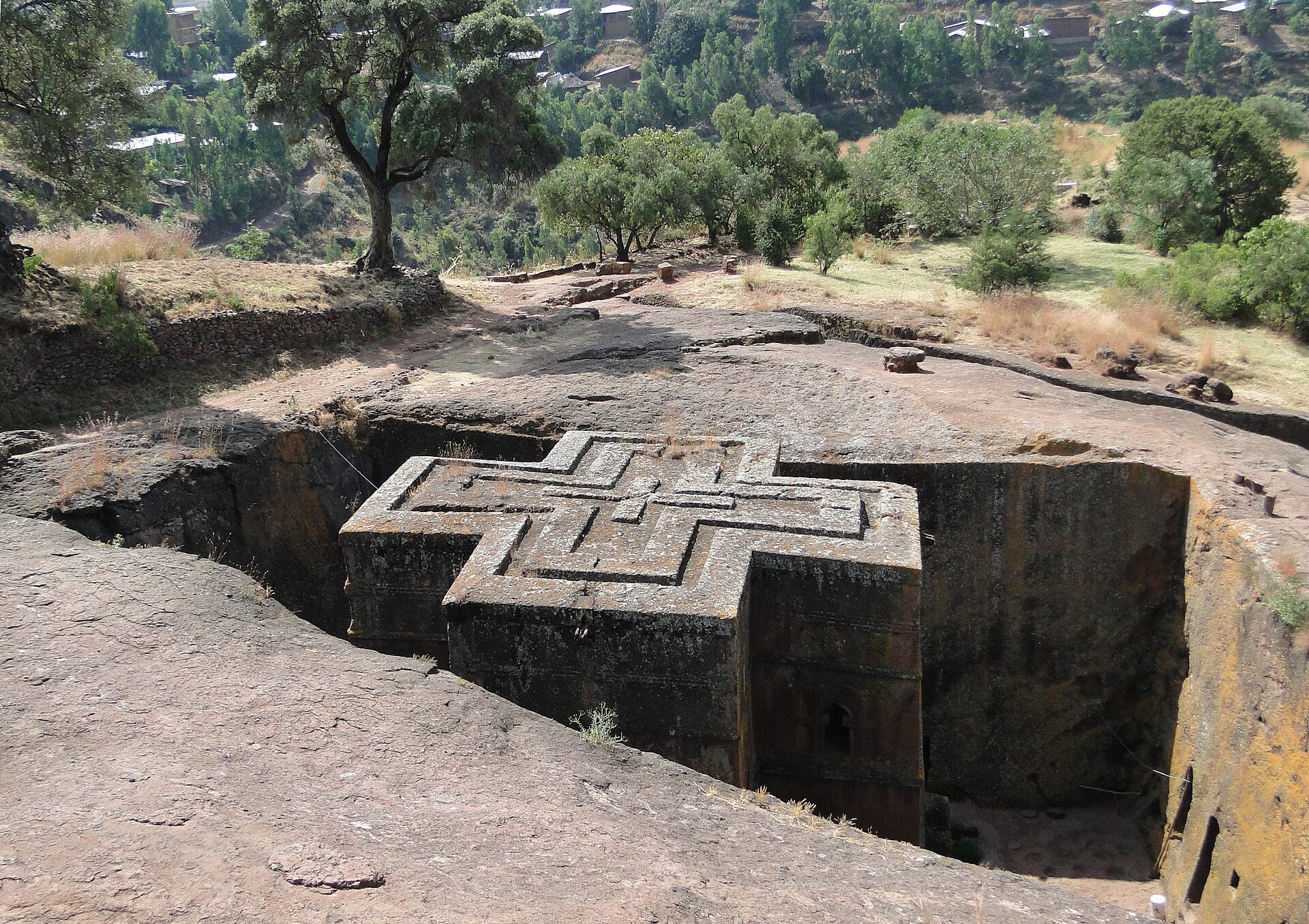
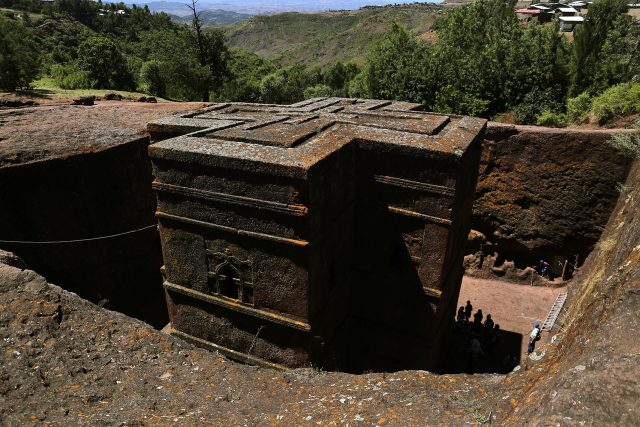
Perched on a gentle slope just outside Kobo, a quiet town in northern Ethiopia, Bet Giyorgis Church feels like a place forgotten by time. It doesn’t appear on most maps or travel itineraries, and even among Ethiopians, it’s not widely known. There are no tour buses parked nearby, no crowds of pilgrims, just the occasional murmur of worshippers and the whisper of wind through the dry grass. The church blends into the landscape, its presence understated yet deeply rooted in the land and its people.
The architecture is unmistakably Ethiopian—round, sturdy, and built to last. Thick stone walls rise from the earth, supporting a wooden roof layered with grass, a technique that has sheltered generations from the region’s harsh sun and seasonal rains. Unlike the vivid frescoes and gilded interiors of more famous churches, Bet Giyorgis is restrained, almost austere. Inside, the walls are rough-hewn stone, the windows narrow slits that cast thin beams of light across the floor. The altar stands at the center, separated from the rest of the space by a simple curtain, a tradition in Ethiopian Orthodox churches. The stone slabs underfoot have been worn smooth by centuries of footsteps, each one a quiet testament to the faith that has sustained this place.
Kobo itself is a town shaped by history, though not the kind that makes it into textbooks. Nestled in a region that has long been a crossroads between highland kingdoms and lowland trade routes, it has seen its share of conflict and change. The church likely served as more than just a place of worship—it was a gathering point, a refuge, and a symbol of continuity in a landscape where power shifted as often as the seasons. While no one knows exactly when Bet Giyorgis was built, its design suggests it dates back to at least the 18th century, when such structures were common in northern Ethiopia. The lack of precise records only adds to its mystique, as if the church has always been here, watching over the land.
For the people of Kobo, Bet Giyorgis is not a monument but a living part of their community. It’s where they come to pray, to celebrate religious festivals, or simply to sit in silence, away from the noise of daily life. Unlike the grand cathedrals of Lalibela or Aksum, where rituals are performed with solemn grandeur, this church feels intimate, almost familial. The priests know their congregation by name, and the elders still tell stories of how the church weathered wars and droughts, standing firm when everything else seemed uncertain. It’s a place where faith is not just observed but lived, quietly and without fanfare.
The surroundings are as unassuming as the church itself. From the hill where it stands, the view stretches across sunbaked fields and scattered acacia trees, the kind of landscape that defines this arid corner of Ethiopia. In the distance, the silhouette of mountains looms, and on clear days, you can just make out the faint outlines of other towns. Locals sometimes bring their livestock to graze nearby or gather herbs from the slopes, but more often than not, the area is empty, offering a rare chance to be alone with the land. There are no cafes, no souvenir stalls, no signs pointing the way—just the earth, the sky, and the quiet.
Bet Giyorgis isn’t the kind of place that draws visitors seeking dramatic backdrops or legendary tales. It doesn’t demand attention; it simply exists, as it has for centuries, a quiet witness to the passage of time. For those who do find their way here, it offers something far more subtle: a glimpse of Ethiopia stripped of pretense. This is a country where history and the present coexist in the most ordinary of moments, where spirituality is woven into the fabric of daily life, and where the land itself feels like a silent participant in the rituals of faith. There is no spectacle here, no grand narrative—just the quiet certainty that some things endure, unchanged and unchanging.