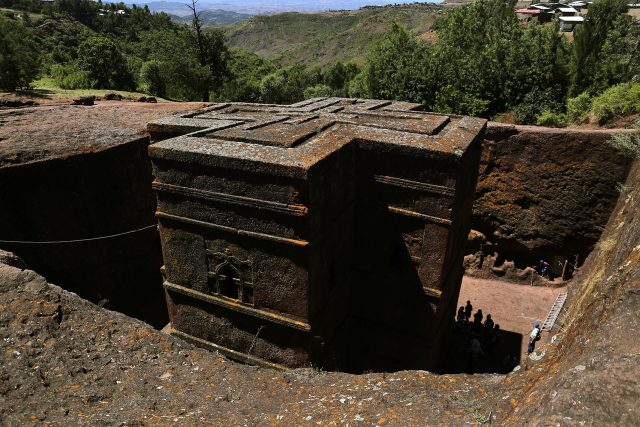
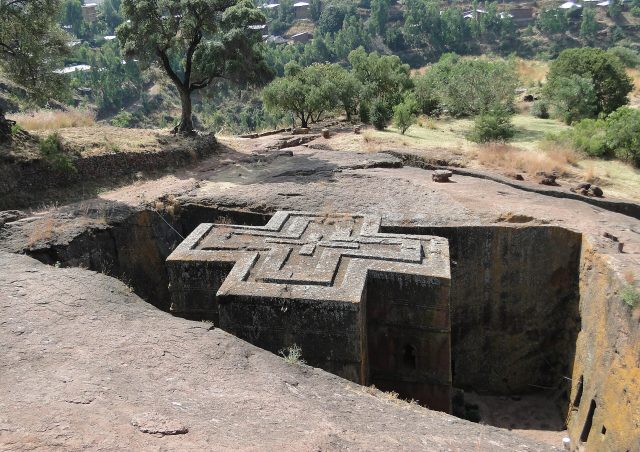
Bete Mariam Church sits quietly in the small Ethiopian town of Kobo, a place rarely found on tourist maps. This isn’t the kind of destination that draws crowds for dramatic photographs or lively tours. Instead, it exists in a rhythm of stillness, where time moves slowly, and the church stands as one of the few landmarks shaping the daily lives of those who call this place home.
Like many of Ethiopia’s ancient rock-hewn churches, Bete Mariam’s origins are shrouded in uncertainty. It was likely carved into the stone during the height of the Aksumite Kingdom, when Christianity had already taken deep root in the region. The architecture is unassuming—thick walls, narrow windows that let in only slivers of light, and a simplicity that feels almost deliberate. Inside, there are no grand frescoes or gilded altars, just rough-hewn stone and wooden beams darkened by centuries of use.
Unlike the more famous rock churches of Lalibela, Bete Mariam isn’t wrapped in legends of divine intervention or miraculous construction. It has always been a place of quiet devotion, a parish church where generations of locals have gathered for prayer and community. Pilgrims don’t flock here, and tourists rarely venture this far. Those who do usually arrive by chance or out of a quiet curiosity for lesser-known historical sites.
Kobo lies in Ethiopia’s arid northern highlands, where the landscape shifts between shades of ochre and dust, and life unfolds at its own unhurried pace. The church sits on a slight rise, its steps offering a view of the surrounding fields and the occasional acacia tree. There are no signs or fences marking its presence—just a worn path trodden by the feet of villagers who come on Sundays or during religious festivals.
Inside, the air is cool and still. Wooden benches, smoothed by years of use, line the walls, and a few icons in the traditional Ethiopian style hang in the dim light. The murals that once covered the stone have faded, though faint outlines of saints and biblical scenes remain. The church’s most treasured relic is an ancient cross, said to have been brought here by one of the earliest Christian missionaries. It’s kept in the altar and only brought out on special occasions.
Bete Mariam makes no claim to grandeur. It wasn’t built to impress or to stand as a monument to human skill. Its purpose was always simpler: to serve the people who lived nearby, offering a place of worship and refuge across the centuries. There are no souvenir stalls outside, no cafes or guides waiting to lead visitors through its history. If you find yourself here, you’ll likely have the place to yourself.
For the people of Kobo, the church is neither a relic nor a tourist attraction. It’s a living part of their world. On ordinary mornings, you might see women carrying water from the nearby well or children playing on the steps. During festivals, the air fills with the sound of hymns and the scent of incense, but on most days, the only noise is the wind rustling through the dry grass.
Kobo moves to its own rhythm, untouched by the urgency of modern life. There’s no need to rush, no pressure to perform or prove anything. Perhaps that’s why Bete Mariam still feels alive—it hasn’t been turned into a museum piece but remains woven into the fabric of daily existence. For the rare traveler who stumbles upon it, the church offers something unexpected: a place where history isn’t just preserved in stone but lingers in the air, tangible and real.