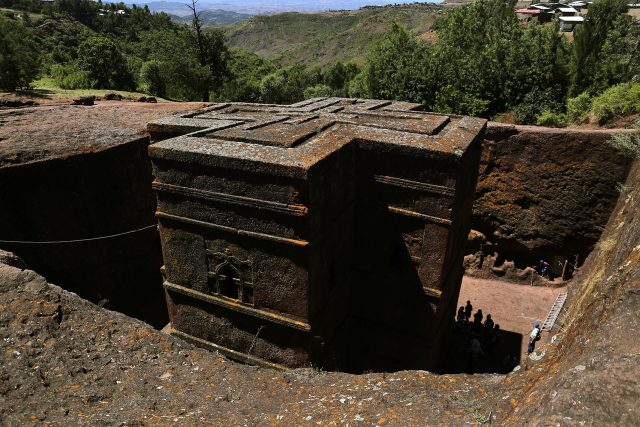
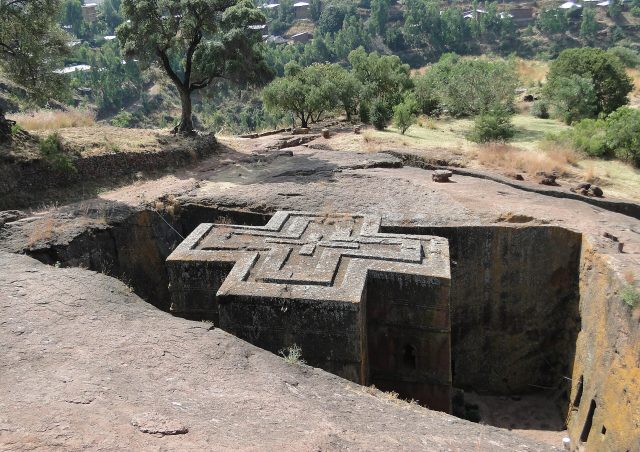
Bet Amanuel is one of those rare places where time seems to have paused, leaving behind a quiet echo of a long-forgotten era. Tucked away in the rugged highlands near the small town of Kobo, in a region where history and landscape blur into one, this rock-hewn church feels like a relic of another world. While the more famous churches of Lalibela draw crowds with their grandeur, Bet Amanuel remains a hidden gem, its solitude preserving the sense of mystery that surrounds it. Here, among the arid hills and rocky plateaus, the past doesn’t just linger—it breathes.
Carved into the living rock sometime between the 12th and 13th centuries, Bet Amanuel was born during the reign of the Zagwe dynasty, a period when Christianity flourished in Ethiopia. Legends tie its creation to King Lalibela, who is said to have envisioned a "New Jerusalem" in the mountains of his homeland. Though Bet Amanuel is part of this ambitious project, it never achieved the same fame as its counterparts in Lalibela. Perhaps that’s why it feels more authentic—untouched by mass tourism, where the only sounds are the wind rustling through the dry grass and the occasional murmur of locals coming to pray.
The architecture of Bet Amanuel is a testament to the skill of its builders. Unlike many other rock-hewn churches, which were simply hollowed out of the stone, this one appears to emerge organically from the rock, as if shaped by nature itself. The facade is adorned with precise arches and columns, their clean lines suggesting a mastery of craftsmanship that feels almost effortless. Inside, the church is divided into three naves, their walls once covered in frescoes. Though time and dampness have faded much of the artwork, traces of biblical scenes and saintly figures remain, hinting at the spiritual life that once filled these halls.
Reaching Bet Amanuel is not as straightforward as visiting other landmarks in Ethiopia. The journey takes you through stark, sunbaked landscapes where sparse trees dot the rocky terrain and the horizon shimmers in the heat. Local guides say that in the past, pilgrims would walk this path as part of their spiritual journey, seeing the hardship as a form of purification. Today, a four-wheel drive can get you close, but even modern vehicles struggle with the rough roads, especially during the rainy season. Yet it’s this remoteness that makes the visit feel like a privilege—here, there are no crowds, only the vast sky, the wind, and the quiet weight of history.
Bet Amanuel’s relative obscurity is part of its charm. While the churches of Lalibela are celebrated for their intricate designs and religious significance, this smaller, less-visited site offers something different: a sense of raw, unfiltered history. There are no grand decorations or gilded altars, just the bare stone and the stories it holds. Those who make the effort to come here often leave with the feeling that they’ve glimpsed the real Ethiopia—not the one in guidebooks, but the one that exists in the quiet corners of the land, where the past is still alive.
The area around Kobo and the church itself is steeped in folklore. One story claims that angels helped build Bet Amanuel, working through the night while the human laborers rested. Another speaks of hidden tunnels connecting it to other churches, though none have ever been found. Locals believe the church holds special power, drawing people not just for prayer but for healing. Whether these tales are true or not, they add to the sense of wonder that surrounds the place, turning it into more than just a historical site—it’s a living piece of tradition and faith.
For historians and archaeologists, Bet Amanuel is a puzzle waiting to be solved. Researchers have tried to restore the faded frescoes, decipher inscriptions, and uncover the secrets of its construction. Yet many questions remain unanswered. How did the builders achieve such precision without modern tools? Why was this church carved here, far from major settlements? New discoveries may one day provide answers, but for now, Bet Amanuel keeps its secrets, just as it has for centuries.
Visiting this place is less about ticking off a tourist attraction and more about stepping into another time. There are no amenities, no souvenir stalls, just the quiet and the vast, open landscape stretching in every direction. The air is thin at this altitude, and the sky feels close enough to touch. In such a setting, it’s easy to lose track of time, to sit and listen to the wind, and to wonder about all the people who have stood here before you.
Bet Amanuel is a reminder that beauty often lies in simplicity. It doesn’t try to impress with grandeur or opulence; it simply exists, as it has for hundreds of years, surviving wars, changing rulers, and the passage of time. That’s what makes it compelling—there’s nothing here but the rock, the wind, and the stories etched into the stone. For some, it will be just another stop on a journey. For others, it will be a revelation, a place that changes how they see history—and themselves.