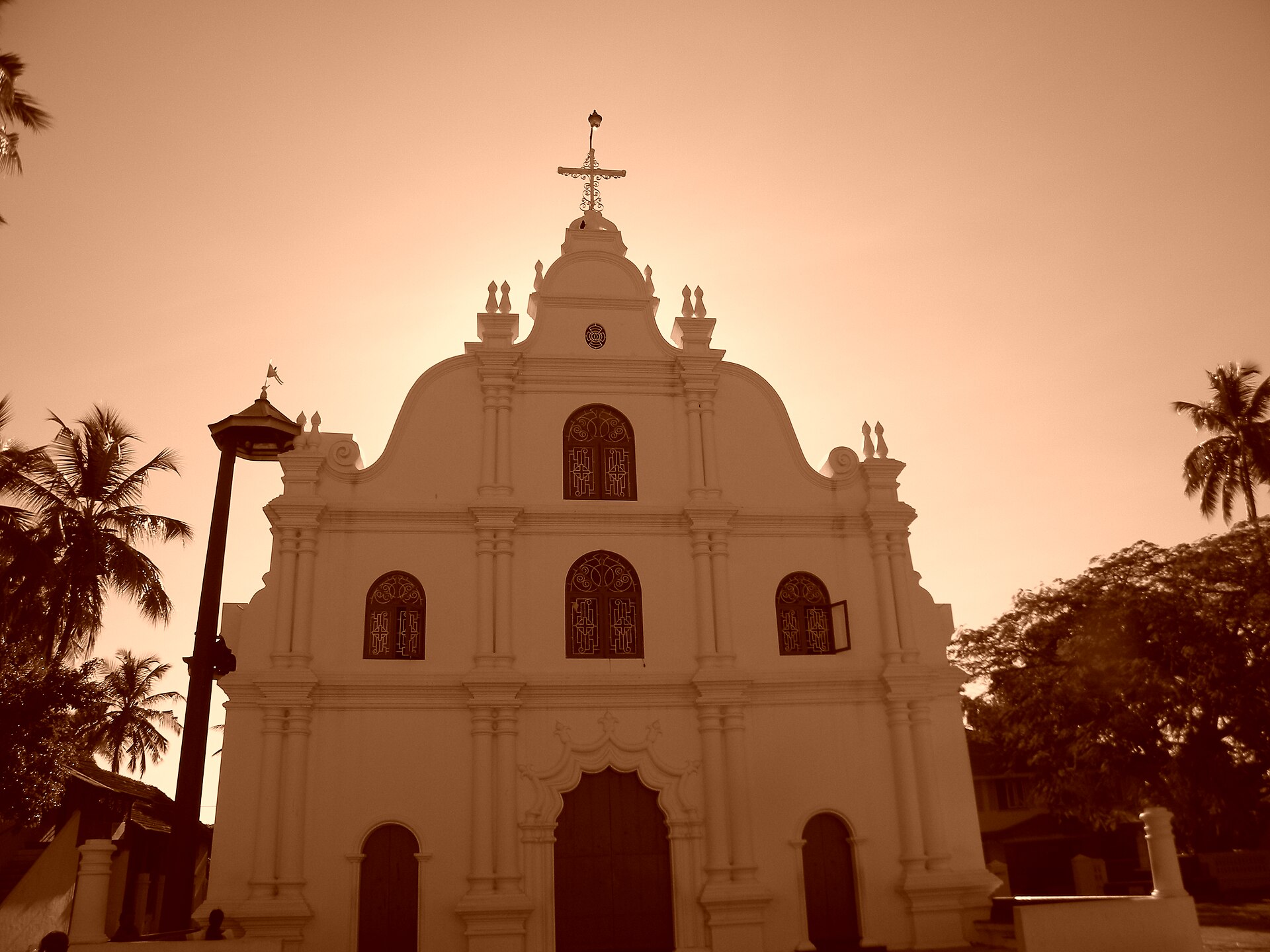
St. Francis Church in Kochi is one of those rare places where India’s layered history feels almost tangible. Built in the early 1500s by Portuguese explorers, it was the first European Christian church on Indian soil, a quiet witness to the ambitions and conflicts that shaped the subcontinent. Standing on a narrow street in the old part of the city, the church doesn’t demand attention—its whitewashed walls and simple wooden roof blend into the surroundings, as if time here moves at a slower pace. There’s no grand facade or towering spires, just an unassuming presence that feels authentic for its modesty.
The church’s origins trace back to 1503, when Vasco da Gama’s expedition arrived in Kochi, then a port where merchants from across the world traded spices, textiles, and ideas. The Portuguese, eager to establish both commercial and religious footholds, built the first wooden structure, which was later replaced with stone. Over the centuries, the church changed hands multiple times—first the Dutch, then the British—each leaving their mark on its architecture and interiors. Yet despite these shifts, the building retained its original form, a silent chronicler of colonial history.
Inside, the church is cool and dimly lit, with high windows casting soft beams across the stone floor. The altar is adorned with wooden figures, and the walls bear traces of its past: Portuguese inscriptions, Dutch coats of arms, and British memorial plaques. The most notable relic is the spot where Vasco da Gama was temporarily buried in 1524 before his remains were moved to Lisbon. Today, a memorial plaque marks the place, a reminder of the man whose voyages reshaped trade and power in the Indian Ocean.
St. Francis Church is more than just a religious site—it’s a symbol of the broader forces that shaped India’s colonial era. The Portuguese arrived as traders and missionaries, and the church became a center for their efforts to spread Christianity. When the Dutch took control of Kochi in the 17th century, they converted it into a Protestant church, only for the British to later reclaim it for Anglican services. Each transition left its imprint, yet the building itself remained largely unchanged.
Despite its historical significance, the church hasn’t been turned into a museum. It remains an active place of worship, where locals gather for Sunday services and visitors wander through its quiet halls. On weekdays, the only sounds are the rustle of pages or the occasional murmur of a caretaker. Outside, a small garden with old trees offers shade, a peaceful contrast to modern Kochi. It’s easy to imagine Portuguese priests planning their next sermon here or Dutch merchants resting after a long voyage, their voices blending into the centuries-old stillness.
Kochi has always been a city of converging cultures, and St. Francis Church embodies that intersection. It stands at the crossroads of East and West, old and new, a place where the past isn’t just remembered but felt. There’s no opulence here, no gilded altars or soaring domes—just the quiet dignity of a building that has seen empires come and go. That simplicity is what makes it compelling.
You don’t need to imagine what life was like centuries ago; the church itself is a living connection to that time.
A visit here doesn’t take long, but it lingers in the mind. The church doesn’t try to impress—it simply exists, as it has for over five hundred years. It doesn’t demand admiration, yet it’s hard to leave without a sense of having touched something enduring. Few churches in the world have witnessed so much change and yet remained so unchanged. St. Francis Church is one of them.