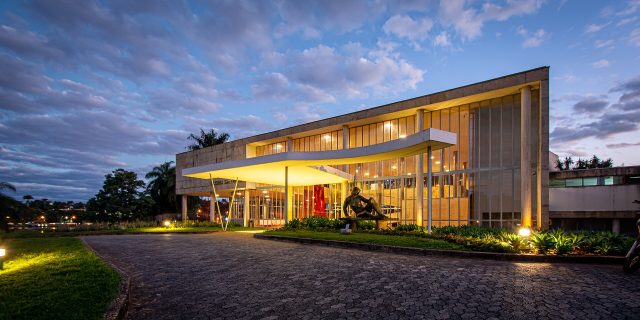
Perched on a gentle hill in Belo Horizonte’s Pampulha district, the Church of Saint Francis of Assisi feels like a quiet secret tucked away from the city’s bustle. Its curves and undulating forms blend into the landscape, as if the building emerged naturally from the earth rather than being constructed by human hands. There are no towering spires or ornate facades here—just smooth, flowing lines that give the church an almost sculptural quality. It doesn’t demand attention the way grand cathedrals do; instead, it invites you to pause and notice the way light plays on its white walls or how the wind moves through the surrounding trees.
Designed by Oscar Niemeyer in the mid-20th century, the church was part of a bold vision for Pampulha, a neighborhood conceived as a testing ground for modern architecture. Niemeyer, whose name is synonymous with Brazil’s architectural identity, rejected rigid angles and traditional forms in favor of organic shapes that echo the natural contours of the land. The church was never meant to stand alone—it was part of a larger complex that included a museum and a school of architecture, each structure complementing the others. The result is a space where art, design, and nature coexist seamlessly, a rare harmony in a world where buildings often compete with their surroundings.
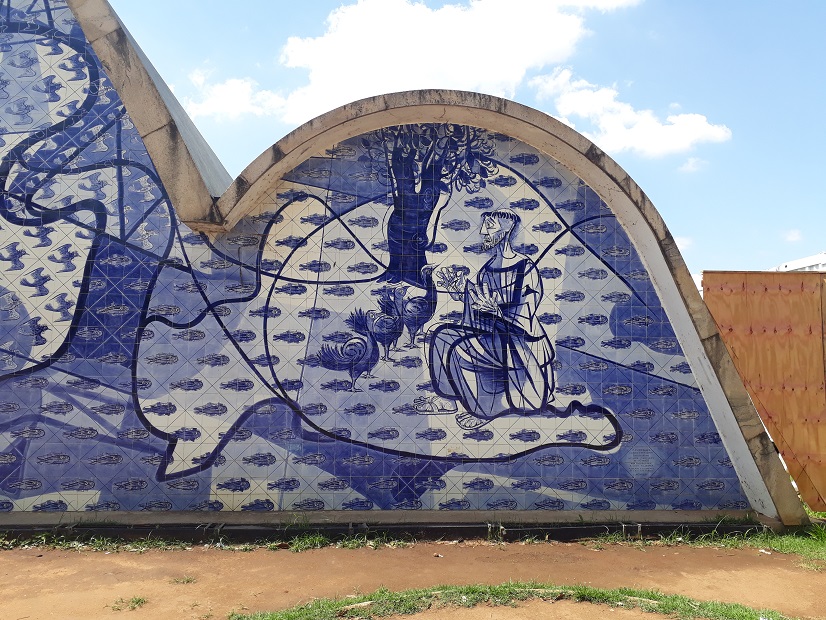
Inside, the church feels more like a sanctuary of light than a conventional place of worship. The high windows filter sunlight into soft, diffused beams that dance across the white walls, creating an atmosphere of weightlessness. The altar isn’t tucked away at the far end but positioned near the center, as if to draw people into the space rather than keep them at a distance. The walls are adorned with murals by Candido Portinari, whose depictions of Saint Francis’s life feel more like illustrations from an old fable than traditional religious art. His figures are both grounded and dreamlike, their expressions suggesting a quiet wisdom rather than divine grandeur.
The choice of Saint Francis as the church’s patron saint wasn’t accidental. Known for his humility and reverence for nature, Francis embodies the spirit of this place—unpretentious, open, and deeply connected to the world around it. There are no gilded altars or elaborate rituals here, just a sense of simplicity that feels almost radical in its restraint. Even the bell tower, usually a dominant feature, blends into the structure rather than standing apart. This understated approach makes the church feel welcoming to everyone, whether they come for prayer, reflection, or simply to escape the noise of the city.
Belo Horizonte itself was born from a similar spirit of reinvention. When it was founded in the early 20th century as the new capital of Minas Gerais, the city was designed to break away from Brazil’s colonial past. Unlike the winding streets and baroque churches of older cities, Belo Horizonte was meant to be a symbol of progress, a place where modernity and tradition could coexist. Pampulha, with its experimental architecture, became a microcosm of this vision. The Church of Saint Francis wasn’t just a religious building—it was a statement about what the future of Brazilian design could look like, one that honored the past while embracing the new.
Today, the church remains one of the city’s most peaceful corners. Unlike the crowded tourist spots of Rio or Salvador, it doesn’t attract hordes of visitors, and that’s part of its charm. On weekdays, you might find it nearly empty, the silence broken only by the echo of footsteps or the distant chime of the bell. There’s no pressure to admire it in any particular way—no guided tours, no plaques demanding your attention. You can sit on a bench outside, watching the hills stretch into the distance, or step inside and let the light wash over you. It’s a place that doesn’t ask for anything, not even understanding. It simply exists, and in doing so, offers something rare: a moment of stillness in a world that rarely slows down.
When the church first opened, not everyone appreciated its unconventional design. Some found it too modern for a place of worship, while others thought it lacked the grandeur expected of a religious building. Over time, though, perceptions shifted. The church became woven into the fabric of Belo Horizonte, as much a part of the city as its rolling hills or the golden light of early morning. It’s hard to imagine the skyline without it now, just as it’s hard to imagine the city without the quiet dignity it embodies.
The Church of Saint Francis of Assisi isn’t just a landmark to check off a list. It’s a place where architecture, art, and nature converge in a way that feels almost effortless. There’s nothing extraneous here, yet nothing feels missing. Every curve of the walls, every brushstroke of Portinari’s murals, every shaft of light that spills through the windows serves a purpose—to create a space where people can feel, even for a moment, that they’re part of something larger than themselves. That’s why visitors return, even if they can’t quite explain why. Sometimes, the most powerful experiences are the ones that don’t need words.