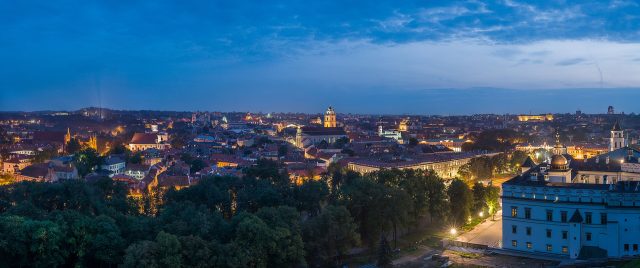
The Church of the Holy Spirit sits quietly in the heart of Vilnius’ Old Town, where narrow cobblestone streets twist between squares and every corner seems to hold another story. Unlike the city’s grand cathedrals with their gilded domes and imposing facades, this place feels different—less like a monument and more like a home. It belongs to the Dominican Order, and that sense of quiet devotion is woven into its very stones. The exterior is unassuming, almost modest, but step inside and the atmosphere shifts. The silence here isn’t heavy; it’s comforting, as if the walls themselves are holding their breath.
Vilnius has always been a city of layers, and the church’s history is no exception. The first records of a wooden chapel on this site date back to the mid-16th century, though like many buildings of that era, it didn’t survive the fires that swept through the city. A stone church rose in its place, and over the centuries, it was reshaped by time and taste. By the 17th century, it had taken on the Baroque features that define it today—though not the flamboyant, theatrical Baroque of palaces, but something more restrained, almost intimate. The Soviet era could have been its undoing, as it was for so many churches, but fate intervened. Instead of being shuttered or repurposed, it remained in the hands of the faithful, preserving its interior almost untouched.
From the outside, the church doesn’t demand attention. Its facade is simple: tall windows, unadorned pilasters, a small pediment crowned with a cross. But inside, the space unfolds in a way that feels both grand and personal. The nave is narrow, yet the high vaulted ceilings and soft, diffused light create an unexpected sense of openness. The altar draws the eye immediately—not because it’s dazzling, but because it’s understated. Dark wood and gilded accents give it a solemn, almost mysterious presence, as if it guards secrets older than the city itself.
The interior is a study in harmony. There’s no excess here, no blinding gold leaf or clashing colors. Instead, the walls are pale, the woodwork warm, and the delicate stucco work adds just enough detail to catch the light. A few old icons hang in quiet corners, their faces worn smooth by time. Among them is a copy of the Our Lady of the Gate of Dawn, the revered icon whose original resides in the nearby chapel of the same name. For many, this is a place of pilgrimage within a pilgrimage, a quiet spot to pause and reflect before moving on.
But the Church of the Holy Spirit is more than a relic. It’s a living part of Vilnius, still shaping the rhythms of the city. Services are held regularly, and the acoustics make it a natural home for concerts of sacred music. Occasionally, the space hosts exhibitions, a reminder that faith and art have always been intertwined here. Beneath the church, the crypts hold the remains of those who walked these streets centuries ago, a humbling connection to the past. During the Soviet years, when religion was suppressed, the church became a rare sanctuary—a place where people could gather not just to pray, but to remember who they were.
The church stands on a small square, surrounded by the red-tiled roofs and pastel facades of Old Town. In summer, the square is alive with the murmur of tourists and locals, the clink of coffee cups from nearby cafes, the laughter of children playing. In winter, snow softens the edges of the cobblestones, and the church seems to glow from within, a warm beacon against the cold. It’s the kind of place that doesn’t announce itself; you might walk past it a dozen times before noticing the quiet pull of its presence.
For many in Vilnius, the Church of the Holy Spirit is more than a landmark. It’s a thread in the fabric of their lives—where they were baptized, where they married, where they come to light a candle on their way to work. There’s no fanfare here, no grand gestures. It simply exists, as it has for centuries, offering a moment of stillness in a city that’s always moving. That’s why it feels so familiar to those who live here and so intriguing to those who visit for the first time.
If you find yourself in Vilnius, don’t rush past. Step inside. Let the quiet settle around you. Look at the details—the way the light falls through the windows, the worn edges of the pews, the faint scent of wax and old wood. You might feel what so many others have felt: that here, for a little while, the weight of the world lifts. The Church of the Holy Spirit isn’t just a piece of history. It’s a place where the past and present meet, where the stories of those who came before are still being written.