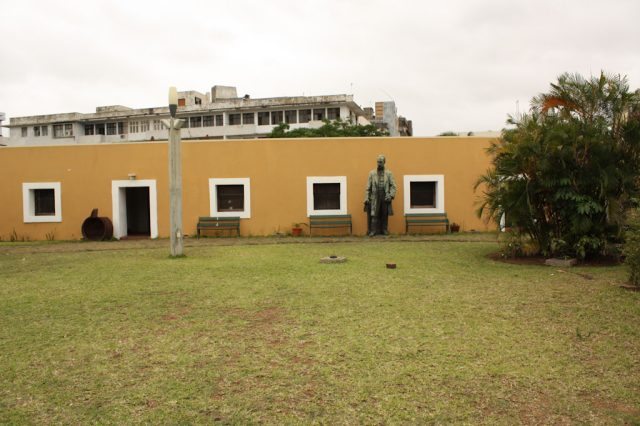
Saint Anthony’s Church in Maputo is one of those quiet places that lingers in your memory long after you’ve left. Tucked away on a side street, far from the city’s bustling avenues and tourist trails, it feels like a pocket of stillness where time moves at its own unhurried pace. The building itself is modest—whitewashed walls, a simple facade—nothing like the grand cathedrals of Europe. Yet there’s a quiet dignity to it, a sense of history woven into the everyday lives of the people who pass through its doors.
Built in the early 20th century, the church was one of the first Catholic places of worship in what was then known as Lourenço Marques. At the time, the city was growing rapidly as a colonial port and administrative hub, and the construction of religious buildings was part of Portugal’s broader effort to shape the urban landscape. Local craftsmen worked under Portuguese architects to create a structure that blended understated Neo-Romanesque elements—tall, narrow windows, rounded arches, and sturdy doors—into something both functional and enduring. The design feels solid, almost reassuring, as if the building were meant to stand as a steadfast presence through the uncertainties of the years ahead.
Inside, the church is unassuming but warm. Sunlight filters through the stained glass, casting soft patterns across the wooden pews and the simple altar. Unlike the ornate interiors of many European churches, this space is stripped of excess. The walls are plain, the floors tiled, and the real beauty lies in the quiet that settles here. For locals, it’s more than just a place of worship; it’s a refuge. Some come to pray, others to sit in silence, to think, or simply to escape the noise of the city. Older residents, in particular, remember it from decades past, when Maputo was a different place, and the church was already a familiar part of their lives.
The church has witnessed much of Mozambique’s turbulent history. During the struggle for independence in the mid-20th century, religious institutions often found themselves at the center of political tensions. The Catholic Church, closely tied to the colonial administration, faced criticism from nationalist movements. Yet after independence in 1975, attitudes shifted. Saint Anthony’s didn’t just survive—it became a symbol of continuity, a quiet reminder of how the city and the country had evolved over time. Today, it remains an active place of worship, its doors open to anyone who wishes to enter.
Services are held here regularly—Sunday Mass, baptisms, weddings—but it hasn’t become a museum or a tourist attraction. It’s still a living space, where people gather much as they have for generations. On ordinary days, you might hear the murmur of prayers or the soft hum of a choir rehearsing. On feast days, the church is adorned with flowers and candles, its simplicity lending a quiet elegance to the celebrations. There’s no grand spectacle, just a sense of community and tradition.
Maputo is a city of contrasts—modern high-rises stand beside crumbling colonial mansions, and bustling markets give way to quiet side streets. Saint Anthony’s Church sits at the intersection of these worlds, neither trying to be fashionable nor courting visitors. That’s part of its charm. It’s a place where you can step out of the city’s rhythm, sit in the cool shade of its walls, and reflect on the countless lives that have passed through here over the years. The church doesn’t demand attention, but it rewards those who take the time to notice it.
If you find yourself in Maputo, it’s worth stopping by, even for a few minutes. You don’t need to be religious to appreciate the atmosphere. There are no rigid rules here, no expectations—just the quiet, the light, and the weight of history in the air. Visit in the morning, when the sun first touches the facade, or in the late afternoon, when the city begins to wind down. Either way, Saint Anthony’s will leave an impression, not as a grand landmark, but as one of those small, unassuming places that make Maputo feel like home.