Santi Pietro e Paolo is one of those quiet places that doesn’t demand attention, yet somehow lingers in memory long after you’ve walked away. Tucked into a small square in the heart of Stresa, it sits among low, sun-bleached houses that have seen generations come and go. There are no grand facades here, no soaring domes or marble columns like in Milan or Rome. Instead, the church carries the unassuming charm of a place built for people, not for spectacle—a quality that defines many towns along Lake Maggiore.
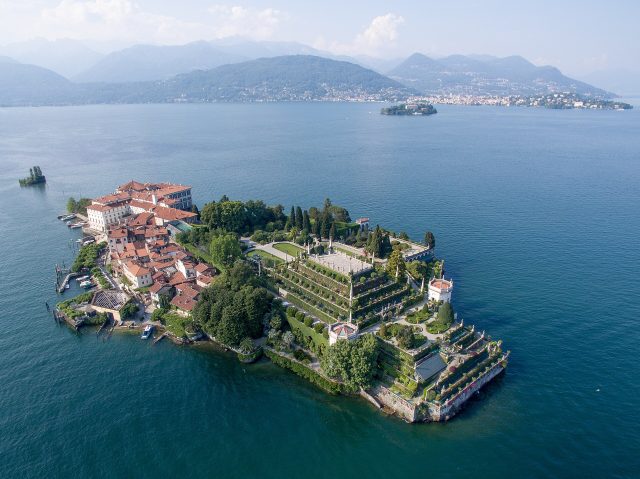
Stresa wasn’t always the refined resort it is today. In the 17th century, it was little more than a fishing village, its narrow streets lined with modest homes and boats pulled up on the shore. But as the centuries passed, the mild climate and breathtaking scenery began to draw artists, writers, and aristocrats from across Europe. The church, originally built for the locals, became part of a cultural landscape shaped by these visitors. It never competed with the grand cathedrals of the north, nor did it need to. Its value lies in something less tangible: the quiet dignity of a place that has witnessed the slow, steady rhythm of life by the water.
The architecture is pure Northern Italian Baroque, though restrained in its ornamentation. The facade is simple, marked by pilasters and a small pediment, with the coat of arms of the Duchy of Milan above the entrance—a subtle reminder of the region’s history. Inside, a single nave leads to a modest altar, where a statue of the Virgin Mary stands beneath a plain arch. The walls are adorned with delicate, understated frescoes, their colors softened by time. High windows let in slanted beams of light, casting shifting patterns across the stone floor. There’s no gilded opulence here, just the kind of quiet beauty that feels lived-in, as if the space has absorbed the prayers and footsteps of centuries.
The bell tower rises above the rooftops, its silhouette familiar to anyone wandering Stresa’s winding streets. The bells still ring out over the lake, their sound carrying across the water like an echo of another era. Once, they marked the hours of the day—calling people to mass, announcing festivals, or warning of storms. Now, their chimes blend into the ambient sounds of the town: the lapping of waves against the shore, the rustle of leaves in the gardens, the distant hum of a passing boat. It’s easy to imagine how, in a place like this, time moves differently, measured not by clocks but by the natural cadence of life.
By the 19th century, Stresa had become a favored retreat for Europe’s elite. Giuseppe Verdi spent time here, and Ernest Hemingway, who immortalized the region in his writing, found inspiration in the lake’s serene beauty. While there’s no record of either man stepping inside Santi Pietro e Paolo, the church seems to carry the same quiet allure that drew them to Stresa in the first place. It’s the kind of place that doesn’t need famous visitors to feel significant; its history is written in the lives of ordinary people who have passed through its doors over the years.
Today, the church remains an active part of the community. Locals stop by not just on Sundays but throughout the week—some to light a candle, others simply to sit in the cool, dim interior and gather their thoughts. Tourists often wander in out of curiosity, only to find themselves lingering longer than expected. The air inside is always cool, even in the height of summer, and the scent of wax and aged wood lends a sense of comfort. There’s no pressure to admire anything in particular; you can just as easily stand by the door, watching the light filter through the windows, as you can kneel in prayer.
The church sits just steps from Stresa’s lakeside promenade and the grand Hotel des Iles Borromées, making it an easy stop on any walk through town. From here, you can stroll down to the water, wander through the manicured gardens of Villa Pallavicino, or take the funicular up to Mottarone for a sweeping view of the lake below. But even if you only pass by, the church leaves an impression—a quiet pause in the midst of a busy day, a reminder that some places are meant to be felt rather than photographed.
In an age where travel often becomes a checklist of must-see sights, Santi Pietro e Paolo offers something different. There are no crowds here, no souvenir stalls, no guided tours rushing you along. Just the soft murmur of voices, the play of light on stone, and the occasional breeze slipping through the open doors. It’s a place that exists not for the sake of visitors, but for the people who call Stresa home. And perhaps that’s why it feels so genuine—because it has never tried to be anything other than what it is.