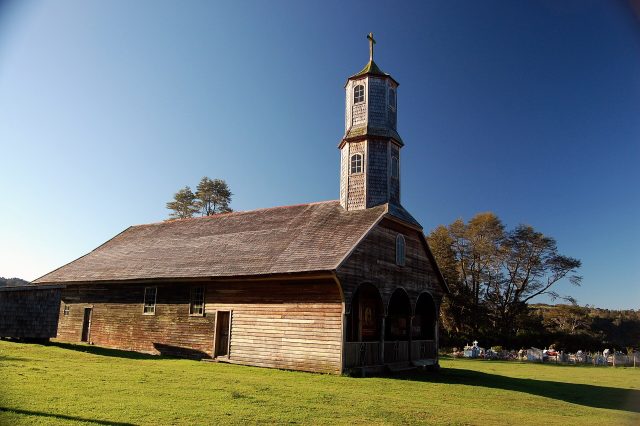
San Juan Bautista Church in Quemchi is one of those places that feels suspended in time, standing at the very edge of the world. It sits on Chiloé Island, where the archipelago meets the Pacific Ocean, where mists and rains alternate so often it seems nature itself can’t decide on a mood. The wooden churches of Chiloé are unlike anything else in Latin America, and San Juan Bautista is one of their most striking examples.
The church’s history stretches back to the 17th century, when Jesuit missionaries arrived on Chiloé. They brought not only Christianity but also European building traditions, which merged in unexpected ways with local materials and techniques. Wood became the primary construction material for a practical reason—it was abundant on the island, while stone had to be transported from afar. The Jesuits built quickly and efficiently, yet with remarkable attention to detail. After the order was expelled from Spanish colonies in the 18th century, the Franciscans took over, maintaining and rebuilding the churches in much the same spirit.
The architecture of San Juan Bautista follows the typical style of Chiloé’s churches, though it has its own distinct features. The façade, with its three arches and twin towers, echoes European designs, but the proportions are different—lower, sturdier, as if the building has adapted to the strong ocean winds. Inside, the church feels surprisingly spacious and bright, despite its small windows. Wooden columns support the roof, their carvings adding a touch of craftsmanship, while the altar, though modest, is executed with the same care as the rest of the interior. The ceiling, shaped like an inverted ship’s hull, is a detail found in many Chiloé churches, possibly symbolizing the island’s deep connection to the sea.
This is more than just an architectural landmark—it’s a living heart of the community. Quemchi is a small village where life moves at its own unhurried pace, and San Juan Bautista plays a central role. Services, baptisms, weddings, and funerals are held here, as well as traditional festivals celebrated with particular fervor on Chiloé. One of the most important is the feast of San Juan, the church’s patron saint, when the streets of Quemchi fill with pilgrims, musicians, and vendors. On such days, the church becomes more than a place of worship—it’s a gathering point for the entire island.
The surrounding landscape adds to the church’s charm. Quemchi sits on the shore of a bay, and from the church, you can see water, mountains, and forests stretching down to the ocean. On clear days, dolphins can sometimes be spotted in the distance, while in the evenings, the sunset paints the sky in shades of orange and violet. Locals often say Chiloé is where the land meets the sea, and San Juan Bautista seems to stand right on that threshold, bridging past and present.
The churches of Chiloé, including San Juan Bautista, were designated a UNESCO World Heritage Site in 2000. This recognition honors not just their architectural value but also how they reflect the island’s unique culture. Here, Christianity intertwined with the ancient beliefs of the indigenous Huilliche people, and European traditions merged with the Chiloé way of life. The churches became symbols of resilience and adaptation, surviving earthquakes, fires, and centuries of change while remaining true to their essence.
Visiting San Juan Bautista isn’t just about seeing a landmark—it’s about stepping into the atmosphere of Chiloé. There are no crowds of tourists here, and the locals are always happy to share stories, whether it’s a legend about the church’s construction or an account of how it withstood another earthquake. Inside, the scent of aged wood and candle wax lingers, while the only sounds are the wind outside and the occasional creak of the floorboards. Time moves differently here, and once you’re inside, it’s easy to understand why Chiloé is called an island of magic and mystery.
If you find yourself on Chiloé, don’t rush. Take the time to wander through Quemchi, visit the church when it’s quiet, and simply sit by the shore, watching the ocean. Maybe then you’ll feel what the locals feel—that San Juan Bautista isn’t just a building, but a piece of the island’s soul.