Panagia Angeloktisti stands on the quiet edge of Lapithos, a village in Cyprus where the hours pass without hurry. No crowds gather here, no signs compete for attention—just the weight of history in its stones and arches. The name means "Our Lady Built by Angels," and the church is one of the few places on the island that still holds the mark of early Christianity, when Cyprus became a center of Orthodox faith.
The church looks small from the outside, its plain shape hiding what lies within. The main building goes back to the 11th century, though parts may be older, possibly from the Byzantine era. Local limestone gives the walls a warm, golden color that matches the land around it. Inside, the space is simple, with frescoes from the Byzantine period still covering the walls. Their stories from Scripture remain clear, as if time had stopped.
The apse at the eastern end holds the oldest mosaics in Cyprus, from the 6th century. They show the Virgin Mary with the Christ Child, surrounded by angels—figures that gave the church its name. The mosaics use bright colors and clean lines, with a directness in how the faces and bodies are drawn. Some parts are missing or worn, but what remains is striking, especially when sunlight catches the gold pieces and makes them glow.
Locals say angels built the church in a single night. The story may be fanciful, but it shows how much the place has always been respected. In the Middle Ages, Lapithos was a religious center, and Panagia Angeloktisti was part of that history. Pilgrims on their way to the Holy Land stopped here, and later, under Ottoman rule, the church became a sign of Orthodox endurance. It was more than a place to pray—it was a quiet refusal to disappear.
A courtyard wraps around the church, shaded by old trees. Visitors sit on benches, listening to leaves and the sound of bells in the distance. Lapithos moves at its own pace, and the people do too—some walk quickly, others linger. The church, unchanged for centuries, feels like a link between then and now.
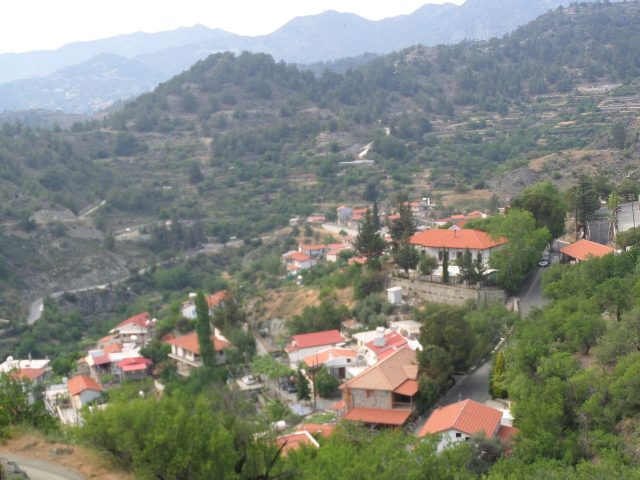
From a nearby hill, the view reaches across the valley to the Troodos Mountains. On clear days, the sea appears in the distance, a sign of the trade routes that once connected Cyprus to the world. This spot was chosen for the church because it was a place where travelers could pause, not just to rest, but to think.
Panagia Angeloktisti is still used for services, though not often. When it is, the church fills with voices and the smell of incense, a brief return to its first purpose. The doors aren’t always open, but if you step inside, the stillness is immediate. No explanations are needed—just the sense that some places hold their past gently, like a book read so many times its pages have worn soft.
Some come for the mosaics, others for the chance to stand in another time. A few find it by accident, wandering the village’s narrow streets. Whatever the reason, the church leaves its mark—not with grandeur, but with quiet. It doesn’t ask for admiration; it simply stands, as it has for centuries, proof that some things are made to endure.