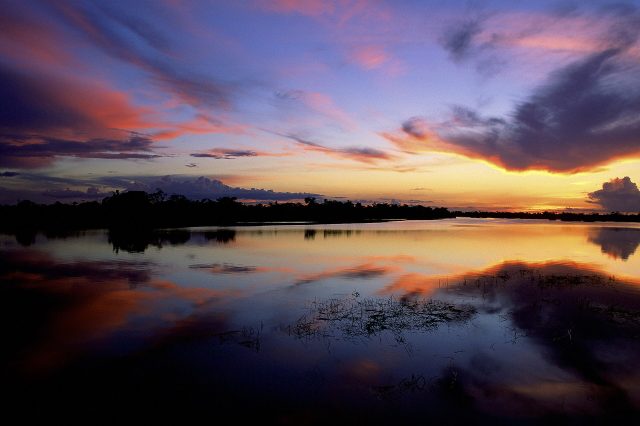
Barcelos sits deep in the Amazon, where the rhythm of life moves to the slow pulse of the Rio Negro. The air is thick with the scent of damp earth and tropical foliage, and time feels suspended in the way it only does in places untouched by the rush of the modern world. Here, among the low-slung houses and winding streets, stands the Church of Nossa Senhora do Rosário, one of the oldest in the region. It isn’t grand like the cathedrals of Rio or São Paulo, nor does it command attention with towering spires or ornate facades. Instead, its quiet presence tells a story of endurance, of the people who carved a life from this wild land centuries ago when Barcelos was little more than a fragile outpost on the edge of the unknown.
The church dates back to 1728, when Portuguese settlers established the town as a foothold in the Amazon. Those early years were harsh—disease, hostile terrain, and resistance from indigenous tribes made survival precarious. The Church of Nossa Senhora do Rosário was more than a place of worship; it was a declaration of permanence, a symbol of the crown’s reach into these remote territories. Built from wood, as most structures were in a place where stone was a luxury, its walls have darkened over time, absorbing the humidity and the weight of history. Yet that very weathering gives it an authenticity that polished monuments often lack. It feels lived in, as if the past hasn’t quite faded from its beams.
The architecture is simple, almost austere, reflecting the practical needs of a frontier settlement. A single nave, a pitched roof tiled in the traditional style, and a modest facade with a small pediment crowned by a cross—nothing about it demands admiration, yet there’s a quiet harmony in its proportions. Above the entrance, a niche holds the image of Nossa Senhora do Rosário, the church’s patroness, her presence a silent guardian over the town. Inside, the space is airy and bright, with high windows filtering the Amazonian light into soft pools on the wooden pews. The altar is unadorned, save for a few aged icons and a crucifix, likely brought from Portugal. Their paint has faded, their edges worn smooth by time, but their expressions remain vivid, as if the faith they represent has only grown deeper with the years.
For generations, the church was the heart of Barcelos. When the town thrived as a trading post along the Rio Negro, it witnessed the milestones of countless lives—baptisms, weddings, funerals. The services were conducted in Portuguese, but over time, the prayers absorbed words from the languages of the indigenous peoples who gradually embraced Christianity. The church became a place where cultures intersected: European devotion, African traditions carried by enslaved people, and the spiritual beliefs of the native tribes. That blending is still palpable, especially during festivals, when the church fills with people from the surrounding villages, their voices rising in songs that carry echoes of all three worlds.
Today, Barcelos is a quiet town, far removed from the bustling port it once was. Yet the church remains active, a steady presence in the lives of its people. On Sundays, the congregation gathers—many of them descendants of the original settlers—and the service unfolds at its own unhurried pace, punctuated by hymns and the murmur of prayers. Afterward, no one rushes to leave. They linger in the pews or outside on the square, sharing stories, catching up on news, or simply enjoying the company. In those moments, the centuries between now and the church’s founding seem to dissolve. It’s easy to imagine the same conversations happening here two hundred years ago, the same laughter, the same quiet reflections.
The small square in front of the church is where the town’s daily life unfolds. Old men play dominoes under the shade of trees, children kick a ball across the dusty ground, and women sell fresh fruit from baskets. It’s a place where the past and present coexist effortlessly. Occasionally, the square becomes the stage for local festivals, particularly those honoring the town’s patron saints. Then, the air fills with music, the scent of grilled meat and sweet pastries, and the church steps become the center of attention, its doors thrown open to welcome the crowd. For a few hours, the building feels alive in a way that goes beyond its usual quiet dignity.
For travelers who make it to Barcelos, the Church of Nossa Senhora do Rosário offers something rare: a chance to step into the living history of the Amazon. There are no tour groups here, no souvenir stands, no crowds jostling for the best photo. Instead, there’s space to sit on a wooden bench, study the faded icons, or listen to the distant murmur of the river. The town moves at its own pace, and so does the church. It doesn’t ask for admiration; it simply exists, as it has for nearly three hundred years, a witness to the people who built their lives around it.
Barcelos reminds us that the Amazon is more than just jungle and rivers. It’s a place where people have lived, loved, and endured for centuries. The Church of Nossa Senhora do Rosário stands as a testament to that resilience, a quiet monument to the faith and determination of those who called this land home. In its walls, the past isn’t just remembered—it’s still alive, breathing in the humid air, waiting for the next person to pause and listen.