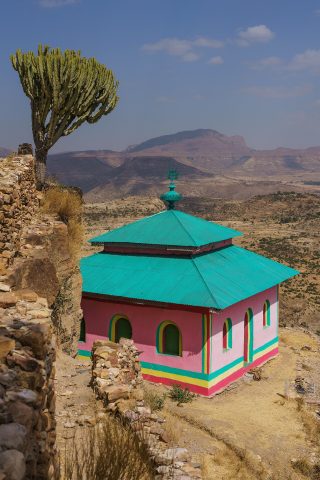
Axum is where Ethiopia’s story begins. Long before the highlands became synonymous with coffee or the rock-hewn churches of Lalibela, this city stood as the heart of an empire that stretched from the Red Sea deep into the African interior. Its rulers were said to trace their lineage back to King Solomon and the Queen of Sheba, their names echoing in legends that still shape the country’s identity. Today, little remains of their palaces, but the royal tombs endure—silent witnesses to a civilization that once rivaled Rome or Persia in influence.
The tombs lie on the edge of modern Axum, where the last paved roads give way to a stony plain dotted with acacia trees. There’s no mistaking them: massive slabs of stone, some weighing over a hundred tons, stacked into chambers without mortar. The most famous belongs to King Kaleb, who ruled in the sixth century. According to tradition, he crossed the Red Sea to defend Christian communities in southern Arabia, returning victorious to cement Axum’s place as a bastion of Ethiopian Christianity. His tomb, like others here, was more than a burial site—it was a bridge between the earthly and the divine, a place where the sacred and the political intertwined.
The stones were quarried miles away in the mountains, transported without wheels, using only human and animal labor. How they were moved and fitted remains a mystery. Some slabs stretch five meters long, their surfaces roughly hewn but aligned with such precision that not even a knife’s blade can slip between them. Inside, the air is cool and thick with dust. Narrow passages lead to small chambers where kings were once laid to rest alongside gold, jewels, and ritual objects. The darkness feels deliberate, as if designed to shield the dead from the world of the living.
Not all the tombs have survived intact. Some were looted in antiquity, others eroded by time, their chambers now open to the sky. Yet even in ruin, they command attention. The so-called Tomb of the False Door is particularly striking—a massive slab carved with the relief of a doorway, its purpose still debated. Some believe it served as a symbolic threshold for the king’s soul to pass into the afterlife. The carvings are simple: geometric patterns, crosses, solar discs. They reflect the aesthetic of a culture that valued symmetry and symbolism over ornate decoration.
These tombs are more than relics; they’re part of a living tradition. Locals regard them with reverence, and oral histories speak of not just kings buried here, but their courtiers, warriors, and sacred objects from Axum’s pre-Christian past. Before Christianity took root in the fourth century, the city was a center of pagan worship, home to the god Mahrem. The tombs may have originated in that era, later repurposed as Christian sites. This duality—pagan roots and Christian legacy—lingers in the air, a quiet tension between past and present.
Visiting the tombs is an exercise in stillness. The only sounds are the occasional cry of a bird or the rustle of dry grass in the wind. The sun beats down, but the shade of the stones offers relief. There are no crowds, no souvenir stalls, no guides shouting over one another. Just you, the stones, and the weight of history pressing in from all sides. At times, it’s easy to imagine the echoes of the past—whispers of priests, the clatter of weapons, prayers offered fifteen centuries ago.
The tombs demand more than a cursory glance. They ask for time, for patience. Unlike the pyramids of Egypt or the temples of India, they don’t dazzle with gold or intricate carvings. Their power lies in their austerity. These are not just graves; they’re testaments to faith, power, and a culture that outlasted empires and religions. They remind you that grandeur isn’t always measured in marble or treasure. Sometimes, it’s enough to stand before a stone laid by hands that believed in something eternal.