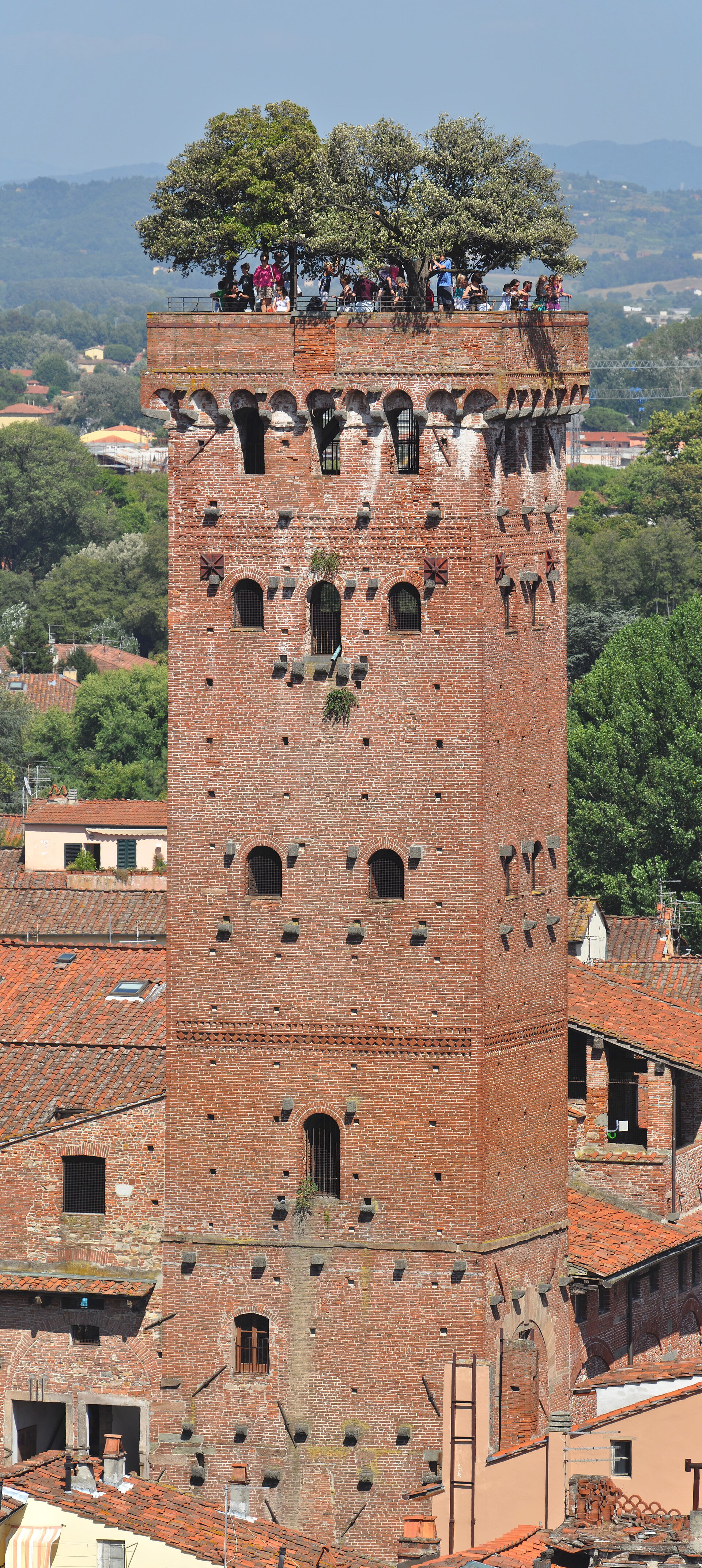
The Guinigi Tower stands as one of the most striking landmarks in Lucca, a city already rich with medieval charm. Rising above the rooftops of the old town, this brick structure is impossible to miss, not just for its height but for the unusual sight of oak trees growing at its summit. Built in the late 14th century by the powerful Guinigi family, who ruled Lucca during a period of political turbulence, the tower was both a symbol of prestige and a practical stronghold. Its construction reflects the era’s blend of ambition and necessity, when noble families competed to outdo one another in displays of wealth and influence while also fortifying their positions against rivals.
Climbing the tower is an experience that rewards patience. The narrow staircase, worn smooth by centuries of footsteps, spirals upward through the thick walls, offering glimpses of the city through small arched windows. The higher you go, the more the sounds of Lucca fade—the hum of scooters, the chatter of café patrons, the distant clang of a church bell—until all that remains is the quiet of the stone around you. When you finally emerge onto the rooftop, the view is worth the effort. The red-tiled roofs of the city stretch out in every direction, punctuated by the domes and spires of Lucca’s many churches. Beyond the medieval walls, the Tuscan countryside rolls away in gentle hills, a patchwork of vineyards and olive groves.
The oak trees at the top are perhaps the tower’s most curious feature. Planted in the 15th century, they were likely intended as a symbol of rebirth and resilience, a nod to the Guinigi family’s enduring power. Over the centuries, the trees have become part of the tower’s identity, their gnarled branches twisting against the sky. They’re not just decorative; they serve as a reminder of how deeply this place is tied to the land around it. Lucca has always been a city that looks inward, protected by its walls, but the view from the Guinigi Tower offers a rare outward perspective, connecting the urban landscape with the rural one beyond.
The tower’s architecture tells a story of its own. Unlike the slender, soaring towers of other Italian cities, the Guinigi Tower is sturdy and broad, its base reinforced to support the weight of the structure. The bricks, laid in a herringbone pattern, are a testament to the skill of medieval masons, who built to last. The tower’s design also reflects its dual purpose: it was both a status symbol and a defensive structure. The small windows and thick walls would have made it difficult for invaders to breach, while the rooftop garden—an extravagance in its time—signaled the family’s wealth and taste.
Today, the Guinigi Tower is one of the few remaining private towers in Lucca. Many others were demolished in the 16th century when the city sought to reduce the power of noble families by limiting their ability to fortify their homes. The fact that this tower survived speaks to its significance, both as a historical monument and as a piece of the city’s architectural heritage. It’s not just a relic of the past; it’s a living part of Lucca, a place where visitors can step into the shoes of the people who once walked these same stairs, looking out over a city that has changed remarkably little in the centuries since.
The tower’s location in the heart of Lucca makes it an easy stop for anyone exploring the city. It sits near the Palazzo Guinigi, the family’s former residence, which now houses a museum. The surrounding streets are lined with shops, cafés, and small piazzas, where locals and visitors alike gather to enjoy the slow pace of life that defines this part of Tuscany. Unlike Florence or Pisa, Lucca doesn’t feel overrun by tourism. It’s a place where you can wander without a map, stumbling upon hidden courtyards or stumbling into a small trattoria serving dishes that have been made the same way for generations.
Visiting the Guinigi Tower is more than just a chance to see a historic site; it’s an opportunity to connect with the layers of history that make Lucca so compelling. The city has been shaped by Romans, medieval merchants, Renaissance rulers, and modern-day Italians who have all left their mark. The tower, with its quiet presence, encapsulates much of that history. It’s a place where the past feels tangible, where the weight of centuries is almost visible in the worn stones underfoot. And yet, it’s also a place that feels alive, especially when the wind rustles the leaves of the oak trees above, as if whispering stories of the people who have stood here before.