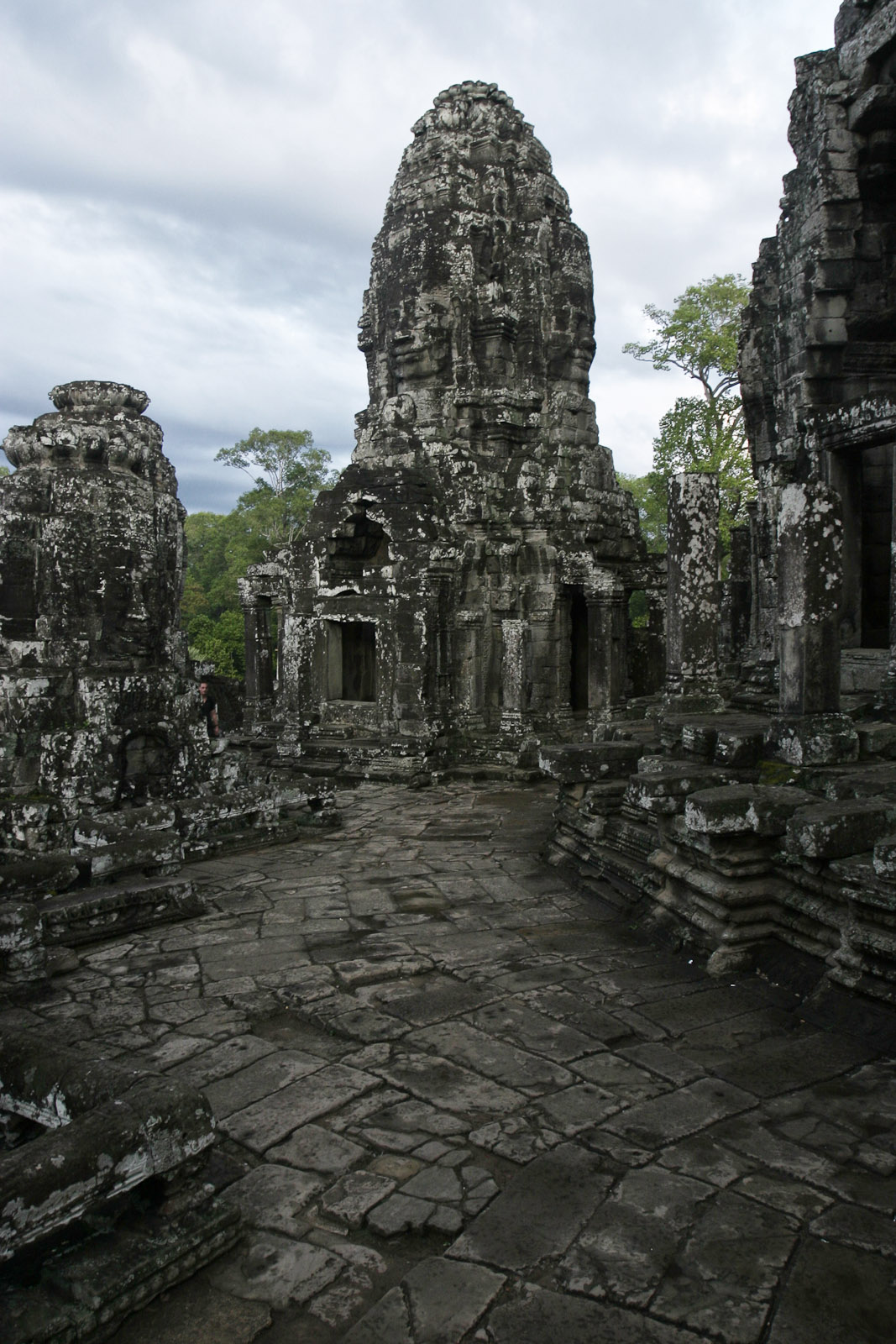
Bayon stands at the heart of Angkor Thom, the last great capital of the Khmer Empire, and it feels like the city’s spiritual core. Unlike the grand, symmetrical temples that dominate the Angkor Archaeological Park, Bayon is a maze of stone faces, towers, and winding corridors that seem to shift with the light. Built in the late 12th or early 13th century under King Jayavarman VII, it was conceived not just as a temple but as a monument to the king’s vision of a unified, prosperous empire. The most striking feature is the sea of serene, smiling faces carved into the temple’s towers—some say they represent the bodhisattva Avalokiteshvara, others believe they are portraits of the king himself, watching over his kingdom in all four cardinal directions. Whatever their meaning, the faces give Bayon an almost mystical presence, as if the past is still quietly observing the present.
The temple’s architecture is a departure from the earlier, more rigid styles of Angkor. Where Angkor Wat is precise and geometric, Bayon is organic, almost chaotic in its layout. The central tower rises like a mountain, surrounded by smaller peaks, each crowned with those enigmatic faces. The galleries and terraces twist and turn, leading visitors through a labyrinth of bas-reliefs that tell stories of battles, daily life, and mythological scenes. The carvings are less refined than those at Angkor Wat, but they have a raw energy, capturing moments of movement and emotion—soldiers marching, elephants charging, fishermen casting nets, and gods locked in cosmic battles. The effect is immersive, as if the walls themselves are alive with the echoes of a long-gone empire.
Bayon’s history is as layered as its architecture. It was originally built as a Mahayana Buddhist temple, but later rulers, who favored Hinduism or Theravada Buddhism, altered its purpose. Some of the carvings were defaced or repurposed, and the temple fell into disrepair as the Khmer Empire declined. By the time European explorers rediscovered Angkor in the 19th century, Bayon was overgrown by jungle, its towers crumbling, its faces half-buried in vines. The restoration process has been slow and painstaking, with archaeologists piecing together fragments of stone and deciphering the temple’s original form. Even now, parts of Bayon remain unrestored, giving it a sense of timelessness, as if it’s still emerging from the forest.
Visiting Bayon is less about ticking off a landmark and more about wandering through a living monument. The best time to explore is early morning, when the light is soft and the crowds are thin. The faces seem to glow in the dawn, their expressions shifting from solemn to serene as the sun rises. By midday, the temple can feel overwhelming—hot, crowded, and labyrinthine—but that’s part of its charm. The narrow passageways and steep staircases force you to slow down, to look closely at the details you might otherwise miss. The bas-reliefs, though worn by time, still tell their stories, and the faces, some chipped or eroded, retain their quiet power.
One of the most intriguing aspects of Bayon is its ambiguity. Unlike Angkor Wat, which was designed to impress with its scale and symmetry, Bayon feels more personal, almost intimate. The faces, with their closed eyes and faint smiles, seem to invite contemplation rather than awe. Some visitors find them eerie, others comforting, but few leave without feeling a connection to the people who built them. The temple’s layout, too, is deliberately disorienting, as if the architects wanted to create a space where the boundaries between the sacred and the secular, the past and the present, blur. There’s no single path through Bayon; you’re meant to get lost, to stumble upon hidden courtyards or overlooked carvings, to feel the weight of history pressing in from all sides.
The temple’s location within Angkor Thom adds to its significance. Angkor Thom was the last great city of the Khmer Empire, built after the earlier capital was sacked by invaders. Its walls and moat were designed to protect not just the city but the empire’s legacy, and Bayon was its symbolic center. The faces on the towers may have been meant to ward off evil spirits or to project the king’s power across the land. Even today, standing in the temple’s central sanctuary, you can sense the ambition of Jayavarman VII’s vision—a ruler who sought to unite his people through faith, art, and architecture.
Bayon is not a place for those who prefer their history neat and orderly. It’s messy, contradictory, and endlessly fascinating. The temple has been interpreted as a cosmic mountain, a mandala, a political statement, and a spiritual sanctuary, and it’s likely all of these things at once. The carvings depict both historical events and mythological tales, blending the real and the imagined. The faces, too, are open to interpretation—are they gods, kings, or something in between? The lack of definitive answers is part of what makes Bayon so compelling. It doesn’t offer easy explanations; it invites you to engage with it, to form your own impressions, to wonder.
For all its grandeur, Bayon feels surprisingly human. The carvings show not just kings and gods but ordinary people—farmers, dancers, merchants—going about their lives. The temple’s construction was a massive undertaking, requiring thousands of workers, and their labor is still visible in the uneven stones and rough edges. Unlike the polished perfection of Angkor Wat, Bayon has a handmade quality, as if it was built by people, not just for them. That sense of humanity is what lingers long after you leave. The faces may be silent, but they speak volumes about the empire that created them and the people who still come to marvel at their legacy.
If you visit Bayon, take your time. Climb the steep steps to the upper terraces, where the faces are closest and the views of the surrounding jungle are best. Sit in one of the quiet corners and listen to the wind rustling through the stone. Watch how the light changes the mood of the temple—how the faces seem to follow you, how the shadows deepen in the afternoon, how the colors shift from gold to gray as the sun sets. Bayon is more than a ruin; it’s a place where history feels alive, where the past and present coexist in a way that’s rare and precious. It doesn’t just tell a story—it lets you step inside it.