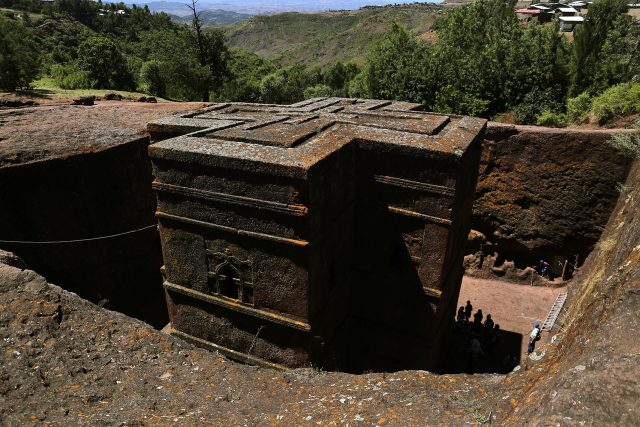
Perched on a hillside overlooking Lalibela’s famous rock-hewn churches, the small archaeological museum blends almost seamlessly into the stone landscape of the town. It’s an unassuming building, easy to overlook, but inside lies a quiet revelation—an intimate collection that unravels the mysteries of one of Ethiopia’s most enigmatic places. Though the museum itself is relatively new, its exhibits bridge the gap between the ancient past and the living traditions of Lalibela today.
The space is modest, with no grand halls or overwhelming displays. Instead, each artifact feels like a piece of a larger story, carefully chosen to speak of centuries gone by. The collection draws from excavations in the surrounding area, offering fragments of daily life—pottery shards, coins, tools, and fragments of jewelry. Among the most striking items are the stone crosses and Ge’ez manuscripts, remnants of a time when Lalibela was the spiritual heart of Christian Ethiopia, drawing pilgrims from across the region.
Lalibela’s underground churches, carved in the 12th century under the rule of King Gebre Mesqel Lalibela, were meant to be a New Jerusalem in the heart of Africa. Legends say the king was divinely inspired, and the work progressed so swiftly that locals believed angels lent a hand at night. The museum preserves the tools used by the craftsmen, offering a glimpse into the sheer ingenuity required to create such masterpieces without modern technology. The precision of the carvings, the way light filters through narrow windows, the acoustics of the stone chambers—all of it speaks to a level of skill that still feels almost miraculous.
But the museum isn’t just about the grandeur of the churches. It also paints a picture of the people who lived here in the Middle Ages. Clay pots, woven textiles, remnants of food, and simple adornments reveal the rhythms of daily life in a town that was both a religious sanctuary and a bustling trade hub. Many of the traditions born here centuries ago endure today, from the way coffee is prepared to the rituals of the Ethiopian Orthodox Church.
The religious artifacts hold a special place in the collection. Ancient icons, priestly vestments, and 13th-century manuscripts aren’t just historical objects—they’re part of a living faith. Every year, thousands of pilgrims flock to Lalibela to worship at its sacred sites, and the museum helps contextualize their significance. The manuscripts, written in Ge’ez, the liturgical language of the Ethiopian Church, are particularly fascinating. They’re not just texts; they’re links to a spiritual tradition that has remained largely unchanged for centuries.
The museum’s approach is far from dry or academic. Instead, it feels like a conversation with the past, one that unfolds gradually as you move through the exhibits. There’s a sense of continuity here—of people who built the churches, prayed within them, and preserved their faith through generations. You see how the town evolved, how its architecture adapted, and how religious practices intertwined with everyday life. The displays don’t just show artifacts; they show the hands that made them, the voices that sang in the churches, and the lives that revolved around them.
This isn’t a place that competes with Lalibela’s rock-hewn churches for attention. Rather, it complements them, offering a deeper understanding of what those monuments represent. After wandering through the dimly lit tunnels of the churches, where the weight of history presses against the stone walls, the museum provides a tangible connection to the past. A worn cross, a fragment of pottery, a rusted tool—these objects make history feel immediate, almost personal.
For anyone curious about Ethiopia’s past, the museum is an essential stop. It may not have the fame of the churches themselves, but it’s here that you’ll find the answers to questions about medieval Lalibela: how its people lived, what techniques they used to carve the churches, and how their culture took shape. It’s not just a collection of relics; it’s a bridge between then and now, a reminder that the past isn’t as distant as it seems.