Samarra sits on the eastern bank of the Tigris, about a hundred kilometers north of Baghdad. The city was once the capital of the Abbasid Caliphate, a vast empire that stretched from North Africa to Central Asia. For a brief but brilliant period in the ninth century, it was the center of the Islamic world, a place where scholars, poets, and architects gathered under the patronage of caliphs who sought to outdo one another in grandeur. Today, the ruins of that era still dominate the landscape, though they are quieter now, softened by time and the slow encroachment of the desert.
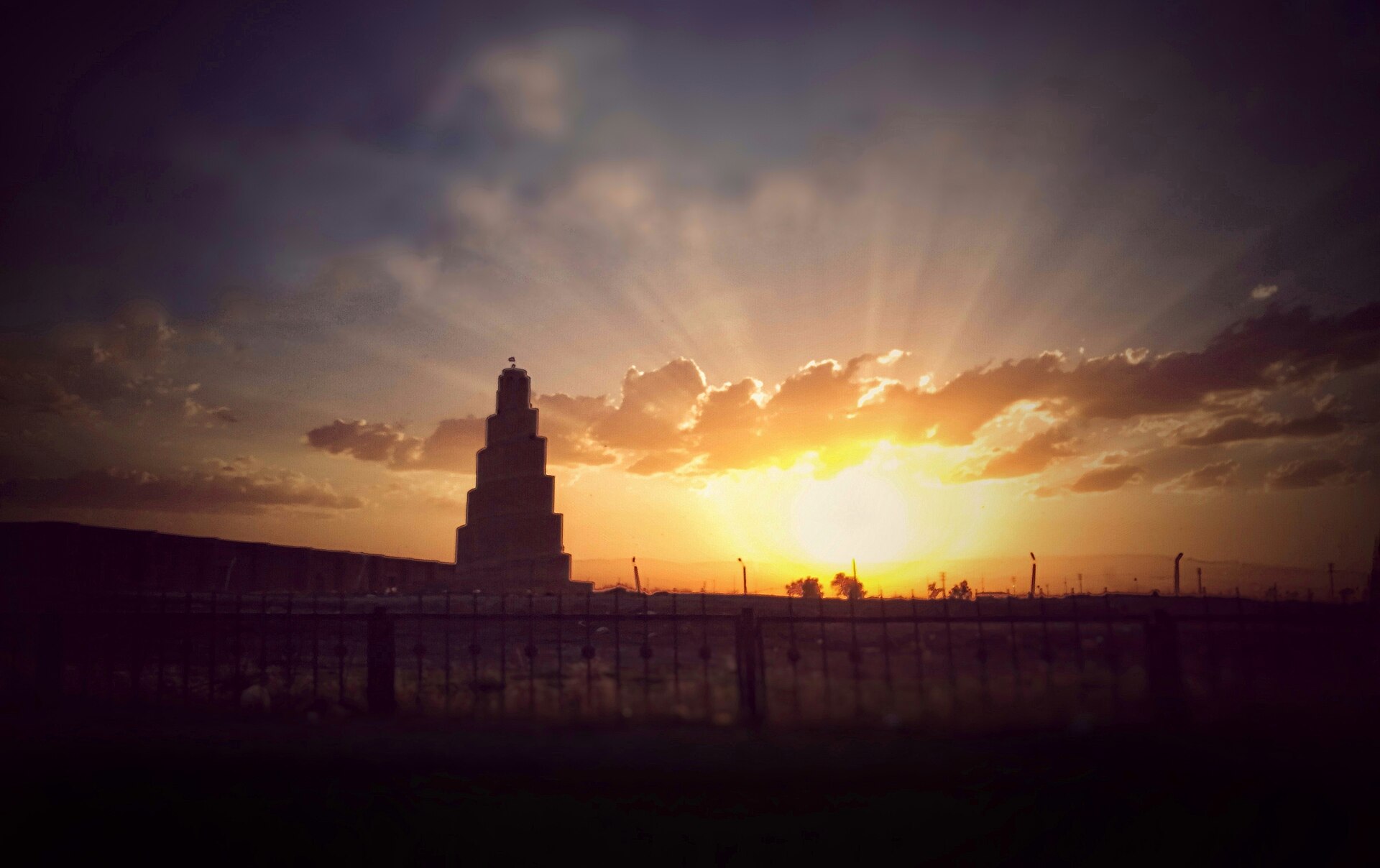
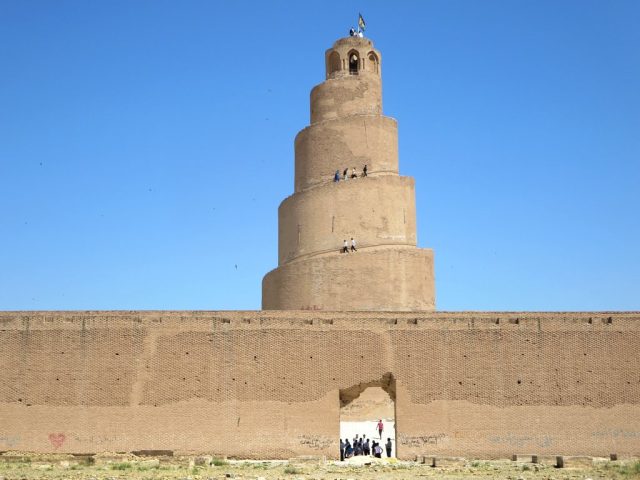
The most striking remnant of Samarra’s golden age is the Great Mosque, or what remains of it. Built in the mid-ninth century under the caliph al-Mutawakkil, it was once the largest mosque in the world, its minaret spiraling upward like a coiled shell. The Malwiya Tower, as it’s called, rises nearly fifty meters into the air, its ramp winding around the outside in a gentle slope, designed so that the caliph could ride his horse to the top. The mosque itself is long gone, reduced to a vast rectangular outline of low walls and scattered columns, but the minaret still stands, a solitary sentinel over the ruins. From a distance, it looks almost fragile, though it has survived centuries of wars, earthquakes, and neglect.
Not far from the mosque lies the Dar al-Khilafa, the former palace complex of the Abbasid rulers. The ruins here are more fragmented, but the scale is still impressive. The palace was built around a series of courtyards, with reception halls, private chambers, and bathhouses arranged in a layout that reflected both the power and the personal tastes of the caliphs. Some of the walls still bear traces of the intricate stucco carvings that once covered them—patterns of vines, geometric shapes, and Arabic calligraphy that must have shimmered in the sunlight. The most famous of these is the so-called Samarra Style, a distinctive form of decoration that spread across the Islamic world and can still be seen in later buildings from Cairo to Isfahan.
Samarra’s decline began in the late ninth century, when the Abbasid capital moved back to Baghdad. The city never regained its former importance, though it remained a provincial center for centuries. By the time European travelers began visiting in the nineteenth century, it was already a shadow of its former self, its monuments crumbling but still awe-inspiring. The British archaeologist Ernst Herzfeld, who worked here in the early twentieth century, was among the first to document the ruins systematically, though much of what he uncovered has since been lost to looting and conflict.
What makes Samarra unusual among ancient sites is how much of its original plan is still visible. Unlike cities that were built over or abandoned entirely, Samarra’s ruins stretch across a vast area, with the outlines of streets, palaces, and mosques still discernible beneath the sand. The Abbasids designed it as a showcase of their power, with wide avenues, grand public spaces, and carefully planned neighborhoods. Even now, walking through the site, you can sense the ambition behind it—the desire to create a city that would reflect the glory of an empire at its height.
The modern city of Samarra has grown up around the ruins, and life here moves at a different pace. The Tigris still flows past, as it has for millennia, and the minaret of the Great Mosque is visible from almost anywhere in town. For locals, the ancient site is part of everyday life, a place where children play and shepherds graze their flocks. There’s a quiet dignity to the way the ruins coexist with the present, as if the past isn’t something to be preserved behind glass but a living layer of the landscape.
Visiting Samarra today means stepping into a place where history feels both distant and immediate. The ruins are not just relics; they’re a reminder of how quickly empires rise and fall, and how much of what was once considered permanent can fade into the earth. The heat, the wind, and the vastness of the sky make the experience feel almost timeless. There are no crowds here, no souvenir stalls, just the occasional archaeologist’s trench or the distant call to prayer from a nearby mosque.
The site has faced its share of challenges in recent decades. Wars and instability have made conservation difficult, and some of the ruins have suffered damage. Yet Samarra endures, much as it has for over a thousand years. It’s a place that demands patience from visitors, a willingness to look beyond the obvious and imagine what once was. The Abbasids built this city to impress, but its lasting power lies not just in its scale or beauty, but in its ability to make you feel the weight of history in a single glance.