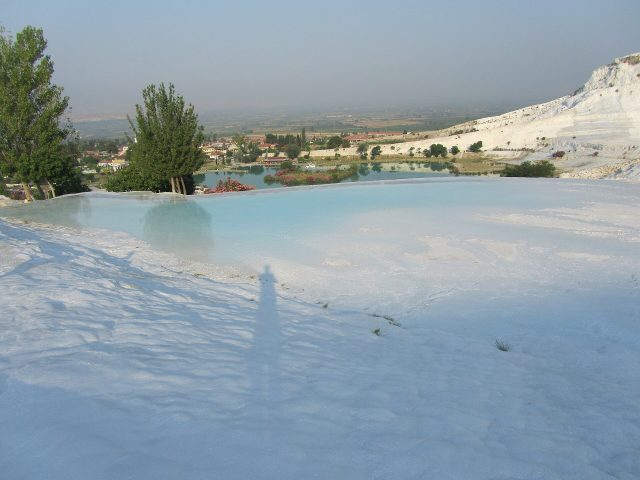
The pool at Hierapolis is where history rises from beneath your feet. Among Pamukkale’s white travertine terraces, this thermal spring holds water that has flowed for centuries. The terraces, shelves of mineral-rich stone, glow in the sunlight. Below them, the pool waits—not just as a place to swim, but as a space where the past lingers in the warmth of the water.
Hierapolis was founded in the 2nd century BCE as a spa city. People came from across the Roman Empire, seeking relief from illness or the comfort of its waters. The pool, sometimes called Cleopatra’s Pool, was part of the city’s baths. The story of the queen bathing here is likely just that—a story. What remains certain is the water: warm, mineral-rich, with a faint metallic taste. It flows from the same springs that feed the travertines above, holding a steady 36°C, easing muscles before you notice.
What lies beneath the water is what makes the pool unforgettable. Fragments of ancient columns, capitals, and building stones cover the bottom. These are not decorations. They are remnants of Hierapolis, toppled by an earthquake in the 7th century. The water is so clear that the stones seem close enough to touch. Sand stirs occasionally, clouding the view before settling again, as if the past hesitates to reveal itself.
The pool is surrounded by tall pines. Their needles scatter sunlight across the water. The air smells of resin and minerals, a reminder of the forces that shaped this place. Once, this was part of the city’s public baths—a place where people gathered to wash, talk, or argue. Water was central to life here, and even now, it feels as if the city’s rhythm hasn’t entirely stopped.
Hierapolis was also a spiritual center. Temples to Apollo once stood here, and later, as Christianity spread, the city became a religious hub. The ruins of a 5th-century basilica and a vast necropolis—thousands of tombs, from simple sarcophagi to grand mausoleums—show its layered history. The pool, likely part of the public baths, would have been a place where the sacred and the everyday met. Stepping into the water today feels like joining a tradition that has lasted for centuries.
The pool rarely feels crowded. Even with others nearby, there’s a quiet that settles over the water. Early mornings are best—the air is cool, the travertines shrouded in mist. Sit at the edge, let your feet dip into the warmth, and watch steam rise from the surface. Or swim slowly, brushing your fingers against the submerged stones. Imagine the voices that once filled this space: merchants, philosophers, laughter.
The pool is just one part of Hierapolis. The ruins of the city stretch around it—the amphitheater, the temples, the necropolis winding through the hills. But the pool offers something the others don’t: a chance to touch history, to move through it. The water isn’t just warm; it feels alive, as if it carries the memories of everyone who has ever bathed here. Floating among the ancient stones, you wonder about the lives that have passed through this place, leaving behind only fragments and faint traces.
Pamukkale and Hierapolis together form a landscape where nature and human history meet. The travertines, shaped by water over millennia, stand beside the ruins of a city that once thrived. The pool connects these two worlds—the water that shaped the land and the stones that were part of a living city. It’s a place where the past feels close, though all that remains is the water, still flowing.