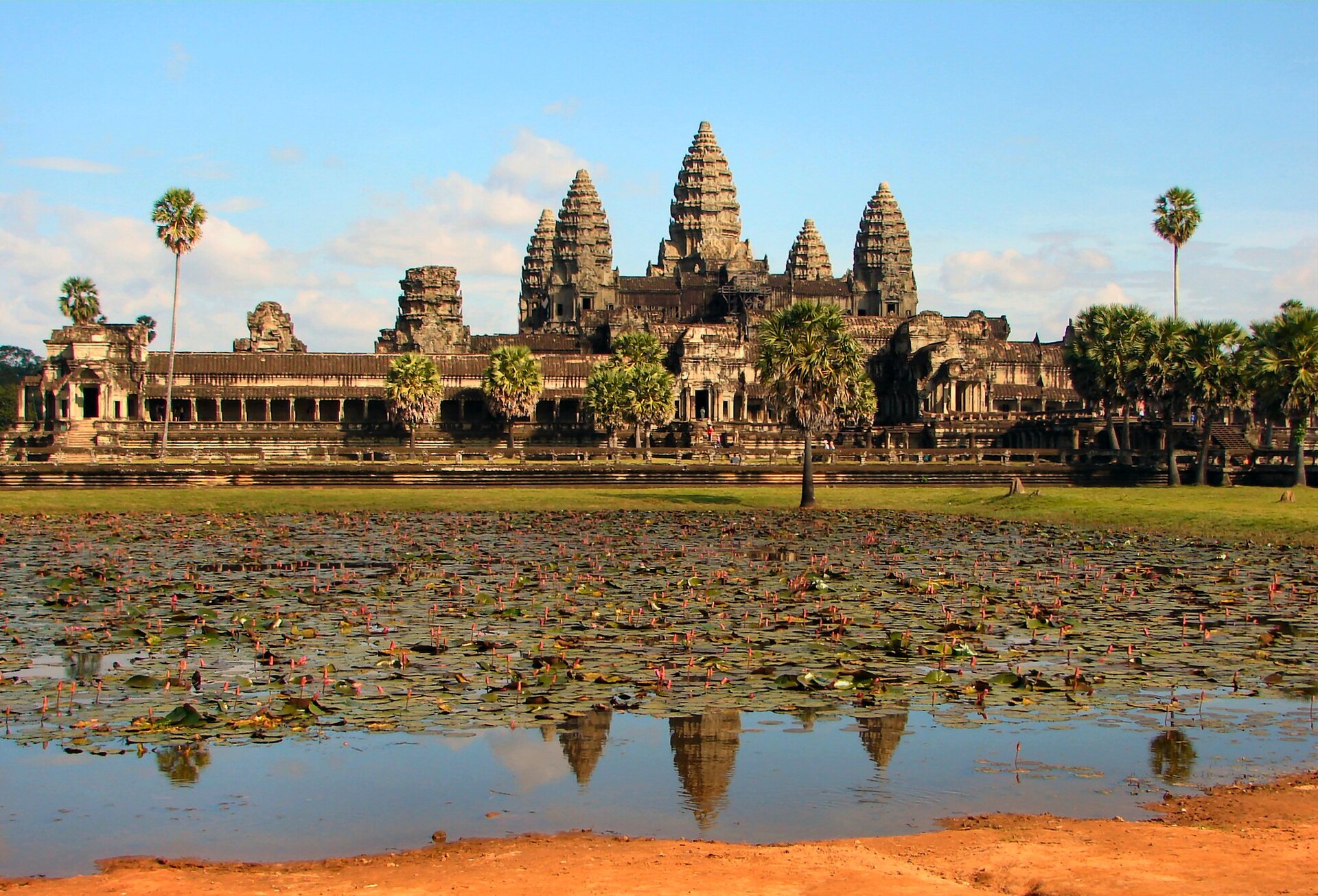
Angkor Wat is the kind of place that lingers in the mind long after you’ve left. It’s not just a temple—it’s a statement, a relic of an empire that once dominated Southeast Asia, and a symbol so deeply woven into Cambodia’s identity that it appears on the national flag. Built in the early 12th century by King Suryavarman II, it was originally dedicated to Vishnu, the Hindu god of preservation, though it later transitioned into a Buddhist site. The sheer scale of the complex is hard to grasp until you’re standing in its shadow, surrounded by the rhythmic repetition of sandstone towers and the quiet rustle of the surrounding jungle.
The temple’s design is a masterclass in symmetry and precision. From above, it resembles a lotus flower, with its central tower rising like a bud above the surrounding moat and concentric galleries. The outer walls stretch for over a kilometer, enclosing a space that feels both vast and intimate. Walking through the western gate, you pass under a stone causeway lined with naga balustrades—serpent deities that guard the path. The bas-reliefs along the galleries are some of the most intricate in the world, depicting scenes from Hindu epics like the Mahabharata and the Ramayana, as well as historical battles and celestial processions. The detail is astonishing, with figures carved so delicately that you can almost see the movement in their postures.
What makes Angkor Wat unusual is how well it has survived the centuries. Unlike many ancient structures that crumble into ruin, this temple has remained remarkably intact, thanks in part to the durability of its sandstone and the care of those who maintained it. The Khmer Empire, which built it, was one of the most powerful in the region, and Angkor Wat was its spiritual and political heart. The temple was not just a place of worship but a symbol of the king’s divine authority, a microcosm of the universe where heaven and earth met. The central tower, reaching over 65 meters high, was meant to represent Mount Meru, the mythical home of the gods.
The temple’s orientation is no accident. Unlike most Khmer temples, which face east, Angkor Wat faces west—a choice that has puzzled scholars for years. Some suggest it was built as a funerary temple for Suryavarman II, while others believe it was aligned with the setting sun to honor Vishnu. Whatever the reason, the effect is striking, especially at dawn, when the first light spills over the moat and turns the stone a warm, golden hue. The reflection in the water creates a mirror image of the temple, a moment of stillness before the day’s heat sets in.
The surrounding jungle adds another layer to the experience. Angkor Wat is part of a much larger archaeological park, where temples like Bayon and Ta Prohm stand half-swallowed by roots and vines. The contrast between the man-made and the natural is stark here—stone structures that once gleamed under the sun now feel like part of the landscape, as if the forest has claimed them back. The silence is broken only by the occasional call of a bird or the distant hum of a motorbike, a reminder that this place is both ancient and alive.
For centuries, Angkor Wat was forgotten by the outside world, known only to local monks and villagers. It wasn’t until the 19th century, when French explorers stumbled upon its ruins, that it began to capture global attention. Even then, it took decades of restoration work to uncover its full grandeur. Today, it’s one of the most visited sites in Southeast Asia, yet it never feels crowded in the way you might expect. The temple’s vastness means there’s always a quiet corner to explore, a hidden corridor or a shaded alcove where you can sit and take it all in.
The best time to visit is early morning or late afternoon, when the light is soft and the temperatures are bearable. The midday sun can be relentless, turning the stone into a radiator and making the walk between galleries feel like a test of endurance. But even in the heat, there’s something mesmerizing about the way the light plays across the carvings, casting shadows that bring the ancient stories to life. The apsaras—celestial dancers carved into the walls—seem to move in the flickering light, their intricate headdresses and flowing garments frozen in time.
Angkor Wat is more than just a tourist attraction; it’s a place that demands reflection. Standing in its central sanctuary, surrounded by the echoes of a civilization that flourished centuries ago, it’s hard not to feel a sense of awe. The temple has witnessed the rise and fall of empires, the shift from Hinduism to Buddhism, and the slow encroachment of the jungle. It has survived wars, neglect, and the passage of time, yet it still stands, a testament to the skill and ambition of the Khmer people. Whether you come for the history, the architecture, or simply the chance to wander through one of the world’s great wonders, Angkor Wat leaves an impression that stays with you long after you’ve left.